FIELD GUIDE / chemical elements
A Reaction Vessel With Terrible Parking
The magnesium car is not a cinematic self-igniting ornament, but it makes the wrong extinguishing instinct matter. The piece follows the material from lightweight promise to the chemistry of a severe fire.
At a glance
- A bulk magnesium component, a chip, a powder, an oxide-coated surface, and an alloy cannot be assigned one fire behaviour by name alone.
- Oxidation is a chemical description; a credible fire account must name the reacting form, exposed surface, atmosphere, and reaction products.
- A material-fire record needs the alloy or grade, physical form, coatings, contamination, temperature and pressure measurements, and the actual sequence of events.
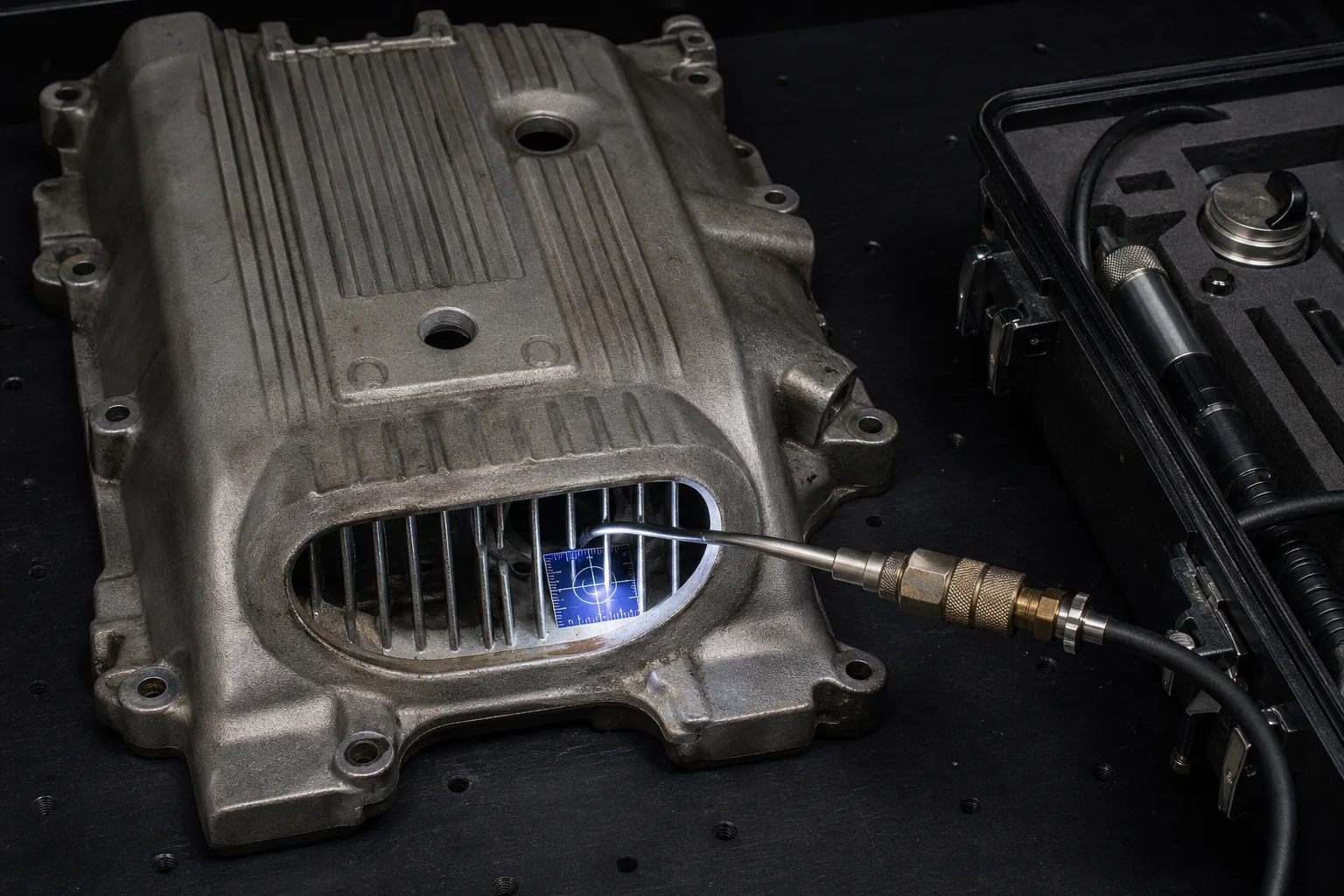
A little way beyond the last sensible cul-de-sac there is a sports car made substantially of magnesium.
Not magnesium badges upon the wheel caps. Not a heroic little bracket hidden beneath the dashboard.
The bonnet, the structure, the castings, the admirable low-mass intentions of the thing: magnesium.
It lived in an ordinary garage, beside the lawn mower, three tins of paint whose ages no household could reliably state, and the cardboard boxes that are always awaiting a more decisive future.
At first there is nothing especially occult about this arrangement.
Magnesium sits in the periodic table between sodium and aluminium, and neighbours in that table are not obliged to share a temperament.
It is at once a light structural metal and a reactive reductant.
Both descriptions are true.
Neither is an instruction for what to do in a burning garage.
That distinction is the entire case.
The car would be charming when parked, rather economical when moving, and entirely without the self-igniting manners assigned to it by the sort of film in which chemistry is represented by a man shouting at a red button.
The difficulty begins only when a severe fire converts a manufactured object into exposed, hot material inside an atmosphere, amid products of its own making, while somebody is deciding what to put upon it.
Then the garage stops being a garage.
It becomes a reaction vessel with terrible parking.
The Car Is Not Made of an Element
The first error is already waiting in the noun.
“Magnesium” may name the element, but a vehicle component is a specified material object.
It has an alloy or a grade, a product form, a wall thickness, a surface finish, a coating, perhaps a casting skin, perhaps a machined face, perhaps contaminants acquired in service.
The difference is not fussy paperwork.
Any honest reaction record begins by naming the grade, the assay, the water content, the inhibitor, the lot and the physical form, because identity governs both what was present and how it behaves.
A car has no obligation to be a pure-element demonstration merely because a brochure has found a handsome word.
Nor does a surface stay the same while a car is made, painted, scratched, repaired, polished, and allowed to fraternize with road dirt.
Even a plain bulk property such as density changes with temperature, pressure, crystal form, porosity and purity, and is reported with those conditions attached.
A material-fire claim needs at least as much in the way of manners.
“Magnesium burns” is not yet a description of a component in an event.
It is a label trying to escape its conditions.
Atomic number tells us what magnesium is.
It does not tell us what the bonnet is made of, what its coating does when heated, whether damage has exposed fresh metal, or what has been mixed into the debris.
The car’s lightness is only its opening argument.
Fire replies in another language.
But Would It Not Burst Into Flame at the First Rainstorm?
No. Here popular culture arrives wearing a laboratory coat over a circus costume.
An intact bulk object is not the same physical proposition as a heap of fine material, and the claim that every magnesium object ignites theatrically on contact with water confuses form with name.
The honest position must include what is not known.
There is no general ignition temperature, no universal water-contact test result, and no single fire-service prescription that can be quoted for “magnesium” without naming the alloy, the form, the temperature history and the surrounding conditions.
It would be dishonest to invent one to fill the gap.
What can be said is why a one-word answer cannot be sound.
Reactions between a solid and a fluid occur at exposed surface, and the response depends on the state of the material and the conditions around it.
Magnesium’s elemental identity is not a curse placed upon every casting at the factory gate.
A sound, coated, bulk component is an object with a finite external surface.
A damaged part is an object with a new surface.
Chips and dust are a large collection of very small objects, and chemistry is allowed to notice the difference.
The myth is false not because hot metal and water are a subject for levity, but because the material name alone omits nearly every fact that decides the event.
The sober correction is correspondingly less satisfying to the cinema.
A material safety response names the actual alloy where known, its form, its temperature history, its coatings and contamination, the atmosphere, and whatever is already burning.
A person who says only “metal” has not yet made the fire simpler.
A person who says only “magnesium” has begun, but has not finished.
Light Metal Becomes a Fast Reaction at a Temperature
Neither low density nor a glamorous silhouette is a reaction rate.
Rate rises with absolute temperature because more encounters cross the activation barrier. The classroom shorthand is that ten degrees roughly doubles the rate of many processes.
It is a useful warning bell.
It is not a magnesium-car threshold, a fire prediction, or a licence to calculate with a shrug.
Activation energy and mechanism decide the real sensitivity, and a higher temperature can accelerate the desired conversion, the decomposition, the evaporation and an uncontrolled exotherm all at once.
Fire is notoriously bad at keeping only the desired column of the worksheet.
There is a further indignity. A temperature reading must say whose temperature it is.
A comfortable bulk reading in a strongly exothermic or heterogeneous system can coexist quite happily with much hotter sites inside it.
In a garage, a number without a sensor location is no wiser than “rather warm.”
Is it a wall, a nearby gas stream, the centre of a component, a flame-facing skin, or a pocket behind a panel?
The answer governs what claim the number can carry.
So the change of character does not arrive when the car is purchased, nor even when a nearby sofa begins to misbehave.
It arrives when heat reaches a material surface and changes the rate at which chemistry may proceed.
A magnesium car is not a candle made of automotive parts.
But a serious fire is not obliged to respect the calm behaviour of the car on Tuesday afternoon.
A Scratch Becomes a Different Question
Because a scratch is geometry disguised as maintenance.
For similar solid shapes, grinding a particle from a millimetre down to a tenth of a millimetre raises its surface-area-to-volume ratio roughly tenfold.
That is not a fire calculation. It is the plain physical reason smaller solids commonly react faster: there is simply more surface available to whatever surrounds it.
Passivating films and agglomeration can blunt the apparent advantage.
They do not turn surface area into an aesthetic concern.
An intact panel and a cloud of debris are therefore not the same material in different moods.
The panel has an exterior.
The debris has a population of exteriors.
Fracture, abrasion, machining residue, corrosion product, or the violence of the fire itself can each change the surface presented to air, to water, or to another phase.
A coating may keep the environment away from the base material until it fails. It may also become another reacting or decomposing material in the story.
The record must name it.
Bulk and fine material do not receive different hazards because one of them is morally reckless.
They receive them because a reaction sees area, contact, temperature, films and transport.
The car, very reasonably, had preferred to be admired for its mass.
The fire has moved the discussion to its surface.
Oxidation Is Not a Polite Word for Burning
Oxidation is a chemical description. Burning is a domestic alarm bell.
The first asks what reaction is occurring. The second correctly announces that dinner has become a secondary concern.
To call a metal event oxidation, without naming the oxidizing environment, the exposed form, the temperature, the rate and the products, tells less than it appears to tell.
To call every oxidation event a generic combustion claim tells more than the evidence permits.
The required account is not theatrical but specific.
Which material is present. Whether it is bulk, thin, broken or finely divided. What gas, liquid or solid contacts it. Where the heat was measured. What products form.
Whether the reaction is spreading heat, gas, particles, or all three.
A fire scene has its own false comforts.
One visible product, one extinguished-looking region, or one elapsed interval does not describe the whole chemical disposition.
Smoke, residues, coatings, debris and unreacted material each have their own opinions.
Water Is Not a Universal Reflex
Because the intervention also joins the chemistry.
That sentence does not identify a safe medium, and nothing here should be read as naming one.
What it establishes is the principle: define the reaction, the actual materials, the hazards, the decision point and the containment route before adding anything, because the order and rate of addition can determine the peak concentration and the heat released.
A suppression choice is not exempt from that logic merely because it arrives in a red cylinder.
“Apply water” has the same defect as “add slowly.”
It omits the identity, the amount, the delivery rate, the contact point, the temperature and the expected response.
A medium is not an abstract kindness.
On contact it becomes an operating condition.
A correct incident plan therefore identifies the burning material and consults the verified procedure for that material in that form.
It records the temperature, the pressure where relevant, the gas composition, the ventilation or containment route, and the response selected.
The reaction may have changed from metal and air to metal, hot products, and an intervention.
It may have become less dangerous.
It may equally have gained another route.
The difference is not something a household maxim can safely decide.
The garden hose, like many domestic objects, is excellent within its jurisdiction.
It has never asked to be a reaction-engineering decision.
One should not promote it casually.
And So the Car Is Parked
Imagine it in the ordinary evening light.
It does not glow. It does not hiss. It does not burst into flame because rain has insulted it.
It waits beneath its paint and coatings with the patience of a manufactured article.
There will, if anyone has taken its material seriously, be records: the alloy or grade, the product form, the coating, the repair history, and the actual materials kept nearby.
There will be a response plan tied to verified magnesium-specific guidance rather than to a legend about water.
There will be people able to say where a temperature was measured, what was burning, and what the chosen intervention was meant to achieve.
The garage would not feel cursed.
It would feel prepared.
And that is the useful reversal.
Magnesium’s lightness was never the whole story.
The consequential moment is not the miraculous car at rest. It is the ordinary emergency, in which temperature, exposed surface, atmosphere, products and response all insist upon being chemistry.
AT THE BENCH
Questions, with the conditions attached.
Does a magnesium car catch fire when it touches water?
A magnesium car cannot be assigned one water response merely because magnesium appears in its material name. A bulk component, a thin exposed section, chips, powder, a coated surface, and a specified alloy present different reaction surfaces and conditions. The supplied corpus does not establish a magnesium-specific water-fire procedure, so an incident plan must identify the exact material form and use primary fire-authority guidance.
Why is magnesium powder more concerning than a solid magnesium part?
A smaller solid has more exposed surface relative to its volume. For similar shapes, reducing a particle from 1 mm to 0.1 mm raises its characteristic surface-area-to-volume ratio by roughly tenfold. More exposed surface can increase the available contact area for a surface reaction, although films, agglomeration, alloy chemistry, and the surrounding atmosphere can change the observed result.
What actually makes a metal fire a chemical-reaction problem?
A metal fire is a chemical-reaction problem when heat, reactant contact, exposed surface, reaction products, and the chosen intervention affect one another. Oxidation names a reaction with an oxidizing environment; it does not by itself state the rate or severity. A usable account identifies the material form, temperature, atmosphere, surface condition, and products instead of relying on the generic word combustion.
Does a ten-degree temperature increase always double a reaction rate?
No. A 10 °C rise approximately doubling a reaction rate is a rough process heuristic, not a universal law or a magnesium-fire threshold. The Arrhenius relationship, k = Ae^(−Ea/RT), expresses why temperature commonly changes rate strongly, but activation energy and mechanism determine the actual sensitivity. Temperature also can accelerate competing reactions, decomposition, evaporation, or heat release.
Why does the response have to name the exact magnesium material?
The word magnesium can describe an element, an alloy constituent, a bulk casting, a sheet, machining debris, or a powder. Material identity also includes grade, assay, water content, inhibitor, lot, and physical form when those affect behaviour. Naming only the element leaves out the information needed to judge exposed area, coatings, contamination, likely reaction paths, and the appropriate verified fire procedure.
What should be recorded after a metal-fire incident?
A useful incident record identifies the alloy or grade, physical form, coating, contamination, ignition sequence, temperature measurement location, pressure where relevant, atmosphere, and the intervention actually applied. It also preserves feed interruptions, agitation or ventilation changes, observed heat or gas evolution, and sample identity where analysis occurs. The as-run record is necessary because an intended procedure does not describe the event that actually happened.
Why is oxidation not just another word for burning?
Oxidation describes a chemical process involving an oxidizing environment, while burning is a broad everyday label that does not identify the reacting species, rate, temperature, exposed surface, or products. A metal surface can oxidize without presenting the same event as an established fire. Conversely, a severe fire can alter the metal, its coating, nearby gases, and reaction products together.
Can a reaction rate be predicted from concentration alone?
No. Concentration affects encounter frequency in a homogeneous phase, but it is not the complete control set. In a rate law r = k[A]^2, doubling A from 0.10 to 0.20 mol L⁻¹ makes the rate four times as large only within the valid regime. Temperature, surface exposure, solvent or atmosphere, phase contact, mixing, and mechanism can change the observed outcome.
What does surface area have to do with a garage fire?
Surface area determines how much solid can contact the surrounding phase at once. An intact car component may present a limited exterior surface, while damage, fracture, machining debris, or thin sections can create fresh or finely divided surfaces. Smaller particles commonly react faster because their surface-area-to-volume ratio is higher, but passivating films and agglomeration can reduce that apparent advantage.
Is a single temperature reading enough to judge a reaction hazard?
No. A temperature must identify what is measured: bulk liquid, wall, gas inlet, catalyst bed, or another defined location. In a heterogeneous or strongly exothermic system, a bulk reading of 50 °C can coexist with hotter sites. A meaningful control record also states the sensor, location, response rule, and the outcome the limit protects, such as pressure, selectivity, impurity, or rate.
Why is the amount of reactive gas not the same as total pressure?
For a gas reagent, partial pressure determines its thermodynamic driving concentration rather than total pressure alone. A mixture at 10 bar total pressure containing 20% reactive gas has a partial pressure of 2 bar. Gas composition, pressure, and temperature must therefore be recorded together; changing the balance gas can change reactant availability without changing the total-pressure reading.
What is the safest general rule for responding to an unfamiliar metal fire?
The safest general rule is to identify the burning material and its form before selecting a response, then follow verified emergency guidance for that specific material-fire system. The supplied corpus supports the need to distinguish material identity, physical form, temperature, phase contact, and reaction sequence. It does not name a magnesium-specific extinguishing medium, so it cannot support a universal suppression instruction.
Sources and further reading
- OpenStax, Chemical Reaction Ratesopenstax.org
- OpenStax, Factors Affecting Reaction Ratesopenstax.org
- OpenStax, Rate Lawsopenstax.org