FIELD GUIDE / stainless steel
A Showroom With a Private Laboratory
The stainless kitchen looks immaculate until salt water and poor geometry give corrosion a private room. The essay makes the sink seam, not the shiny surface, the engineering object.
At a glance
- Stainless steel resists corrosion through a chromium-rich passive film whose performance depends on the actual environment and surface condition.
- A wet lap joint or deposit can retain electrolyte and create a localized environment unlike the exposed kitchen face.
- Drainage, few crevices, accessible cleaning, and inspection access are corrosion controls rather than cosmetic preferences.
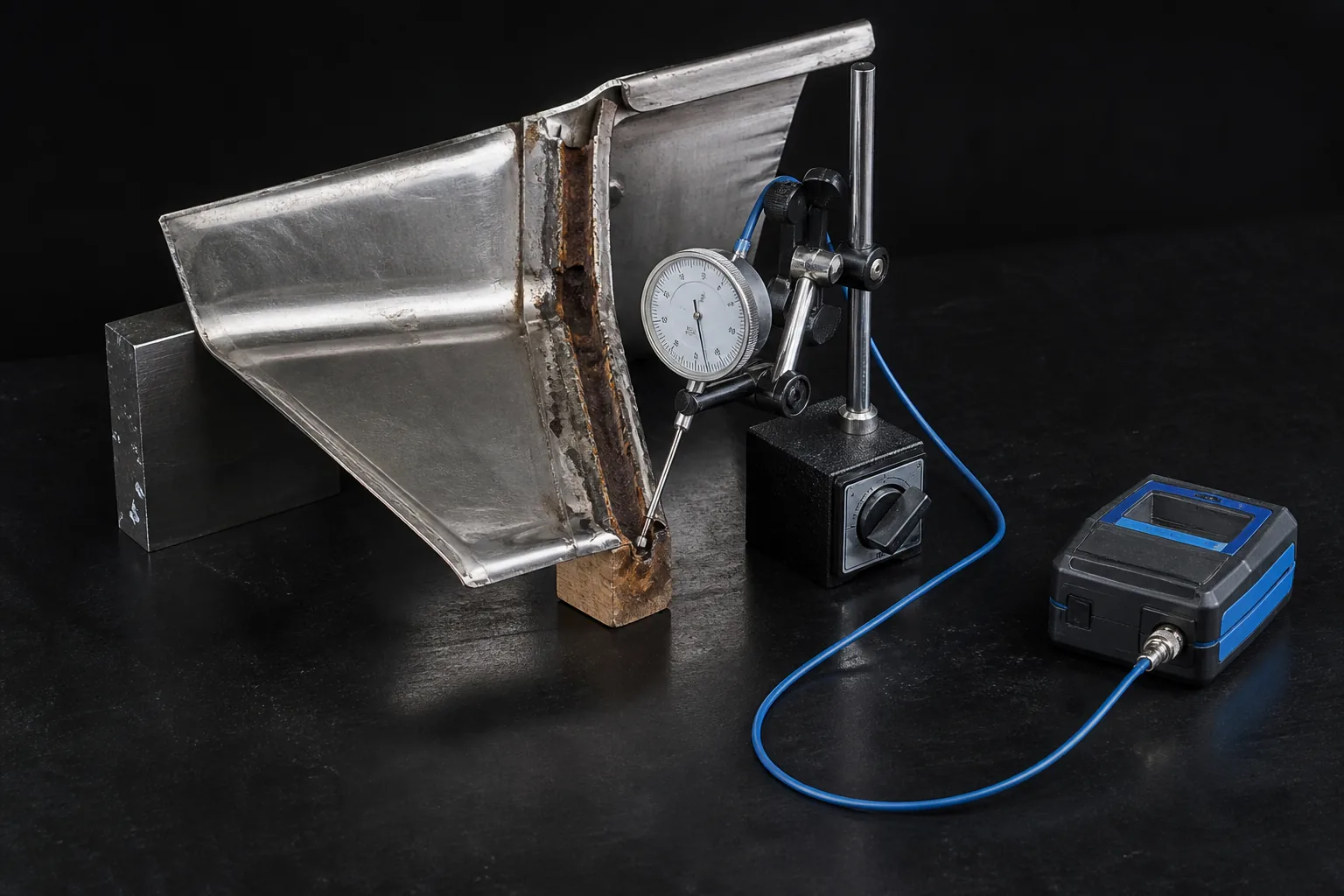
A commercial kitchen has been given its modern sacrament: walls of stainless steel, a sink surround of stainless steel, counters of stainless steel, and a handsome folded splashback whose seams are so neat that the owner may reasonably feel the age of corrosion has at last been shown the door.
It is a room made for water, heat, sharp knives, white cloths, and the stern little rituals by which a kitchen persuades the public that nothing questionable has ever happened there.
The panels are bright. The basin is bright.
The inspector sees no orange tide advancing across the wall. The chef sees a surface that can be wiped. The architect sees a photograph waiting to happen.
Beneath the sink rim, however, two sheets overlap in a lap joint which looks sealed from the room and cannot be rinsed from the room.
Wash water carries chlorides into it. A trace of food soil or cleaner gives the water somewhere to stay.
The joint admits liquid more readily than it permits air, cleaning, drying or inspection.
The kitchen is therefore not one environment.
It is a stainless showroom with a private laboratory underneath it.
And the laboratory is where the invoice begins to acquire opinions.
But Is Stainless Steel Not Supposed to Rust?
This is the myth correction, and without it the rest of the kitchen becomes either panic or advertising.
No. Stainless steel is not a metal which does not corrode.
It is a metal whose corrosion resistance rests upon a chromium-rich oxide film.
A clean surface in air or aerated water forms that film readily.
And the guidance is explicit about what “self-healing” means: repassivation in an oxidizing environment, not that a contaminated crevice automatically repairs itself.
The distinction is not clerical. It is the kitchen.
The word stainless has the unfortunate manners of a royal title. It sounds hereditary and absolute.
In service it is conditional. Fluid composition, chloride concentration, pH, temperature, oxidizing character, flow or stagnancy, crevices, deposits, exposure duration and surface condition all belong in the corrosion record.
A sheet which behaves beautifully in an aerated, regularly cleaned room has not thereby promised to behave beautifully in a stagnant salt-bearing overlap.
One might say that the exposed panel has air.
The joint has a tenancy dispute with it.
This does not mean that every stainless sink is a trap laid by metallurgy.
It means that a material name is not a service environment.
The kitchen has chosen a surface which can form a protective film, and then built one small chamber where that film’s ordinary assumptions are least secure.
A broad face may be continuously persuaded by oxygen to stay passive, while the hidden liquid is concentrated by wet and dry cycles, interrupted by deposits, and denied the ordinary conditions of the room.
The problem is not that the word stainless lied.
The problem is that it was asked to do the work of a joint drawing.
Then Somebody Must Say Which Stainless
Now comes the grade label, which is useful precisely when it is not permitted to become a charm.
The common austenitic reference is a chromium and nickel steel. Its low-carbon variant restricts carbon to reduce susceptibility to sensitization during welded fabrication, which is genuinely useful.
It does not appoint a guardian angel for a concealed salt-water seam.
The next family adds molybdenum, and that addition is what makes the pair a material-selection neighbour for chloride-bearing water. It is an important difference.
It is not a pardon for geometry.
Even the folk sentence “the molybdenum grade is more corrosion resistant” cannot be allowed into the kitchen unescorted.
There are strongly oxidizing acids in which the plainer grade performs better.
A grade is not ranked like a hotel. It is matched to an environment, and the environment is allowed to be particular.
Nor is a grade number a complete delivery identity.
Flat products and long products are covered by different standards, and plate, welded tube, bar, casting, fastener, filler metal, thickness, delivery condition, finish and heat traceability are not afterthoughts.
They are the nouns which say what has actually been installed.
The kitchen may display a certificate with a proud number upon it.
The lap joint will want to know which product, which weld, which finish, and which water arrived after closing time.
The Water Goes Somewhere It Cannot Leave
A reasonable kitchen surface expects to be washed and to dry. It is a simple civil arrangement.
The lap joint is a breach of it.
The safety guidance recommends free and complete drainage, fewer crevices and dead spots, and ease of cleaning and inspection, as the way to reduce localized corrosion.
This is not an aesthetic preference for tidy drawings.
It is a method of refusing a confined liquid the time it needs to become a separate chemical environment.
A 3 mm drain hole is useful only while it stays open in service.
Its diameter is therefore a feature to inspect, not a proof that a hidden lap dries.
The little hole may be blocked by soil, by sealant, by scale, or by the practical indifference of a later alteration.
Water does not read the detail drawing.
It obeys the detail as built.
Nor is a small deposit an innocent guest. Closing a joint over half a millimetre of scale changes the crevice geometry, and it can defeat an otherwise sound material choice.
A contaminated gasket, reused at reassembly, carries the old environment back into the new joint.
A cleaning regime which makes the visible sheet splendid while driving residues into an unflushable overlap has succeeded only in the department of appearances.
Here the inversion becomes almost impolite.
The exposed sheet, which receives the spills, the heat, the wiping and the public scrutiny, is the safer part.
The hidden joint, which looks cleaner because nobody can see it, retains the condition that matters.
A kitchen is not governed solely by what water touches.
It is governed by what water touches and cannot afterwards leave.
The broad panel says: I am stainless.
The seam says: I am a vessel.
Those are different jobs.
A Fine Weld Can Leave an Unhelpful Surface
Very easily, if the fabrication record ends when the welding torch is put down.
The passive surface has its own evidence chain: mill scale removed or not removed; weld heat tint removed or not removed; embedded-iron test result; cleaning chemistry; pickling or passivation treatment; rinse quality; final exposure condition.
These sound like the domestic paperwork of a metal with excessive standards.
They are in fact a record of the surface which will meet the wash water.
Pickling and passivation are not the same ceremony performed in two coats.
Scale can require pickling or abrasion. A freshly pickled surface normally passivates once the acid has been washed away. A nitric-acid treatment can remove light iron contamination and assist passivation.
Where a procedure requires it, the record carries the acid concentration, the temperature, the time and a verification method.
“Polished” is not such a record.
Without a finish designation or a stated roughness, it is barely even a description, and a crevice-sensitive surface deserves better.
The ordinary saving grace is that good fabrication can decline to build the problem at all.
Continuous welds where appropriate, controlled gasket details, seals which stop electrolyte entry, slopes which do not retain liquid, and accessible cleaning paths are mechanical answers to chemical questions.
The best crevice treatment is often a joint that never offered the electrolyte a room.
This is not a demand that every stainless corner be melted into a single heroic bead. Fabrication, thermal movement, hygiene, access and service all have their claims.
It is a demand that a proposed overlap be asked the questions it dislikes.
Can it drain? Can it be cleaned? Can it be inspected?
Can its seal be renewed without preserving an old deposit beneath it?
A beautiful negative answer is still a negative answer.
The Shiny Face Misleads the Inspector
Because localized corrosion has no obligation to distribute itself democratically.
Uniform loss permits a thickness budget, but only where broad, even loss is genuinely credible.
A wall which starts at 12 mm, must retain 3 mm, and loses fifteen hundredths of a millimetre a year has sixty years of arithmetic in it.
That is a screening illustration, not a remaining-life certificate. Rate changes, local thinning, uncertainty, pressure design and damage interaction all retain voting rights.
A hidden stainless lap demands the other logic entirely.
Pitting and crevice corrosion make the maximum defect controlling, not the average one.
Consider two hundredths of a millimetre a year of average mass loss, and a single pit 1.2 mm deep through a wall of 1.5 mm.
The average is not false.
It is merely elsewhere, serenely averaging a defect which has already decided the outcome.
So inspection is not satisfied by admiring the countertop in a good light.
It records the location, the density of sites, the maximum depth, the morphology, and the presence of a sheltered geometry or a deposit.
It asks whether the lower edge drains, whether the gasket line holds soil, whether the seam can be opened and restored, and whether a thickness reading has missed the very local feature that needed another method.
Where chloride exposure, tensile stress and a susceptible condition make stress-corrosion cracking credible, the question changes again.
Austenitic stainless steels are susceptible in chloride service, and no universal stress or chloride threshold reliably prevents it.
Tight cracks may also decline to reveal themselves to a low-sensitivity penetrant method.
A wall-thickness survey can find a 2 mm pit and still be poorly fitted to a tight planar crack.
Inspection has to be qualified for the expected flaw orientation, the access, the surface state and the minimum relevant flaw size.
A programme called “inspection every so often” is a diary entry.
It is not an examination plan.
And So the Kitchen Ages at Its Seams
Not miraculously.
There would be a stated grade tied to its product form and governing standard, rather than the reassuring word stainless on its own.
There would be records of welding, heat tint removal, cleaning, rinsing and the final surface condition.
The sink seam would have a drainage orientation. Crevices and dead spots would be reduced.
Gaskets would be controlled, rather than treated as black curtains behind which chemistry agrees to behave.
There would be inspection access. A drain route would be observed to drain. Deposits would be removed before a joint was closed.
A repair would record what was taken out, and how the protective surface was restored.
The kitchen would not look like a laboratory.
There would be no orange alarm lamp above the dishwasher, no choir chanting the molybdenum content of the sink.
Its surfaces could remain handsome, and the cook could still have better things to consider than the oxygen supply beneath a folded edge.
But the room would be governed by unromantic habits: drainage, cleaning, drying, material traceability, surface restoration, and inspection of what cannot be seen from the pass.
That is the anticlimax stainless steel deserves.
The kitchen would not fail because its panels ceased to shine.
It would survive because nobody mistook shine for service evidence.
AT THE BENCH
Questions, with the conditions attached.
Does stainless steel really rust in a commercial kitchen?
Stainless steel can suffer localized corrosion in a commercial kitchen when chloride-bearing moisture, deposits, stagnant geometry, or a damaged surface condition defeat the passive film locally. The exposed face can remain bright while a lap joint, gasket edge, weld region, or retained deposit corrodes. Stainless is conditionally corrosion resistant; it is not an exemption from water management, cleaning, fabrication control, or inspection.
Why does the rust start at a seam instead of on the shiny panel?
A seam can retain an electrolyte and become a confined environment with different oxygen availability, concentration, and drying behaviour from the exposed panel. HSE recommends complete drainage, fewer crevices and dead spots, and access for cleaning and inspection because those details prevent a confined liquid chemistry from persisting. A bright exposed face therefore does not demonstrate the condition inside a hidden lap joint.
Is 304L stainless good enough for a kitchen sink surround?
304L is a low-carbon austenitic stainless grade, not a universal approval for a sink surround. The cited EN composition table gives 304L, EN 1.4307, 17.5 to 19.5% chromium, 8.0 to 10.5% nickel, and 0.030% maximum carbon. The lower carbon helps reduce sensitization susceptibility in welded fabrication, but chloride level, stagnation, surface condition, weld state, and cleaning chemistry still govern localized-corrosion risk.
Does 316L mean a kitchen joint cannot corrode?
316L contains molybdenum and is a distinct chloride-bearing aqueous-selection option from 304L, but its name does not guarantee a chloride-retaining joint. The cited table gives 316L 16.5 to 18.5% chromium, 10.0 to 13.0% nickel, 2.0 to 2.5% molybdenum, and 0.030% maximum carbon. Geometry, deposits, temperature, wet time, cleaning residues, weld condition, and the actual fluid remain part of the service decision.
What does the L in 304L or 316L actually change?
The L designation identifies a carbon-controlled variant, not a general quality ranking. In the cited EN table, 304L and 316L limit carbon to 0.030%, while the corresponding 304 and 316 entries allow 0.07% maximum carbon. The lower-carbon variants are routine choices where welded fabrications need lower susceptibility to sensitization, but the certificate, product form, surface condition, and service environment still require separate evidence.
Can polishing or passivation fix a badly designed stainless seam?
Polishing or passivation can improve a surface condition, but neither makes a liquid-retaining crevice drain or become inspectable. A clean stainless surface exposed to air or aerated water forms the chromium-rich oxide film on which resistance depends. BSSA distinguishes pickling, which can remove scale, from passivation, while HSE separately recommends drainage, fewer crevices, and cleaning access. Surface treatment and joint design therefore address different parts of the problem.
What has to be recorded after a stainless kitchen weld is cleaned?
A usable record states whether mill scale and weld heat tint were removed, whether embedded iron was checked, the cleaning chemistry, pickling or passivation treatment, rinse quality, and final exposure condition. For the delivered material, the record also binds the grade to product form, dimensions, delivery condition, governing standard, and weld procedure. A generic statement that a seam is polished does not establish the surface condition facing chloride-bearing moisture.
Is a drain hole enough to protect a hidden stainless lap joint?
A drain hole can assist only when it remains open and the whole detail actually drains in service. HSE notes that a 3 mm drain hole is a feature to inspect, not proof that a hidden lap joint dries. The assembly still needs drainage orientation, slopes that do not retain liquid, seals that stop electrolyte entry where appropriate, and cleaning and inspection paths that reach the retained-moisture zone.
Why is average corrosion loss a poor check for a stainless seam?
Pitting and crevice corrosion are governed by the deepest credible local defect rather than average loss over the whole surface. The corpus illustrates a component with 0.02 mm/y average mass loss that fails through a single 1.2 mm deep pit in a 1.5 mm wall. Inspection therefore records location, maximum depth in mm, morphology, deposits, and sheltered geometry instead of treating an average loss result as proof of soundness.
What should an inspector look at if the stainless face still looks clean?
Inspection examines concealed laps, gasket lines, lower surfaces, fastener interfaces, weld regions, deposits, drainage paths, and places that cannot be rinsed or dried freely. The record identifies location, deposit type, coating or surface condition, and local thickness in mm where relevant. Visual examination of the broad face is useful but cannot establish the condition in a crevice or beneath a deposit where localized attack is credible.
Can thickness readings prove that a stainless joint has no stress-corrosion crack?
Thickness readings can find broad thinning or a pit, but they may be poorly suited to a tight planar stress-corrosion crack. HSE classifies corrosion pits and stress-corrosion cracks as defect types that an NDT programme must consider, and it warns that tight SCC cracks may not reveal themselves with a low-sensitivity penetrant method. Where chloride exposure and tensile stress make SCC credible, the inspection method is qualified for crack orientation, access, surface state, and relevant flaw size.