FIELD GUIDE / chemical handling
A Solvent Drum Needs a Procedure
A solvent drum becomes hazardous through its actual work: decanting, ventilation, static control, storage, incompatibility, spill response, and waste. The article is deliberately plainer because the object is already real.
At a glance
- Flash point describes a momentary vapour flash under a stated test and is neither boiling point nor a complete handling decision.
- Vapour pressure, exposed area, temperature, duration, and the number of open vessels determine why transfer needs capture rather than a room label.
- Storage segregation follows chemical compatibility and credible leak paths rather than shelf convenience or a nominal aisle gap.
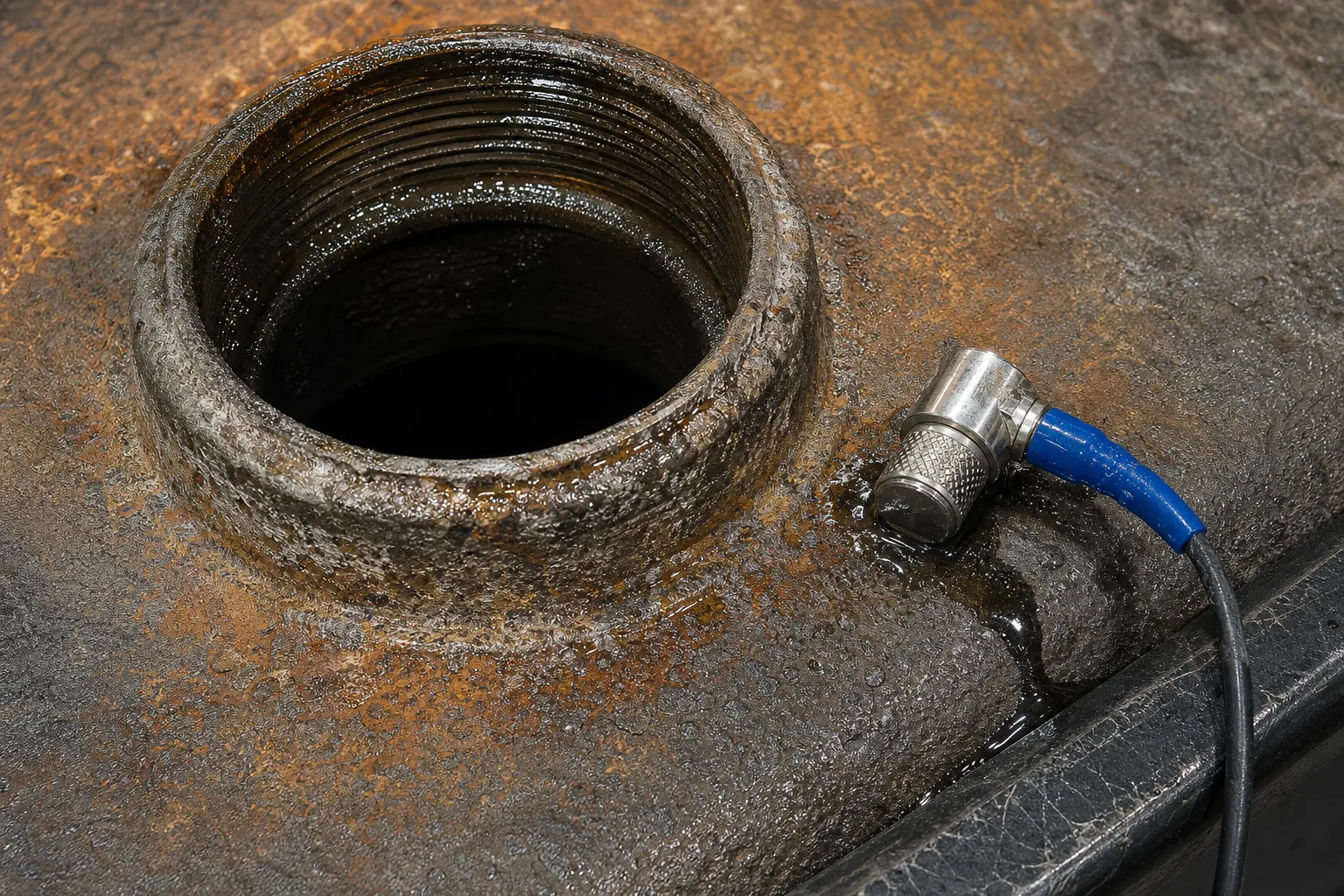
A drum has a label because it needs one.
It may say flammable, toxic, irritating, corrosive, or something more exacting still.
It identifies the material sufficiently for a hurried person to understand that the object is not lunch, not water, and not an invitation to improvise.
But a label is a beginning.
A procedure is the thing that happens after the cap is turned.
The distinction matters most for a solvent, because the sealed drum and the active transfer are not the same state of the material.
In its drum, the liquid has a defined container, a closure and an inventory.
When it is decanted, sampled, poured into a parts washer, connected to a process, or swept into a waste can, it acquires an exposed surface, a vapour path, an operator, nearby equipment, an ignition environment and an eventual residue.
The solvent’s name has not changed.
The governing situation has.
Start With the Material That Is Actually Present
The first task is not to ask whether the drum says solvent.
It is to identify the exact substance or mixture, its concentration, its actual form, the maximum quantity, the intended operation and the credible loss.
A pure compound, an aqueous grade, a stabilized grade and a trade mixture are four different records.
A chromatography-grade solvent carries water and impurity specifications on top of its molecular identity, and those specifications are the reason it costs what it costs.
Quantity must then be stated in the form which can actually be released.
A litre of a one-percent solution and ten millilitres of the neat liquid may both be called one chemical.
They do not contain the same inventory.
And the controlling amount for a transfer is the maximum simultaneously open, not the amount owned in a locked store.
A half-litre stock contaminated by a returned aliquot is not made harmless because only a few millilitres were used.
Its entire contents have acquired a question mark.
This is why “acetate solvent,” “hexanes,” or “rubbing alcohol” is not an adequate procedure title.
Ethyl acetate has its own boiling point, its own flash point below zero, and its own water solubility.
Not one of those facts migrates to butyl acetate, to a mixture sold under an acetate description, or to an aqueous product.
The label identifies a family resemblance.
The procedure must identify the household member.
A Flash Point Is Not a Whole Operating Method
Flash point is useful precisely because it is modest.
It is the lowest temperature at which a substance gives off vapour which flashes or burns momentarily on ignition.
It is not the temperature at which a bulk liquid burns continuously.
It is not a measure of ignition energy.
It is not a boiling point wearing a hard hat.
The apparatus belongs to the number as well. A closed-cup result is a closed-cup result, and it is not an excuse to average unlike results into a more reassuring figure.
For mixtures, the actual formulation requires its own evidence, because azeotropy and selective evaporation can make neat-component values a poor description of the liquid in the drum.
A procedure which copies a pure-solvent flash point onto an unknown blend has merely transferred the uncertainty into the work area.
Boiling point answers a different question again.
A normal boiling point means equilibrium boiling at ordinary atmospheric pressure.
It does not mean that no vapour exists below that temperature.
Vapour pressure, reported at a named temperature, is very often the more direct clue to how much vapour an open liquid can produce.
The drum does not have to boil before the air around a pour has become the important part of the job.
Acetone is the compact demonstration.
Its flash point sits well below the temperature of any room a person would willingly work in, and its explosive limits in air span a wide band from a few percent upward.
Those percentages are gas-mixture limits.
They are not occupational exposure limits, and they are certainly not permission to work near them.
They explain why “it evaporates cleanly” is not a conclusion.
Evaporation removes liquid from the bench.
It puts vapour into an atmosphere where ignition and exposure controls now govern.
Transfer Is the Hazardous State Change
The routine must be planned before the source is opened.
The receiving vessel, the closure, the dispensing tool, the absorbent, the secondary containment and the waste receptacle are all put in place first.
One source is opened at a time. The closure is protected from the bench. The source is reclosed as soon as the required amount has been removed.
This is not ritual neatness.
It limits the period in which the source can spill, shed vapour, accept contamination, or be confused with the receiving vessel.
For a volatile liquid, an open bench has no special moral authority.
The source, the exposed area, the temperature, the duration and the number of open vessels together determine the vapour challenge.
A general room ventilated at a respectable number of air changes an hour can be entirely acceptable for comfort and still fail to capture a plume from a small open vessel beside a worker’s breathing zone.
“Ventilated room” describes the building.
It does not describe capture.
So the choice may be a closed transfer, a local exhaust, or a hood, depending on the material and the layout.
At a fume hood, apparatus is set well back from the sash opening, and large equipment is raised so that it does not block airflow to the baffles.
The sash stays within its marked operating range, and the airflow indicator is checked.
A hood indication is evidence that a control is functioning in its present arrangement.
It is not evidence that every future arrangement is captured.
An obstruction, a door cross-draft, or a new large vessel can change the pattern entirely.
Ignition control belongs in the same transfer plan.
The procedure identifies credible ignition sources and, where static ignition is credible, the bonding and grounding arrangement for the source container, the receiving container and the transfer equipment.
It records the continuity path, rather than treating a loose clamp as a talisman.
Grounding and bonding do not substitute for vapour capture or closure. They address one route by which the vapour created during a transfer can meet an ignition source.
The object of the plan is not a ceremonial ground wire.
It is an ordinary transfer with no uncontrolled vapour, and nothing available to ignite it.
Every transfer also needs a declared point at which it stops.
Loss of hood indication, a cap which will not seal, a cracked vessel, an unexpected temperature rise, visible aerosol beyond containment, or an unknown odour are not invitations to complete the pour quickly.
The source is closed only where that can be done without entering a dangerous zone. Otherwise the operator withdraws, warns others, and uses the site escalation procedure.
Familiarity with the liquid does not turn the operator into an emergency-response team.
Protection Is a Contact Limit, Not a Costume
Gloves, eye protection, body protection and respiratory protection are selected against the actual chemical and the actual task.
The hand-protection record needs the identity, the concentration, the contact pressure, whether the exposure is splash or immersion, the temperature, the thickness, the length, the dexterity required and the planned duration.
A published half-hour breakthrough result, under a stated test, is a boundary.
It is not a half-hour promise for a worn glove, a hotter liquid, repeated flexing, or a mixture that was never tested.
The contrast is deliberately plain.
An intact glove may be a reasonable splash barrier for a two-minute transfer.
Two hours of continuous handling can require a different glove, a layered system, or a redesigned transfer.
No fixed glove interval can be inherited merely because both liquids are called solvents.
A respirator has the same refusal to be generic. Contaminant, concentration, oxygen condition, variability, cartridge limits, fit and duration all belong in a complete programme.
A mask kept in a drawer is not an entry plan for an unknown vapour cloud.
Storage Is an Incompatibility Map
The procedure continues after the pour.
Containers return closed to an assigned location. A hood is not permanent storage.
A half-used bottle left out for a planned later task acquires an afternoon in which it can tip, leak, be misidentified, or become somebody else’s assumption.
Storage considers the vessel, the closure, the liner or gasket, the absorbent, the secondary tray, the temperature, the age, and the substances sharing the credible leak path.
Shelf geometry is not compatibility.
A metre of separation is meaningless if two incompatible containers can both drain into the same sump.
Conversely, separate compatible containment or separate cabinets may be entirely effective with no theatrical aisle at all.
The important question is where a credible release goes, and what it meets when it arrives.
A small bottle held for one week and a large drum retained for a year do not call for identical inspection or storage plans.
Inventory is itself a control, because it can reveal an old peroxide former, a corroding container, or a drum retained long past its purpose.
Ethers supply the useful warning against one-number thinking.
A cyclic ether has a boiling point and a flash point, both properly reported.
Its handling decision also includes a storage chemistry: ethers can form peroxides on exposure to oxygen over time.
A flash point is not wrong for omitting that fact.
It was never asked to carry it.
The incompatibility map is where the whole material history meets the workplace.
A Spill Is First a Decision Branch
The first spill question is not which absorbent to fetch.
It is whether the release is known, contained, within the trained worker’s capability, and covered by the local plan.
An unknown chemical, a vapour cloud, a fire, an injury, a strong reaction, compromised ventilation, or a release beyond the plan all require isolation, notification and trained responders.
A universal volume cutoff fails, because ten millilitres of a highly volatile or acutely toxic liquid can be well beyond the proper self-cleanup boundary.
For an authorized incidental liquid spill, access is restricted, spread is confined without creating a new reaction, and work proceeds from the outside toward the centre in the assigned protection.
Laboratory guidance describes collecting the sorbent, then wiping the area down twice with mild detergent and water.
The used sorbent and wipes are now chemical residues with a known source.
Dry sweeping a hazardous powder, by contrast, can turn a surface event into an inhalation exposure.
And nobody enters an unknown atmosphere merely to discover whether it is serious.
The selection, fit, maintenance and programme behind respiratory protection are not small print appended to courage.
They are the distinction between planned protection and an unplanned second casualty.
Waste Is the Last Transfer, Not the End of the Story
The waste can is another receiving vessel.
It is not a solvent retirement home.
It must be compatible, in good condition, identified with its actual constituents and their approximate proportions, and kept closed except during addition.
Condition, compatibility and closure are central container-management requirements, and the applicable disposal route remains material- and jurisdiction-specific.
Neither a sink nor evaporation is the default answer.
Headspace is part of the design.
A ten-litre container is not automatically a permissible ten-litre fill, if heating, vapour expansion or chemical evolution needs somewhere to go.
“Half full, five litres actual” is a great deal more useful than “almost full.”
A new addition is accepted only when its constituents, concentration and quantity belong to the defined waste stream.
If it is unknown, outside the stated range, or from a reaction which may continue to evolve gas, it is quarantined for review.
It is not introduced to a twenty-litre compatibility experiment.
This is the unromantic conclusion a solvent drum earns.
It should not be treated as a villainous red can, nor as a familiar liquid whose name has settled everything.
Its label gives a truthful first warning.
Its procedure supplies the actual safety: identity, quantity, vapour control, ignition control, compatible containment, a stop point, a spill branch, and a known waste route.
The quiet drum will usually remain quiet.
The work begins when it is opened.
AT THE BENCH
Questions, with the conditions attached.
Is a flammability label enough to tell a workshop how to use a solvent drum?
No. A flammability label communicates a hazard class, but a handling procedure must also identify the exact substance or mixture, concentration, quantity open at one time, transfer method, temperature, ventilation, ignition sources, compatible containers, storage neighbours, spill route, and waste destination. The same labelled drum has different controls while sealed, sampled, decanted, connected to equipment, or released.
What does a flash point actually say about a solvent?
Flash point is the lowest temperature at which a substance gives off vapour that flashes or burns momentarily on ignition under a stated test. It is not the boiling point, the temperature at which bulk liquid burns indefinitely, or an ignition-energy value. The test method matters: PubChem reports ethyl acetate at −4 °C closed cup, so a record must retain the apparatus and material scope.
Why is boiling point not enough for deciding whether vapour control is needed?
Boiling point describes an equilibrium condition at a stated pressure, while vapour pressure indicates how much vapour can be produced at a given temperature. Normal boiling point conventionally refers to 101.325 kPa. NIOSH lists acetone with a normal boiling point of 56 °C and vapour pressure of 180 mmHg; opening acetone at ordinary conditions can therefore create vapour without boiling.
What makes pouring acetone different from simply storing its drum?
A sealed drum limits the liquid’s exposed area and keeps its vapour contained. During pouring, the exposed area, duration, receiving vessel, temperature, and number of open containers affect vapour generation and capture. NIOSH gives acetone a −18 °C flash point and a 2.5 to 12.8 vol% flammable range in air. The procedure must therefore control the transfer location, ignition sources, and closure sequence.
What are grounding and bonding for during solvent transfer?
Grounding and bonding are task controls used when static ignition is a credible hazard during transfer of a flammable solvent. The procedure identifies the source container, receiving container, transfer equipment, continuity path, and ignition sources before liquid moves. They do not replace ventilation, compatible containers, closure, or the control of vapour concentration; static control is one part of a transfer system.
Does working in a ventilated room mean solvent vapour is controlled?
No. A room description does not establish capture at the point where vapour leaves a container. The chemical-handling guidance notes that a room at 8 air changes per hour can be comfortable yet fail to capture a plume from a 100 mL open vessel near a worker’s breathing zone. Ventilation selection must consider the source, exposed area, location, duration, and enclosure or local-exhaust configuration.
How should a fume hood be arranged for a volatile solvent transfer?
A fume hood is operated within its manufacturer’s marked sash range with the airflow indicator checked and baffles unobstructed. OSHA guidance places apparatus at least 6 in (15 cm) behind the opening and raises large equipment at least 2 in (5 cm) so airflow can reach the baffles. The hood is a transfer control, not permanent chemical storage.
Can solvent drums be stored together if there is enough room on the shelf?
Shelf room does not establish compatible storage. Storage must consider the substance, container, closure, gasket, absorbent, secondary tray, temperature, credible leak volume, and path of a release. A 1 m shelf gap can be meaningless when both containers drain into the same 40 L sump. Segregation uses compatible trays, barriers, cabinets, or separate areas that prevent incompatible mixing.
When can a worker clean up a solvent spill without calling emergency responders?
A release is handled as an incidental spill only when it is known, contained, within the trained worker’s capability, and covered by suitable equipment and the local plan. An unknown chemical, vapour cloud, fire, injury, strong reaction, compromised ventilation, or release beyond the plan requires isolation, notification, and trained responders. Volume alone is unreliable; 10 mL of a volatile or acutely toxic material can exceed self-cleanup capability.
What happens to the absorbent after an authorized solvent spill cleanup?
For an authorized incidental liquid spill, the release is confined without creating a new reaction and absorbent is collected into an approved receptacle. EPA laboratory guidance describes two mild-detergent-and-water wipe-downs after collection. The used sorbent, wipes, and contaminated protective equipment are residues with identified constituents and a material-specific waste route; they are not ordinary rubbish by default.
Why can’t leftover solvent just be poured into a general waste drum?
A waste container is not a compatibility experiment. It must be in good condition, compatible with its contents, closed except during addition or removal, and labelled with actual constituents and approximate proportions in the required form. The acceptance rule identifies allowed constituents, concentration ranges, volume ranges, headspace, and conditions that require review, especially when a stream may evolve gas or heat.
Is a high-boiling solvent automatically less of a fire concern?
No. A higher boiling point describes a temperature ordering and does not establish nonflammability or low exposure concern. Dimethyl sulfoxide has a reported closed-cup flash point of 89 °C, substantially above acetone’s −18 °C flash point, yet flash point remains only one property. Identity, mixture scope, exposure route, compatibility, temperature, and the actual task still determine the control plan.
Sources and further reading
- IUPAC Gold Book, flash pointgoldbook.iupac.org
- NIOSH Pocket Guide, Acetonecdc.gov
- OSHA, Chemical Hygiene Plan guidanceobis.osha.gov
- OSHA, Laboratory Safety: Chemical Fume Hoodsosha.gov
- EPA, Hazardous Waste Accumulation Requirements Summaryepa.gov