FIELD GUIDE / refractories
An Argument Between Temperatures
A cup made for furnaces survives the heat and fails the tea. Its embarrassment is not insufficient refractoriness but a temperature gradient that becomes a crack before the temperature can become uniform.
At a glance
- Maximum recommended service temperature is a product- and exposure-specific datum, not a thermal-shock rating.
- Thermal-shock resistance depends on material condition, wall thickness, geometry, heat-transfer conditions, and the existing flaw population.
- A refractory record needs the manufactured product and the installed form, conditioning, dimensions, and service zone.
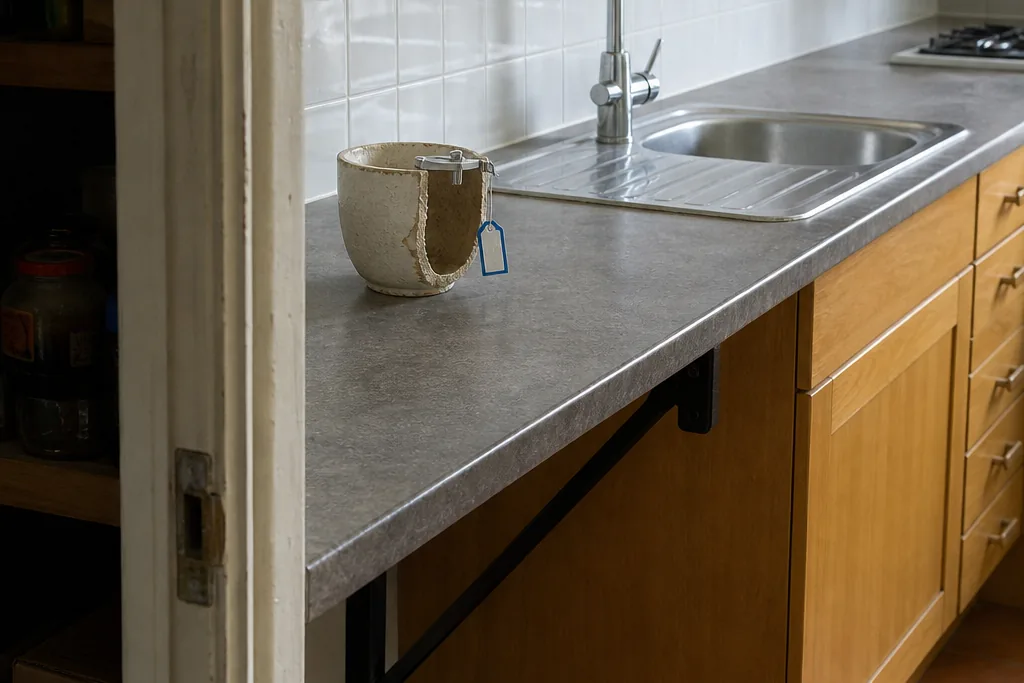
In the pantry, among the decent porcelain and the jars of things nobody can identify after moving house, there is a teacup made of refractory ceramic.
Not a cup merely decorated with a little fireclay colour. Not a novelty mug declaring itself furnace-proof in the manner of a man who owns one pair of boots.
A proper refractory thing: the kind of material ordinarily asked to line a furnace, meet a melt, endure heat flux, and retain some dignity where the rest of the machinery has begun to look philosophical.
It has been heated brightly, for reasons which need not detain us. Humanity has always found reasons to overheat a teapot.
It emerges splendidly hot.
Then a conscientious hand puts it under a cold tap.
The cup breaks.
This seems, at first, a moral failure. A refractory cup has come through furnace heat only to be defeated by plumbing. One expects it to sue the tap for defamation.
But the cup has not lost an argument with temperature.
It has lost an argument between temperatures.
But Is “Refractory” Not a Promise Against Heat?
No. It is a promise of a much more sober sort.
Refractory names a population of materials selected for high-temperature industrial service: linings, shapes, installed masses, blocks, mortars, castables, ramming mixes, gunning mixes, and their more complicated cousins.
It does not name a magic caste of ceramics to whom heat has been instructed to show respect.
Fireclay, silica, high alumina, mullite, magnesia, doloma, magnesia-carbon, silicon carbide, chromia, zirconia and carbon have different chemistries, forms, bonds, atmospheres and enemies.
The standards keep silica brick and fireclay brick in separate classifications, because the names do not describe one interchangeable tribe.
The popular myth says that if a thing is refractory, it is immune to heat damage.
That is what happens when a service-temperature chart is asked to become a character reference.
It cannot.
A dense high-alumina castable may be advertised for service up to 1,800 °C under stated conditions. That is a product claim, not an emancipation proclamation from thermal cycling.
The record still needs the atmosphere, the load, the exposure, and the supplier’s own definition of service.
Maximum recommended service temperature is not the melting range, nor the softening point, nor the pyrometric cone equivalent.
The difference between them can be several hundred degrees, because slag, gas chemistry, cycling and heat flux all have opinions.
Opinions become expensive when molten.
Nor is a cup a grade name in disguise.
A straight brick and a large precast block may arise from related chemistry while making wholly different demands of joints, handling and replacement.
The domestic cup has its own wall thickness, rim, base, glaze if any, and local changes of section.
It has already begun making thermal-shock decisions before anybody turns on the tap.
The Cold Water Objects to Being First
When the hot cup meets the cold stream, the outer skin cools while the interior remains hot.
The cooled surface seeks a different length from the hot material behind it.
A uniformly heated, unconstrained body can change dimension with comparatively little thermal stress.
A gradient turns neighbouring regions into mutual restraints.
The wall must remain one wall, and so a free strain becomes a disagreement conducted through the ceramic.
This is why thermal conductivity, specific heat, thermal expansion and emissivity must all arrive with a temperature and a method attached.
None of those figures is a thermal-shock verdict on its own. Porosity, direction and the temperature span all change what the number means.
The tap does not read the data sheet, but it discovers its omissions rather quickly.
A post-mortem on a gasifier lining gives a useful sense of scale without giving a universal threshold: the gradient from hot face to cold face across the brick was about a hundred degrees.
In that porous chromia system, the relatively small gradient helped slag penetrate the structure.
It is not a cup limit, and it is certainly not an instruction to test a cup at a hundred degrees.
It is the reminder that a gradient has a physical address through the thickness, whereas “it got very hot” has none.
The cold rinse is not a lesser version of furnace service.
It is another event entirely.
A furnace may heat a body with enough patience that temperature can spread. A tap is the domestic representative of abrupt boundary conditions.
And here is the inversion. The cup is safest in the condition that sounds most alarming, which is uniformly bright hot.
It is least safe during the kindly attempt to make it less alarming.
The Wall Does Not Agree With Itself
Because a refractory wall is not a parliamentary system.
It contains no provision by which the surface may vote to contract while the core registers a dignified objection.
Wall thickness changes both the time available for heat to travel and the stress geometry through which a crack would have to travel.
A thin lip cools quickly and has little remaining ligament.
A thick base preserves a hotter interior, and therefore preserves a larger gradient, for a different length of time.
The usual wish for one number, a shock resistance quoted in degrees, is advertising language unless the specimen, the starting temperature, the transfer time, the quench medium, the thickness and the pass condition all accompany it.
The same warning belongs to the mechanical values.
Cold crushing strength, modulus of rupture, elastic modulus, abrasion loss, creep under load and permanent linear change are separate answers to separate questions.
A cold crushing result, after a stated conditioning history, does not announce the response of a hot cup to a surface quench.
Nor may a hot modulus of rupture be set beside a room-temperature crushing strength as though the two were rival candidates for a single office.
One says something at a named test state. The other says something else.
The cup’s difficulty is not that it is weak in the broad, idle sense.
It is that a constrained temperature field can generate tensile demand exactly where ceramics are least fond of negotiation, and the answer depends on the actual product condition.
A castable has further reasons to be individual. Mixer type, water addition, mixing time, vibration, cure temperature, cure duration and the dryout schedule all influence the installed result.
Monolithic work proceeds through kneading, casting, curing, deframing, drying and preheating, and each stage can be done badly.
A bag of castable is not yet a cup, just as a bag of flour is not yet an alibi for a cake.
Porosity Is Not a Moral Quality
Bulk density, apparent porosity, true density, water absorption and permeability are different properties.
Apparent porosity is accessible void space. True density excludes the pores. Permeability also cares whether the pores and cracks form a connected route.
A low apparent-porosity value does not prove low permeability, and the word impermeable does not become zero without a method and a detection limit.
Pores are not obliged to arrange themselves according to the wishes of a brochure.
In that same high-chromia gasifier case, the hot face carried somewhere between fourteen and seventeen percent porosity.
The porosity aided its thermal-shock resistance. It also permitted deep slag penetration, and set up structural spalling.
That is the whole riddle in working clothes.
A little compliance makes a thermal gradient less tyrannical.
The same open structure gives an attacking liquid a road into the lining.
The correct conclusion is neither to make the cup porous nor to ban pores.
It is to identify the chemistry, the pore structure, the exposure and the failure that actually govern.
This is why dense and insulating refractories belong to different duties even when both stand near heat.
A dense hot face is asked to retain shape, resist abrasion and meet chemical attack.
An insulating refractory deliberately contains more void volume to reduce heat transfer, usually accepting lower strength and less tolerance of severe slag or particle impact.
The pantry has no slag line, happily.
It still has a cold tap, a wall section, and whatever flaws manufacture or use have already introduced.
The Crack Finds Its First Door
Usually where nobody thought to look, because the bulk material had been given an excellent reference.
Ceramics do not enjoy generous crack resistance to begin with, and the numbers published for them are modest beside those of structural metals.
But a named toughness without its product form, orientation, temperature, method and flaw population is not a passport to indifference.
The relation between crack resistance and quoted strength in monolithic ceramics is weak enough to be a warning in itself.
Two ceramics quoted at the same flexural strength can differ substantially in how they meet a crack.
The cup’s first door may be a rim chip, an abrasive scratch, a pore cluster, or a machining mark small enough to have been forgiven, until cold water arranged an argument around it.
Nothing about the quench created that flaw.
The quench merely supplied the tension that made it interesting.
Should the pieces ever be examined, the first repairman with a grinder should be kept well away from the evidence.
Small surface features are lost in cleaning, and a bright final fracture region is very often the last event rather than the first.
The origin is usually less theatrical, and rather more entitled to an alibi.
Then the Cup Is Treated as a Finite Object
Rather than as an honorary furnace.
The cup should have a product identity, a chemistry family, a bond, a supplied form, dimensions, and its relevant installed or fired condition.
A lining record would also name the hot-face thickness, the backup layers, the anchors, the expansion arrangement, the zone, and whether the sample is new, repaired or post-mortem.
The cup does not need anchors, one hopes. It does need the underlying habit.
Do not call something “seventy alumina” or “basic brick” and imagine that the bond type, the density class, the aggregate and the condition have introduced themselves.
Its thermal and mechanical data need conditions.
Its quench behaviour needs a starting temperature, a cold medium, a transfer time, a wall thickness and an inspection criterion.
Its service temperature needs an atmosphere, a load, an exposure and a supplier’s definition.
A lining that survives some thousands of hours in one gasifier is evidence about that configuration.
It is not a life guarantee for a domestic vessel, or for any other object seeking a smaller career.
And So the Cup Is Allowed to Cool
The ending is not smoke, nor a heroic cup exploding into a thousand shards while the kettle plays its part in an opera.
There would be product sheets, controlled heating and cooling where the service demands them, records of cracks and dimensions, and the boring wisdom to let a hot ceramic cool in a manner its actual construction can tolerate.
Which mostly means leaving it alone for a while.
And cold water would not seem to have conquered fire.
It would merely have arrived at the surface a good deal sooner than the rest of the cup was prepared to agree.
AT THE BENCH
Questions, with the conditions attached.
Does a refractory cup survive any temperature change?
No. A refractory rating describes a named product under stated service conditions such as atmosphere, load, exposure, and supplier definition. It does not establish resistance to rapid heating or cooling. Thermal shock depends on the temperature gradient, thermal expansion, heat transfer, wall thickness, geometry, material condition, and pre-existing flaws. A maximum service temperature and a quench result therefore answer different engineering questions.
Why can cold water crack a cup that has just survived furnace heat?
Cold water cools the contacted surface before heat has left the interior. The surface and interior then seek different thermal strains at the same time, and their continuity converts that disagreement into stress. A refractory cup can remain intact while uniformly hot yet crack during a cold rinse because the dangerous condition is the transient through-thickness temperature gradient, not heat alone.
Is the maximum service temperature the same thing as a melting point or a thermal-shock limit?
No. Maximum recommended service temperature is a product-specific service datum and is not the same as a pyrometric cone equivalent, softening point, melting range, or thermal-shock limit. Load, slag, gas chemistry, cycling, heat flux, and atmosphere can change usable margin by several hundred degrees. The number needs its supplier definition, date, and exposure conditions to retain a decision meaning.
Does a thicker refractory wall make thermal shock better or worse?
Wall thickness changes the rate at which a refractory body heats and cools and changes the geometry of the temperature gradient. It also changes crack constraint and the flaw geometry used in a fracture assessment. A 12 mm-deep surface flaw in a 50 mm wall is not represented by the same solution as a 12 mm centre crack in a thin sheet, so thickness cannot be reduced to a single thermal-shock ranking.
Can pores help a refractory resist thermal shock?
They can in a stated material and service system, but they are not a universal improvement. In one high-chromia gasifier case, 14 to 17% porosity aided thermal-shock resistance while allowing deep slag penetration that set up structural spalling. Apparent porosity, permeability, pore connectivity, crack population, chemistry, and exposure all require separate treatment before porosity becomes a specification decision.
Is a high crushing strength enough to show that a refractory cup will not crack?
No. Cold crushing strength, modulus of rupture, elastic modulus, abrasion loss, creep under load, and permanent linear change measure different risks. Cold crushing strength is useful for handling and comparative control after a stated conditioning history, but it does not by itself predict hot-face spalling, impact resistance, slag corrosion, or the crack tolerance of a thermally shocked ceramic.
Why do tiny marks matter so much in a ceramic cup?
A crack changes the relevant question from uncracked strength to crack-driving force and resistance. At fixed toughness and geometry, critical nominal stress falls with the inverse square root of crack size: increasing an idealized crack from 1 mm to 9 mm cuts fracture-controlled stress to one-third. A scratch, machining mark, pore cluster, or damaged rim can therefore govern before the bulk material has a chance to display its advertised strength.
Does a tougher ceramic always have a higher strength?
No. Strength and fracture toughness can move in opposite directions and neither is calculated reliably from the other. NIST’s brittle-material compilation reports most assembled toughness values below 8 MPa√m, while some stabilized tetragonal zirconia polycrystals exceed 10 MPa√m. The comparison still needs product form, test method, flaw population, elastic modulus, grain boundaries, and crack path before it supports a component decision.
What has to be recorded to judge thermal shock in a refractory part?
The record needs the manufacturer, product designation, batch or revision, supplied form, chemistry family, service zone, hot-face thickness, backup layers, anchoring, expansion arrangement, and installed condition. Thermal properties need temperature and method; mechanical properties need specimen state, conditioning, geometry, loading configuration, and test temperature. A pass or fail without the starting temperature, quench medium, transfer history, wall thickness, and inspection criterion does not describe a transferable thermal-shock result.
How should a crack in a refractory lining be examined?
The examination begins by preserving and mapping the feature before cutting or cleaning. A 10 mm-scale overview can locate origin candidates and separate pre-existing crack regions from final overload, while a 10 µm-scale image can reveal local morphology. Photographs, location, thickness map, operating history, material record, and corroborating examination are needed because a bright final rupture region may be the last event rather than the origin.
Why is a uniformly hot refractory cup safer than a merely warm one under a cold tap?
A uniformly hot cup has little internal temperature difference, so its regions can expand or contract together with comparatively little thermally generated stress. A cold rinse imposes a surface-to-interior difference before the wall can equalize. The cup is then governed by transient gradient, restraint between neighbouring material, and crack tolerance rather than by the fact that its maximum service-temperature rating remains high.
Sources and further reading
- ASTM, Refractory Standardsstore.astm.org
- Calderys, TABCAST HWcaldezone-india.calderys.com
- Failure Mechanisms in High Chrome Oxide Gasifier Refractorieslink.springer.com
- NIST, Fracture Toughness Data for Brittle Materialsnvlpubs.nist.gov
- PIP RFSM2000, Monolithic Refractory Installation Specificationnormsplash.com