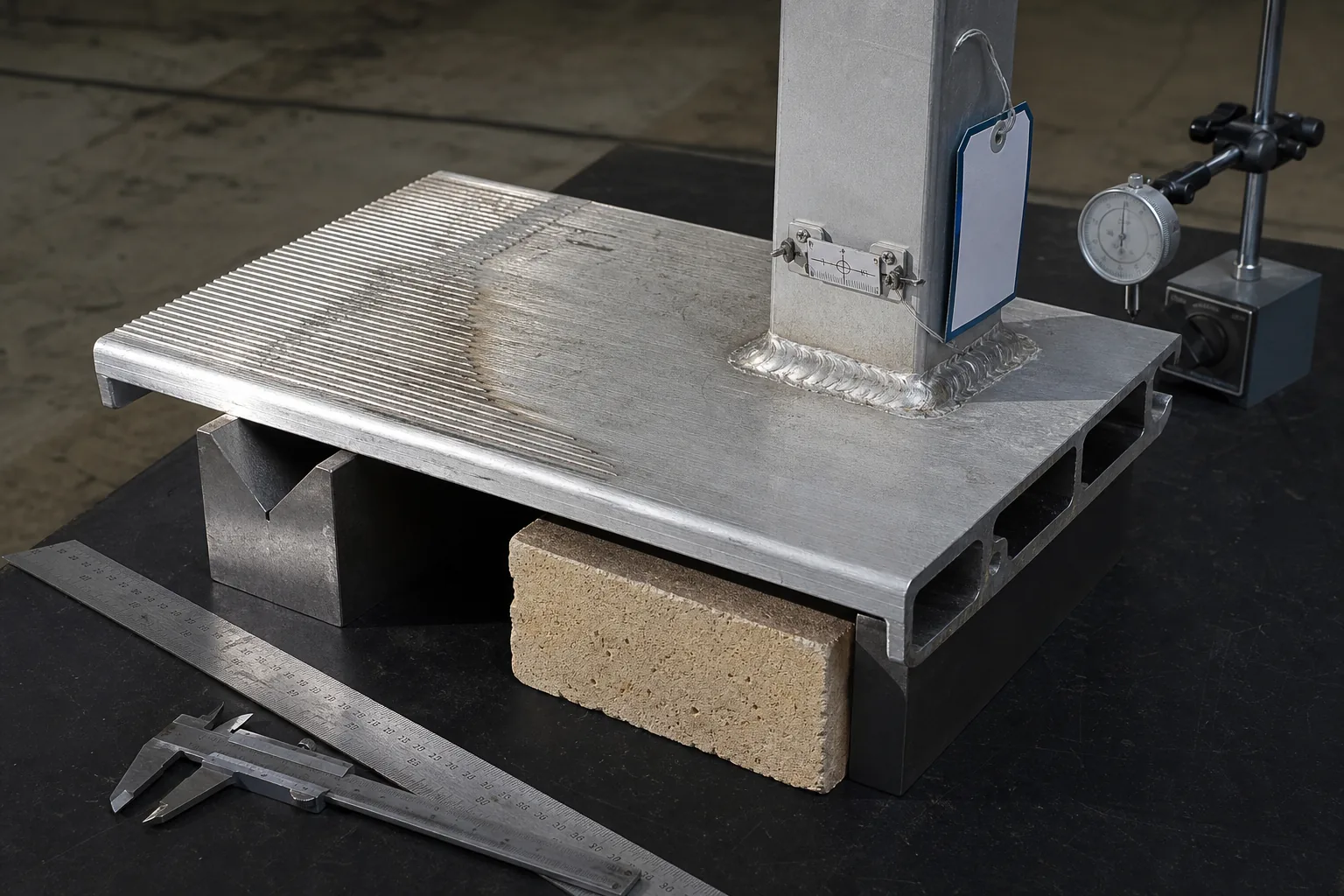
Consider an aluminium footbridge of admirable lightness, standing a little way beyond the last sensible park gate.
It crossed no Alpine chasm. It bore no procession of artillery.
It carried, in the main, dog walkers, schoolchildren, umbrellas, bicycles pushed rather than ridden, and the occasional person who pauses in the middle to consider water in the grave philosophical manner encouraged by railings.
The bridge had been proof-loaded. Its members had not yielded. The drawings pronounced its alloy and temper. Its deck gave a pleasing hollow answer to a heel.
It was, by every ordinary public standard, safe.
And each crossing was a small withdrawal from an account the bridge could not replenish.
That is the awkward civility of aluminium fatigue.
The structure may be lighter than the masonry it lands on. It may carry its exceptional crowd with dignity.
It may remain well clear of the single grand insult called overload.
Yet repeated service can still ask a welded toe, a bolt hole, a deck attachment or an unblended machining mark the same question, over and over, until one morning it answers with a crack.
This does not make the bridge melodramatic.
It makes it a fatigue detail.
A Bridge Is a Machine for Receiving Repetitions
The phrase flight limit belongs naturally to aircraft, which is where aluminium’s finite-life manners acquired their public gravity.
But a pedestrian bridge is also a machine for receiving repetitions.
Feet, wind, thermal movement, maintenance carts where permitted, and the flexible disagreement between deck and supporting frame all make a history.
A history is not a maximum load. It is an accumulation of reversals, ranges, dwell times, bias and inconvenient little local peaks.
The bridge will not count them.
Engineers must do that work on its behalf.
The instrument for it is an S-N curve, which supplies stress amplitude against cycles to a stated outcome. It is not a tensile-strength table in a theatrical hat.
Static strength asks whether one stern visitor can break the door.
Fatigue asks what happens when the family uses the handle for years.
Nor is “aluminium” an identity sufficient to begin the inquiry.
A designation with its temper has named composition, thermal condition and product form, and even then a plate and an extrusion of the same thickness are not automatically one record.
A registered alloy is a fact about chemistry.
It is not permission to paste a coupon curve onto every member that happens to be light-coloured and made in the same century.
The bridge’s flight limit, then, is not a number painted beneath the handrail.
It is a conditional promise about a particular alloy, temper, product form, detail, surface, spectrum, survival basis and environment.
A great deal of engineering consists of refusing to omit one of those nouns.
A Proof Load Is Evidence of a Different Sort
A proof load can show that the assembled structure has borne a specified event without a specified immediate failure.
It may reveal a gross error, a loose fastening, an unwelcome deflection, or a member that was not in fact what the drawing had imagined.
These are valuable discoveries.
One ought not sneer at a test merely because it declines to become magic.
But proof loading does not reproduce a life.
It does not reproduce the rain on a joint, the surface damage from a dropped tool, the tensile bias left by assembly, or the repeated movement of a deck under ordinary traffic.
Nor does it settle whether the governing local response is even elastic.
A calculated elastic notch stress well above the material’s cyclic yield is a summons to local strain treatment, not a forecast that the notch will remain there in polite elastic obedience.
There are two distinct courts in this matter.
Stress-life analysis is for a detail expected to remain predominantly elastic, provided the analysis uses the same stress definition as the curve: nominal with nominal, hot spot with hot spot, or a properly corrected local stress.
Strain-life analysis enters where a short-radius fillet, a formed corner or a press-fit region develops cyclic elastic-plastic response. It works with total strain amplitude and a cyclic stress-strain description.
The point is not that one method is grander.
The point is that a nominal stress curve and a local notch strain are not relatives merely because both are measured in an engineer’s office.
Where the crossover sits belongs to the material and its condition. It declines all invitations to become a universal boundary.
But Does Aluminium Not Have a Safe Stress Forever?
This is the myth correction, and it is the one on which the rest of the bridge stands.
The seductive story says a structure is safe indefinitely whenever it is not overloaded. It dresses static strength in a cape and sends it out to patrol the calendar.
Aluminium declines this arrangement.
Some ferrous smooth-specimen data do show an apparent endurance plateau.
Historical axle experiments reported apparent nonfailure beyond a million cycles at a low stress, and that result helped give the idea its name.
But even there the plateau belongs to a tested material, a loading, a specimen and a stopping rule.
It is not a family inheritance distributed to everything called steel.
Other materials and configurations continue to fail as cycles rise.
For those, the honest statement is a fatigue strength at a finite reference life, commonly ten million cycles, rather than everlasting innocence.
An aluminium bridge detail should therefore be designed and maintained as a finite-life question, unless relevant evidence under relevant conditions says precisely what narrower claim may be made.
The useful word is not forever.
The useful word is specified.
The curve itself also requires a survival basis.
A curve drawn at fifty percent survival is not a curve drawn at 97.5 percent, and design curves are often lower scatter-band limits rather than mean fits.
A bridge cannot be safely designed from a curve whose statistical meaning has wandered off, perhaps to enjoy the view.
Small changes in amplitude matter enormously on a power-law segment.
On a representative slope, dropping a stress range from 240 MPa to 200 MPa can multiply median life by something near five.
That arithmetic is an illustration, not a bridge allowable.
Its lesson is only that ordinary traffic does not become harmless by being ordinary.
A small recurring stress is still recurring.
The Ordinary Crossing Goes Into a Spectrum
A bridge does not experience one immaculate sinusoid, repeated until a clerk arrives with a stamp.
Its strain records are reduced to counted cycles, usually by rainflow counting.
A two-hour record sampled at 200 Hz contains something over a million samples.
The fatigue-relevant result might be 900 cycles in a modest range bin and a dozen cycles in a high one.
The dozen are not decorative.
The high ranges may charge the account most heavily of all.
Each bin also retains its mean stress, and this is essential, because identical alternating amplitudes need not produce identical lives.
A cycle running from 0 to 180 MPa has an alternating stress of 90 MPa and a mean stress of 90 MPa.
A cycle running from −90 to +90 MPa has the same amplitude and no mean at all.
Tensile mean stress generally reduces fatigue resistance. The first cycle holds the detail nearer opening, and nearer tensile deformation, for the whole of its life.
Modified Goodman, Gerber, Soderberg, Morrow and Smith-Watson-Topper are not interchangeable ceremonial robes. A calculation names the correction it chose, because the choice changes the answer.
After mean-stress treatment, each bin meets a compatible allowable life, and a linear screening sum accumulates the damage: the counted cycles in each bin divided by the life allowed in it, added together.
Two thousand cycles against an allowable of two million, and a hundred cycles against an allowable of a hundred thousand, produce a damage index of about 0.002 for that block.
Such a number is neither a crack length nor a prophecy that every bridge fails with identical punctuality.
It is the formal way of admitting that the bridge has a memory.
Wind and feet have now ceased to be scenery.
They have become bins, counts, ratios and a maintenance question.
The Crack Prefers a Hole, a Weld, or a Scratch
Because these places have the bad manners of being local.
The broad centre of a clean member may possess an excellent parent-metal certificate and never get the chance to prove it.
Initiation is commonly where geometry concentrates stress, or where manufacture has left a smaller geometry pretending not to be one: a weld toe, a hole edge, a fillet, a pit, a lap, a tool exit, or a scratch running the wrong way across tensile stress.
A geometry with a theoretical stress concentration of 2.4 does not automatically deliver a fatigue notch factor of 2.4. Notch sensitivity still has a say.
But it has announced that nominal stress will not be permitted to govern without an argument.
Opening a fillet radius from a quarter of a millimetre to a millimetre can substantially lower the concentration.
Moving the hole can be better still, if it takes the discontinuity out of the maximum tensile field.
The strongest correction is often not a correction factor.
It is an absence.
Welded aluminium makes the principle particularly unromantic. Weldability ratings are compiled separately from general corrosion, stress-corrosion cracking, cold workability, machinability and brazeability, because they are separate questions.
“Weldable” is therefore not a structural report card.
A fusion weld in a precipitation-hardened parent locally loses that condition. The weld metal and the heat-affected zone need their own properties, their own procedure and their own geometry.
A bridge is not made prudent by a family name. It requires drainage, exposure context, fastener context, welded state, and the rather more prosaic habit of looking.
Surface finish joins this parliament of minor tyrants.
A roughness requirement is meaningful only with its measured area, cutoff, direction, finishing method and relation to principal tensile stress.
It must not let an isolated pit or scratch escape behind a respectable average.
Polishing may remove a sharp valley. Shot peening may introduce useful near-surface compression.
A coating may delay initiation, right up until the ruptured hard coating becomes a rapid initiation site of its own.
Cosmetics is what surface treatment looks like to somebody not paying for the replacement interval.
Then the Flight Limit Becomes a Maintenance Plan
Only after the curve has met the actual bridge, and neither has been permitted to impersonate the other.
The alloy designation must stay paired with its temper, product form, governing specification, direction where applicable, and welded state.
A temper is not a decorative suffix sewn onto the end of “aluminium”; it names a thermal and mechanical history, and one of the letters means only that the material is still unstable and has an ageing period yet to serve.
A bridge design also needs its governing structural code and the relevant detail category, and no generic material certificate supplies those.
The certificate tells a portion of the truth.
The welded toe has additional opinions.
Finite-life results can then support inspection intervals, replacement intervals, proof-test scope and validation plans.
But an assumed damage index of unity at the end of a mission spectrum is a planning input only when the spectrum, surface state, statistical curve and safety policy all support it.
It is not a date on which every part has agreed to become a cautionary tale.
Testing keeps the same discipline. At 25 Hz, accumulating ten million cycles needs about 111 hours of uninterrupted running, before any allowance for temperature holds, corrosion exposure, interruptions or inspection.
Raising the frequency buys time and can cost representativeness, because heat generation and rate effects do not politely stand aside.
The bridge has no obligation to reproduce its service life in a laboratory merely because the laboratory has refreshments.
And So the Bridge Is Crossed
Imagine it on an ordinary afternoon.
There is no visible count beneath the deck. No little abacus clicking at each shoe. The aluminium does not sigh theatrically.
A member does not become unsafe because a child runs across it once, nor because the wind has found a reason to be wind.
There will be records: the specified material rather than a casual name, the weld procedure, the detail category, surface controls, monitoring where justified, and inspection of the places where initiation was expected to begin.
There may be a finite replacement interval.
There may be a revised detail after the first service evidence.
There will certainly be the unglamorous requirement to tell a proof load apart from a demonstration of life.
The bridge would not feel doomed.
It would feel counted.
And that is the useful correction. The exceptional crowd was never the whole story.
The true client of the bridge was the ordinary crossing: the heelfall, the small gust, the routine flexure, arriving without drama and leaving behind one more counted question.