FIELD GUIDE / thorium
Loose in the Gardener’s Hand
The thorium lamp asks what happens when an old lighting material acquires a damaged, regulated afterlife. Its drama is neither brightness nor bomb-making but identification, decay, dust, and disposal.
At a glance
- A radionuclide record identifies nuclide, nuclear state, chemical form, physical form, total activity, and reference time before it makes a handling claim.
- Activity in becquerels is not absorbed dose, dose rate, count rate, or a complete description of external or internal exposure.
- Sealed or intact material and friable material require different assessment because containment and particulate release change the exposure route.
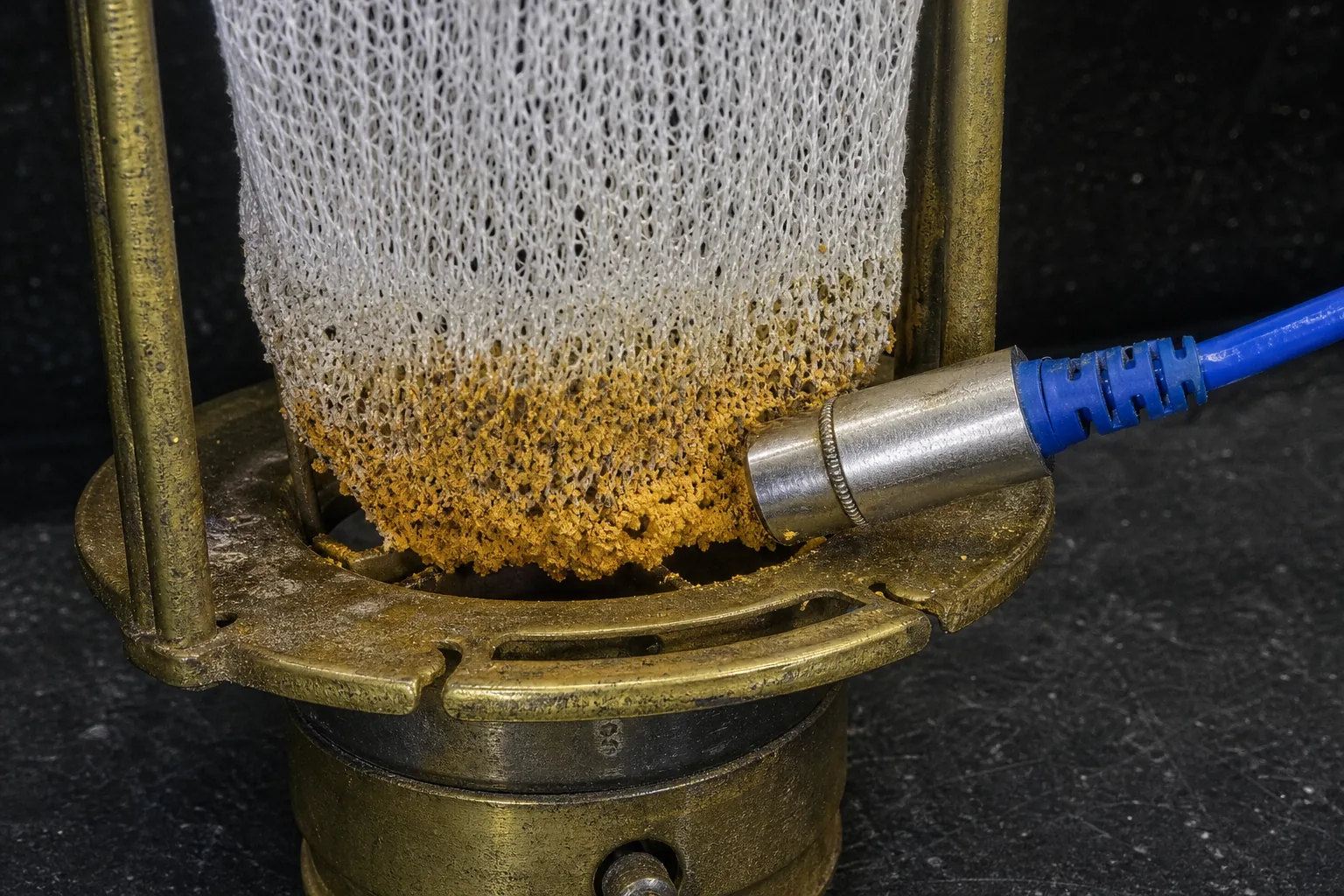
Beyond the last sensible hedge of a very determined garden there stands a lamp of the sort which cannot be bought without acquiring a second vocabulary.
It had a handsome iron post, a glass globe, a little weatherproof switch, and large thorium-bearing mantles which the owner treated as household consumables.
One burned through.
Another fell apart while being changed.
A third, after a wet season, acquired that deplorable softness by which objects announce that they have resigned from the category of objects.
The gardener wished to replace the mantle and put the old one in a bin.
The material wished first to be identified.
That is the whole quarrel between the domestic world and radioactive material.
A burned bulb is allowed to be a burnt bulb. A broken plate is allowed to be a broken plate.
But a thorium-bearing mantle cannot be responsibly described by the element name alone, any more than a medical source can be described as “a little radiation.”
It brings a nuclide, a form, an inventory date, a possible set of daughters, and a question about whether it is still contained.
The lamp does not become dramatic because it is radioactive.
Drama is usually the least helpful property of an inventory.
The question is whether the thing is still a thing.
What Has Been Put in the Garden
The first correction is linguistic.
Thorium may name an element, a material form, a mineral figure, or a fuel-cycle proposition.
None of them is a complete lamp record.
The thorium literature is quite stern about the distinction. An average soil abundance of a few parts per million is an environmental figure, not an ore grade.
Monazite is described as a few percent thorium phosphate, and in some material as high as about twelve.
A beach sand, a mineral concentrate, a separated chemical inventory and a reactor loading are therefore not interchangeable, simply because all four have the good fortune to contain the same element.
A mantle makes the same demand on a smaller scale.
Its record needs the chemical compound, the physical state, the carrier mass, the volume or concentration where applicable, and whether it is sealed.
It needs the actual radionuclide and its nuclear state, not merely the proud brass phrase thorium.
Where a parent and a daughter both matter, it needs both. Two half-lives, two decay schemes and potentially two inventories can live quite comfortably under one practical arrangement.
This is not paperwork dressed as science.
It is the beginning of science, dressed as paperwork.
Consider the plainest possible demonstration. A vial, a sealed capsule and a metal pellet may each carry the same activity, to the same decimal place.
They cannot be handled or discarded on that number alone.
They differ in form, before any instrument has been taken from its case.
The mantle has exactly the same objection to being called merely a mantle.
But Is Thorium Not Harmless Because It Is Future Fuel?
No. This is the moment when the popular story generally arrives carrying a reactor brochure and forgetting its shoes.
Thorium-232 is fertile, in the fuel-cycle sense.
After neutron capture it can lead toward a fissile uranium isotope. It is not, in an ordinary thermal spectrum, the initial fissile charge.
A thorium system requires a fissile driver, a stated spectrum, an arrangement and a back-end choice.
Which is why a heavy-water path, a light-water arrangement, a coated-particle high-temperature reactor and a molten-salt concept are not one thing, merely because all four have been invited to the thorium dinner.
None of that is a gentleness certificate for a mantle in a hedge.
Nor does the opposite story hold. Radioactive is not a synonym for instantly catastrophic.
Practical radionuclides range from half-lives of hours to half-lives of centuries, and half-life, emission, physical form, activity and containment together make very different practical cases.
A future-fuel slogan cannot flatten them.
A warning label should not try.
The garden lamp is neither a reactor nor a bomb.
It is a material-identity problem with a broken domestic wrapper.
And the wrapper is the part that changed.
Half-Life Is Not an Expiry Date
For a simple nuclide, activity falls exponentially, and the arithmetic is memorable.
After ten half-lives, roughly a thousandth of the starting activity remains.
That calculation is neat, and it is entirely unsuitable for being waved over a mixture, or over a parent-and-daughter chain, like a municipal permit.
Those require their own inventories and their own decay relations.
This is why a lamp cannot be dated by a vague family resemblance to some other source.
Half-lives in practical use span from hours to hundreds of years, and they are not a ladder on which an unidentified mantle may stand.
They demonstrate only that a name without a nuclide, a nuclear state and a reference date is a poor substitute for a record.
The record also gives the decay mode and the branching, rather than one theatrical label.
A beta transformation can be followed by gamma de-excitation. Electron capture can create characteristic X rays. Positron decay produces annihilation photons.
Even a quoted branching probability needs its evaluation and its edition.
Nature has no obligation to make a source legible to a shopkeeper.
Radioactivity Gives Questions, Not an Instruction
Which is less convenient and more civilized.
Activity is measured in becquerels, and one becquerel is one transformation per second.
These are units of radioactivity. They are not units of absorbed dose, nor of equivalent or effective dose, nor of exposure rate, nor of detector count.
An activity label tells the gardener that atoms are transforming.
It does not tell the gardener what a person receives from standing nearby, from touching a fitting, or from making dust.
The emissions need their own entry: the particle or photon energy, the emission probability per decay, and whether the value quoted is a line, an endpoint, a mean or a sum.
A beta endpoint energy is not a monoenergetic electron field, and treating it as one flatters the shielding.
A weak high-energy gamma line and a strong lower-energy one do not demand equal shielding merely by taking turns with the unit.
So time, distance, shielding and containment are not four names for a lead box.
Time and distance address an external exposure opportunity.
Shielding depends on the radiation type, the energy, the strength and the geometry.
Containment keeps radioactive material confined to the smallest possible space.
A sealed alpha-emitting device may present very little external hazard, because its capsule and a few centimetres of air are enough to stop what it emits.
When the same material disperses, the internal-exposure question acquires an entirely different importance.
The material has not changed its name.
It has changed its route.
Then the Mantle Stops Being a Mantle
When it becomes friable enough that form must govern the conversation.
There is the inversion.
The intact lamp fitting is principally an inventory item. Identify it, keep its condition and its geometry, and distinguish its external field from its containment performance.
The moment its mantle crumbles, mundane replacement becomes a question of particles, surfaces, tools, ventilation and transfer.
The domestic noun has become a radiological-control noun, which is an unflattering promotion.
The distinction is written into the records themselves.
For unsealed material, the questions are solvent, acidity where relevant, aerosol or volatility potential, and any biological targeting agent.
For a sealed source, they are capsule construction, geometry, leak-test status, device model and serial number.
Those are not two levels of caution about one object.
They are two different objects.
So nobody should infer a complete hazard from a mantle’s intact appearance, and nobody should infer one from a spectacular word on a label either.
Chemical form, oxidation state where relevant, physical state, carrier mass and the possibility of airborne material are the governing facts.
An intact fragment and a friable residue may have come from the same original article.
They do not present the same control problem.
The lamp has therefore performed a small household miracle.
It has turned breakage into classification.
A Meter Cannot Decide It Alone
A meter is an honest instrument. It cannot answer a question it has not been asked.
An ambient dose-equivalent rate at one metre, a detector count rate, and a contamination level per square centimetre are three different observations.
Careful records go further still, asking for a dose rate at one metre from a device and another at a tenth of that distance from its target after operation.
Geometry is not an irritating footnote.
It is part of the quantity.
Nor is total activity the same as specific activity.
The same total activity in one gram and in ten grams differs by a factor of ten per unit mass, and the arithmetic is simple enough to make the distinction genuinely dangerous.
It says nothing whatever about gamma energy.
It can decide the compactness of a source, and how much material must be treated as material.
Any actual assessment of the garden lamp would therefore retain the instrument, the uncertainty, the calibration time, the reference date, the geometry and the state of the fragments.
A ten percent error in elapsed time is trivial for an isotope with a half-life of centuries and severe for one with a half-life of hours.
Nobody needs to know the mantle’s half-life in advance to see why the actual nuclide has to be found.
And So the Garden Is Lit
The bin, almost offensively, is the one named by a complete record and the applicable authority.
An end-of-life record needs the total and isotope-specific activity, the mass and volume, the physical form, the free-liquid status, contamination as against activated material, any hazardous chemical constituents, decay-storage eligibility, and an inventory date.
The international waste framework weighs activity concentration, half-life, heat generation, containment and isolation together.
That is a framework field.
It is not a permission slip for an unexamined garden object.
Nor is a waste class an elemental property, like a melting point on a catalogue card.
Low-level radioactive waste in the United States is defined by exclusions, and can contain no upper amount of radioactivity at all.
Mixed waste adds a chemically hazardous component to the problem.
The waste code, the clearance criterion and the destination all remain jurisdiction- and facility-specific.
The adjective low has, in this trade, an unfortunate capacity for sounding like a bedtime assurance.
So imagine the lamp after the sensible work has been done.
There is no blue revelation among the roses. No reactor in the potting shed. No explosion of secret science because an old lighting material has met weather and human impatience.
There is identification before handling. There is a condition record before a repair.
There are controls chosen for the emitted field, and for the possibility of material travelling where it ought not.
There is a measurement with a geometry, an activity with a reference time, and a disposal decision which does not mistake an element name for a waste class.
The lamp would not feel haunted.
It would feel inventoried.
And that is the proper anticlimax.
The important event was never that thorium appeared in a garden.
It was that a disposable mantle stopped being disposable, the instant it became uncertain what exactly was loose in the gardener’s hand.
AT THE BENCH
Questions, with the conditions attached.
Is a thorium garden mantle harmless because thorium is discussed as a future fuel?
No. A thorium fuel-cycle discussion describes a system in which fertile thorium-232 is combined with a fissile driver, neutron spectrum, core arrangement, and back-end choice. It does not describe the activity, chemical form, containment, or exposure route of a lamp mantle. A material’s fuel-cycle role and its handling record answer different questions.
What has to be identified before a broken thorium mantle is handled?
The identification record states the radionuclide and nuclear state, chemical compound, physical form, total activity, reference date and time, and whether the material is sealed or unsealed. It also records parent and daughter nuclides where relevant. The word thorium alone does not establish decay behaviour, emissions, contamination potential, or a disposal classification.
Does a half-life say when a radioactive mantle becomes safe?
No. Half-life is the time for activity or atom number to fall by half; it is not the time at which the material disappears. For a simple single nuclide, ten half-lives leave 1/1,024 of the starting activity, about 0.098%. Parent-daughter ingrowth and mixtures require a different calculation and separate isotope records.
Is an activity reading the same thing as radiation dose?
No. Activity in becquerels measures transformations per second: 1 Bq equals one transformation per second. It is not absorbed dose in gray, equivalent or effective dose in sievert, dose rate, or detector count rate. A useful measurement record adds the radiation type, energy, yield, geometry, distance, instrument, reference time, and material form.
Why does an intact mantle need a different assessment from crumbled mantle dust?
An intact or sealed object and a friable material have different containment and intake pathways even when their isotope inventory is the same. A radioisotope record therefore states physical state, chemical compound, aerosol or volatility potential, and whether the material is sealed. Breakage can change an object into material requiring particulate containment and contamination assessment.
Can shielding replace containment for a broken radioactive mantle?
No. Shielding addresses an external radiation field, while containment keeps radioactive material confined to the smallest possible space. Time and distance also reduce an external exposure opportunity, but neither identifies chemical form nor prevents particulate migration. The appropriate controls depend on emission type, energy, source strength, geometry, and whether the material remains intact.
Can one meter reading decide whether a mantle is safe to discard?
No. An ambient dose-equivalent rate at 1 m, a detector count rate in s⁻¹, and surface contamination in Bq cm⁻² are different measurements. A disposal decision also needs isotope-specific activity, mass, volume, physical form, free-liquid status, hazardous constituents, inventory date, and the receiving facility’s acceptance criteria.
Does the word thorium tell a waste facility what class of waste it is?
No. Waste classification is not an intrinsic isotope label. The IAEA framework considers activity concentration, half-life, heat generation, containment, and isolation, while U.S. low-level radioactive waste is defined through exclusions and may also be mixed waste with a chemical hazard. The applicable code, clearance criterion, and destination are jurisdiction- and facility-specific.
Why must a measurement record include a date and time?
Radioactive activity changes continuously, so a record states calibrated activity with date, time, time zone, instrument, and uncertainty. A 10% elapsed-time error has very different consequences for a 432-year radionuclide than for a 6-hour radionuclide. Without a reference time, an activity value cannot be reliably compared with a later measurement or waste record.
Does thorium in a lamp mean the lamp can become a nuclear reactor or bomb?
No. Thorium-232 is fertile in nuclear-fuel language: after neutron capture it can lead to uranium-233, but it is not the initial fissile charge in an ordinary thermal spectrum. Thorium systems require a stated fissile driver and neutron environment. A lamp-mantle inventory is not made into a reactor or weapon by the element name alone.
What should be kept after a thorium-bearing mantle is removed or broken?
The retained record states the identified isotope or mixture, activity and reference date, chemical and physical form, mass or volume, containment condition, contamination status, hazardous-chemical constituents, and any decay-storage eligibility. The record also distinguishes a source’s external field from its internal-exposure potential. These fields support a later measurement, transfer, or disposal decision.
Sources and further reading
- NIST, Radionuclide Half-Life Measurementsnist.gov
- CDC/ATSDR, Ionizing Radiationwwwn.cdc.gov
- NRC, Minimize Your Exposurenrc.gov
- IAEA, Classification of Radioactive Wastepub.iaea.org
- USGS, Thorium Statistics and Informationusgs.gov