FIELD GUIDE / aluminum alloys
The Boat and Its Sensible Bolts
The aluminium hull meets stainless hardware and discovers that a fastener can be a chemical design decision. The piece keeps the boat distinct from the copper roof by making seawater, area ratio, and isolation the principal actors.
At a glance
- Galvanic compatibility belongs to the electrically connected pair in its actual electrolyte, not to either metal considered alone.
- A cathode-to-anode exposed-area ratio can concentrate the same electrochemical current on a small aluminium area.
- Electrical isolation breaks the metallic path required for a galvanic couple, while drainage removes the retained electrolyte that completes it.
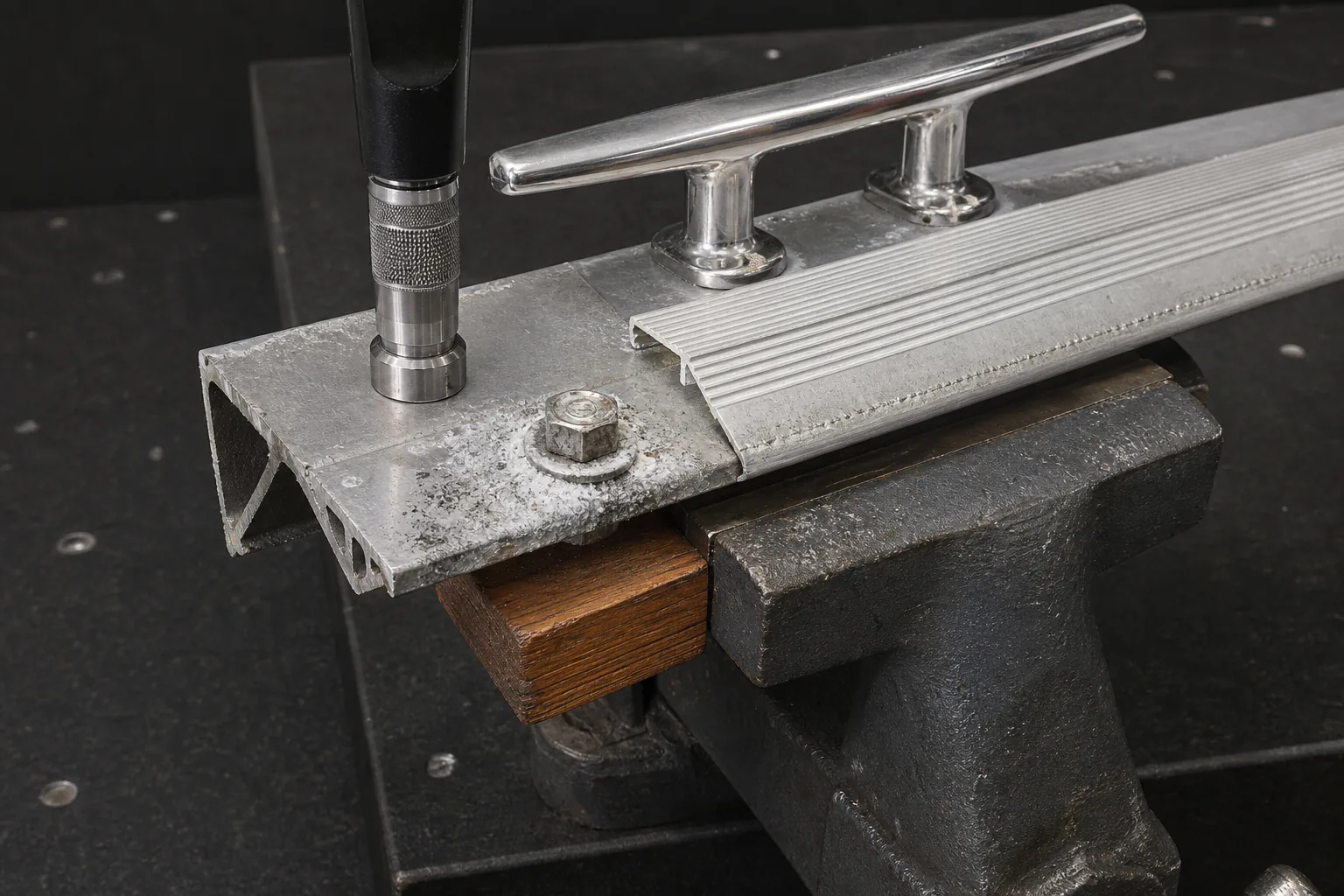
In a small harbour of great practical common sense there lies an aluminium boat, fitted throughout with stainless bolts.
Not a few bolts, mind.
Bolts at the cleats, bolts at the rails, bolts at the hatch fittings, bolts beneath the little boxes in which a man keeps rope, sandwiches, and the documents proving that the boat is somebody else’s responsibility.
Every one of them bright, resolute, and selected because stainless steel is plainly the better fastener.
This is, at first, an agreeable thought.
The hull plate is marine alloy, chosen for salt water and welded service. It is light. The bolts do not rust in the familiar red fashion.
The owner has bought the good small things, which is often what distinguishes a well-kept boat from a floating argument with a marina.
Then seawater enters the joint.
And the boat discovers that a fastener is not merely a fastener.
It is an electrical connection wearing a sensible hat.
The resulting trouble is not that stainless steel has behaved badly, nor that aluminium has forgotten its manners.
It is that two conductors, touching through a conductive electrolyte, have become one electrochemical arrangement.
The more active metal is anodic and gives up electrons more readily; the less active metal is cathodic.
The bolt may be the more composed member of the household.
That does not mean the household is at peace.
The Admirable Bolt Is a Chemical Decision
A boat fitting is a small parliament.
At the cleat there is hull plate beneath the flange, a rail extrusion of a different alloy nearby, the stainless bolt and its washer, a coating perhaps, a sealant perhaps, a stray bare edge, an intentional bonding path or an accidental one, and whatever water has been invited into the recess.
To call the selection “stainless fasteners” is rather like calling a legal case “paper.” It identifies an object while omitting the mechanism.
The same arrangement occurs on land, wherever aluminium frames, stainless fasteners, supporting members and electrical continuity meet outdoors.
What such an assembly needs is an interface schedule: base metal, plated or bare fastener, conductive bonding element, local coating removal, the exposed areas of each metal, and whether water can bridge the parts.
A boat needs the same seriousness, with seawater doing the bridging more persistently and with better connections.
Consider the supposedly minor 6 mm bolt.
It is small in mass. It can nonetheless establish both the electrical path and the wet contact region at once.
So the tiny bright object enters the drawing not as standard hardware but as a participant in the mating system.
The hull has paid for lightness.
The bolt now asks whether it has also paid for isolation, for drainage, and for a record.
This is no argument against stainless steel. It is an argument against an adjective becoming a design method.
“Corrosion resistant” names a property of a material under conditions.
“Compatible” names a relationship between materials, geometry and an environment.
They are different nouns, and the boat will enforce the grammar.
But Does Stainless Steel Not Improve Every Assembly?
No.
This is the myth correction, since the phrase stainless fastener has acquired the moral authority of a well-polished church key.
It suggests that a bolt which resists its own corrosion must improve whatever it touches. Popular material selection then rushes in wearing a captain’s cap at a foolish angle.
A corrosion-resistant fastener can make a coupled aluminium detail worse: when it is electrically joined to the aluminium through conductive seawater, when wetness remains in the joint, and when the exposed areas give the aluminium a poor bargain.
The point is not that the fastener dissolves.
Quite the contrary.
Its endurance is part of the local arrangement that leaves the aluminium to supply the loss.
Seawater is the principal actor in this drama, because it provides the conductive path.
In dry air, hull and bolt sit near one another with the reticent civility of strangers in a waiting room.
Retained conductive liquid turns proximity into a circuit.
A properly isolated bolt interrupts the metallic path. Proper drainage denies the joint its persistent electrolyte.
Neither measure is a magic amulet. Together they remove the conditions on which the coupling relies.
The boat does not need a lecture on the moral status of stainless steel.
It needs its hardware specified alongside the aluminium it meets.
A Small Hole Pays for a Large Surface
By area ratio, which is the quiet arithmetic behind an unusually expensive blemish.
Take a plain example. Let 10 mm² of electrically coupled anode be exposed to the electrolyte beside 1,000 mm² of cathode.
The cathode-to-anode area ratio is 100 to 1.
The same total electrochemical current, concentrated on the smaller area, gives that smaller area far greater local current density than it would have had if the anode occupied the larger one.
This does not produce a corrosion rate. It does not date the first pit. It does not issue a warranty with a small umbrella printed on it.
Area ratio is a compatibility figure, not a service-life oracle.
But it tells the designer why a small exposed ring of aluminium around a fastener deserves more fear than its size would ordinarily command.
Here is the inversion.
The strongest-looking little bolt is not the part likely to disappear.
The surrounding aluminium becomes the sacrificial member, precisely because its exposure is small and its partner’s is large.
A bright bolt surrounded by a spoiled halo is not an advertisement for excellent fastening.
It is an electrochemical receipt.
The calculation belongs on the joint record: exposed anode and cathode areas rather than nominal bolt diameter; whether coatings are intact; whether a washer enlarges or limits the wetted region; and whether some other bonded fitting has made the effective cathode larger than the eye suggests.
The boat is not made of areas alone.
But corrosion has always been fond of the part of a drawing marked “minor detail.”
Seawater Occupies the Crevice
This is more formidable than the open wet deck, because a crevice holds the electrolyte at the interface and declines to let it leave.
Rainwater bridging, condensate, a fluid film and salt deposition should be described rather than assumed into one word called wet.
Splash, immersion, sheltered condensation and a salt-deposit cycle do not produce the same electrochemical situation.
Marine is therefore not a useful final adjective.
It is the beginning of a questionnaire.
Is this joint repeatedly splashed? Is it immersed? Does it dry?
Does it collect salt where a flange covers the hull? Does a sealant make a crevice out of otherwise open geometry?
Has a coating been locally removed under a washer? Is a bonding path intentional?
A corrosion record keeps general corrosion, pitting, galvanic coupling, crevice conditions, intergranular corrosion, exfoliation and stress-corrosion cracking as separate modes, because a boat has more ways of being wet than a brochure admits.
Drainage has an almost boring dignity here.
A drained joint has not made aluminium noble, nor turned stainless into some other metal. It has reduced wet retention, which is all it claimed to do.
A sealed joint may be entirely reasonable when its sealing system is specified and remains sound.
A casually sealed joint merely gives seawater a private room.
These are different domestic arrangements.
Marine Aluminium Is Not One Material
No more than “boat” is a single part.
The 5xxx family provides the familiar marine anchor, and its magnesium is what makes it good at salt water.
But the family name does not dismiss the rest of the record.
There is a useful restraint hidden in the same alloys. Higher-magnesium 5xxx material can sensitize during cold work and ageing, and become susceptible to stress-corrosion cracking in service.
So marine plate should not be waved about as salt-water proof, any more than a life jacket is waved at a storm and considered a voyage plan.
Welded state, service history, tensile stress and exposure all remain part of the question.
The 6xxx alloys supply a different lesson.
They are the magnesium and silicon family, structurally useful and widely specified for marine frames, and an alloy with its temper is still not the complete identity of a fitting.
Nor does welding permit a man to keep his parent-material certificate and call the subject closed.
A precipitation-hardened parent locally loses that condition during fusion welding. The weld metal and the heat-affected zone need their own properties and their own procedure.
The filler alloy is a joint participant, not a copy of the parent.
The boat has now acquired a third metal history in the immediate vicinity of its stainless bolt.
It will not be improved by being called “all aluminium.”
Then the Fitting Needs a Schedule
First, separate the claims.
“Weldable” is not “marine proof.” “Stainless” is not “galvanically harmless.” “Aluminium” is not “this alloy, in this temper, welded thus, with this fastener system.”
Engineering becomes briefly more useful whenever one adjective is prevented from claiming the work of six.
Then separate the metals, wherever the joint design permits it.
Electrical isolation breaks the metallic connection a galvanic couple requires.
Coatings and sealants form part of that separation only when their condition, their local damage and their edges have been considered.
Drainage and joint geometry reduce retained seawater.
None of this bans the intentional bonding of boat hardware where bonding is required.
It demands that intentional continuity be recorded as continuity, with its materials and its wet environment understood.
The schedule itself can name the aluminium alloy and temper, the product form, the welded state, the coating state, the stainless fastener condition, the insulating components, the sealing system, the exposed areas, the intended electrical bond, and the particular exposure: splash, immersion, condensation, or deposited salt.
It can also name the inspection question.
Is the aluminium around the fastener lifting? Is moisture being retained? Has a coating edge been breached?
Nothing in this schedule is romantic.
Romance, in a boatyard, is generally moisture with a budget.
And So the Boat Sits at Its Mooring
Not cursed.
There would be no green bloom rising from the cleat at midnight, no bolt delivering a speech about electrons, no owner driven mad by a washer of occult alloy.
There would be fittings, sleeves where specified, drained details, sealants used with a stated purpose, bonded parts where required, and inspection of the little places where water waits.
The stainless bolt would remain very respectable.
The aluminium hull would remain light.
Neither material would have betrayed the other. They would simply have been made to meet under conditions that either completed an electrochemical circuit, or interrupted it.
For the boat does not ask whether its parts are noble.
It asks whether they are wet together.
And the answer, written around every small fastener, decides how much of the hull is required to pay.
AT THE BENCH
Questions, with the conditions attached.
Why can stainless bolts damage an aluminium boat?
Stainless bolts can damage an aluminium boat when stainless steel and aluminium are electrically connected through conductive seawater or another wet electrolyte. The more active member of the pair acts anodically and loses electrons, while the less active member is cathodic. Aluminium around the wet joint can therefore corrode even though the stainless fastener itself appears corrosion resistant.
Is stainless steel always safe to use on aluminium?
Stainless steel is not automatically safe on aluminium. Compatibility depends on the actual electrolyte, electrical connection, exposed areas, coatings, retained moisture, and joint geometry. A pairing that remains harmless in dry air can become a galvanic couple when a conductive fluid bridges the metals. The fastener grade alone does not describe the corrosion behaviour of the assembled boat fitting.
Why does the size of the bolt matter in galvanic corrosion?
Bolt size matters because exposed cathode and anode areas affect local current density. A 6 mm bolt can be small in mass while establishing the electrical path and wet contact region. If 10 mm² of aluminium is exposed as an anode beside 1,000 mm² of cathode, the cathode-to-anode area ratio is 100:1, concentrating the same current on the smaller aluminium area.
What does a 100:1 cathode-to-anode area ratio mean?
A 100:1 cathode-to-anode area ratio means that 1,000 mm² of cathodic area is electrically coupled to 10 mm² of anodic area in the same electrolyte. The ratio does not predict a corrosion rate or service life by itself. It identifies a geometry in which electrochemical current can be concentrated on the small anodic aluminium area and make local attack more consequential.
Does an insulating washer stop galvanic corrosion?
An insulating washer can interrupt the metallic electrical path at a fastener joint, which prevents the electrical coupling required for galvanic corrosion at that interface. It is not a complete corrosion specification by itself. Conductive liquid can still be retained in a crevice, coatings can be damaged, and other electrical paths or bonded hardware can reconnect the metals elsewhere in the assembly.
Why is trapped seawater worse than a wet surface?
Trapped seawater matters because a crevice retains the conductive electrolyte at the aluminium-stainless interface instead of allowing the joint to dry. Galvanic compatibility must be assessed in the actual fluid film, salt deposition, condensate, splash, or immersion condition. A broad surface that dries and a sheltered fastener recess that remains wet are not the same electrochemical environment.
Is 5083-H116 simply salt-water proof?
A marine designation is not a universal salt-water-proof promise. Higher-magnesium 5xxx alloys can sensitize during cold work and ageing, and become susceptible to stress-corrosion cracking in service, so welded state, service history, tensile stress, and exposure all remain necessary records. The alloy earns its marine reputation from its magnesium; the same magnesium is what makes its condition worth recording.
What has to be written down for an aluminium boat fitting?
A useful fitting record states the aluminium alloy, temper, product form, governing specification, welded state, corrosion mode, wet or dry exposure, coating state, stainless fastener condition, exposed areas, and whether rainwater or seawater can bridge the parts. It also states whether electrical bonding is intentional. A label such as marine aluminium with stainless hardware omits the interface conditions that govern the joint.
Does welding an aluminium fitting leave the parent material as it was?
No. A precipitation-hardened parent locally loses that condition during fusion welding, and the weld metal and heat-affected zone need their own properties and their own procedure. The filler alloy is a further participant rather than a copy of the parent, so a welded fitting has three metal histories in the same vicinity as its stainless bolt. Calling the assembly all aluminium conceals every one of them.
Are splash, immersion, and salt deposits the same marine exposure?
Splash, immersion, sheltered condensation, and a salt-deposit cycle are different corrosion environments. A corrosion record separates medium, temperature, chloride condition where given, wet or dry exposure, coating state, fastener couple, and tensile-stress state. Calling a part marine does not establish which electrolyte reaches the joint, how long it remains there, or which corrosion mechanism is relevant.
What actually interrupts a galvanic couple on a boat?
A galvanic couple needs dissimilar metals, a metallic path between them, and a retained electrolyte. Electrical isolation removes the metallic path; drainage and joint geometry remove the retained seawater. Neither is an amulet, and neither bans the intentional bonding that some boat hardware requires; the requirement is that deliberate continuity be recorded as continuity, with its exposed areas and its wet environment stated.
Why does the stainless bolt often look fine when the aluminium does not?
In a galvanic couple, the less active member is cathodic while the more active member is anodic. The cathodic stainless bolt can remain visibly sound while surrounding aluminium loses material. The surprising appearance is therefore not evidence that the joint is healthy. It can be the signature of a local anodic aluminium area paying for a larger or more noble cathodic surface.
Sources and further reading
- TWI, Corrosion of welded components in marine environmentstwi-global.com
- DOE, Managing and Mitigating Solar PV Corrosionenergy.gov
- Aluminum Association, Standards and alloy familiesaluminum.org
- The Aluminum Association, Teal Sheetsaluminum.org
- The Aluminum Association, Comparative Characteristics and Applicationsaluminum.org