FIELD GUIDE / titanium alloys
The Contact That Would Not Let Go
The titanium bicycle is light and durable until two clean titanium surfaces begin to quarrel under contact. The failure is adhesive wear: a mechanical intimacy, not a lack of tensile strength.
At a glance
- Titanium grade, heat-treatment condition, product form, and certified record do not by themselves establish galling resistance.
- Galling risk belongs to a stated material pair and depends on counterface, contact pressure, surface roughness, lubrication, motion, temperature, and contamination.
- Lubricants, surface treatments, texture, alignment, preload, and a dissimilar or otherwise compatible mate must be evaluated under the actual contact duty.
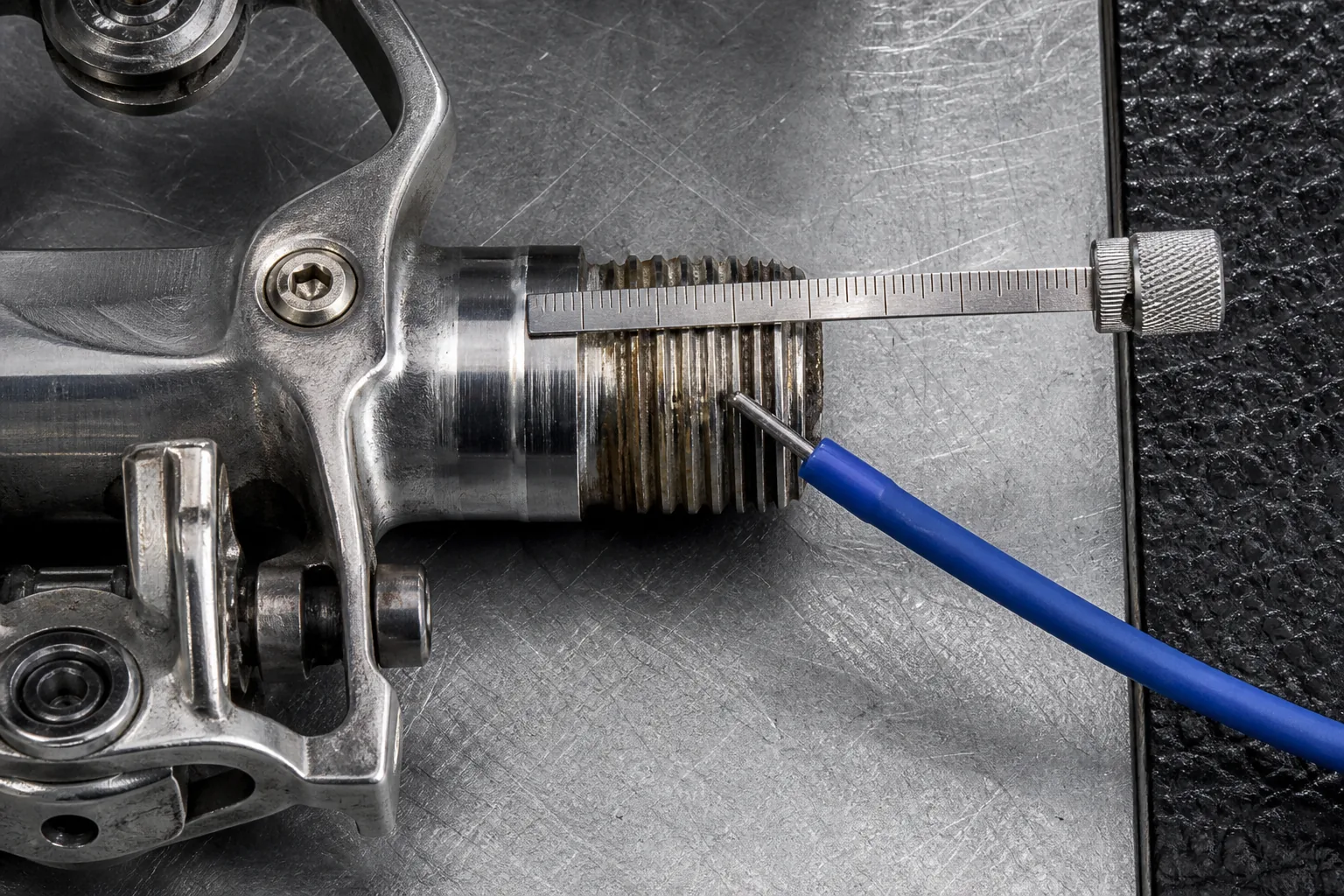
At the end of a long and creditable campaign against unnecessary mass, a bicycle has been fitted with titanium wherever titanium could be made to sound like an improvement.
Not merely a titanium frame, which has at least the decency to stand still while being admired.
The pedals would be titanium. Their axles would be titanium. The threaded fittings would be titanium.
The little interfaces which ordinary bicycles permit to be dull and mutually tolerant would be promoted into a family reunion of the same excellent metal.
The bicycle would be light, durable, corrosion-conscious, and very expensive in the manner of a small religious object.
Then, on a morning chosen by nobody in particular, a pedal would refuse to come off.
It would not have bent.
It would not have rusted.
Its tensile strength would remain in possession of a formidable reputation.
Yet two clean-looking titanium surfaces, pressed together and made to move, can begin to seize by adhesion and material transfer.
The bicycle would have discovered that strength is not an introduction to every room.
But Is Titanium Not Supposed to Be the Durable Metal?
It is, within the limits of the question.
But titanium is not a single answer, and durable is not the name of a test.
The controlled grades differ in chemistry, in condition and in purpose.
One family adds an element for corrosion service; another restricts interstitials for toughness; a solution-treated and aged condition may nearly double a proof stress while cutting elongation to a quarter of what it was.
These are changes of condition, product and mechanical outcome.
They are not an ordering of metals from “will seize” to “will not seize.”
Here is the popular myth in its purest form.
Titanium is imagined as universally durable because it is strong and corrosion resistant.
The myth takes a tensile certificate, gives it a cape, and sends it out to supervise every surface in the workshop.
It has taken the wrong job.
Bulk strength asks what happens when the body of a specimen is pulled.
Galling asks what happens where two actual surfaces meet: their roughness, their films, their chemistry, their pressure, the lubrication between them, the debris they make, and the particular motion imposed upon them.
A galling observation must state the counterface, the contact pressure, the lubrication, the temperature, the displacement and the surface roughness.
An observation that says only “poor galling resistance” has forgotten the very thing galling is about.
The Pedal Quarrels at the Interface
Which is a small republic with laws of its own.
The threaded fitting looks broad in the hand, but it does its practical work at contacting flanks.
Assembly puts those flanks under load. Turning provides relative motion. A pedal axle and its surrounding bearing arrangements add their own contact history.
The standard sliding-wear methods begin from precisely this refusal to call one member, rather than the pair, the candidate.
There is no requirement that a material which performs splendidly as a beam should behave decorously at every concentrated, moving boundary it encounters.
The first defence may be a surface film.
It separates the nearer asperities for a while, or at least persuades them to share their disagreement. A lubricant may do the same more deliberately.
But loaded vibrating contacts produce oxide debris, which is one reason a surface cannot be assumed to keep its first innocent condition.
And the relevant question is never whether a lubricant was once present in a tube.
It is whether the stated pair, at its pressure and its motion, retains a useful film while surfaces, debris, temperature, alignment and contamination conduct their private politics.
When the film is disrupted, small regions adhere.
Continued motion tears and transfers material.
The bright, innocent contact begins to scuff. Transferred matter makes a new, rougher and less cooperative contact. Resistance rises.
And the part becomes less a removable fitting than a philosophical position.
This is adhesive wear.
It is not the same injury as a hard grain cutting a furrow through a surface.
The distinction has the useful plainness of a fingerprint. Two-body abrasion leaves parallel grooves aligned with the sliding direction, where fixed or embedded grit returns along a related path.
Three-body abrasion more often leaves distributed indentations and rolling marks, as free particles travel between the solids.
A contaminant five micrometres across is nothing beside a broad contact, and enormous beside a surface finished to a fifth of a micrometre.
It may become an active third body.
So the surface with grooves is asking for cleanliness, exclusion, or a harder defence.
The smeared adhesive scuff is asking for a different mate, or a more suitable lubricant.
There is no honour in giving either complaint the wrong medicine.
A Higher Strength Figure Does Not Rescue the Contact
It may answer another question excellently.
Even the highest tensile result in the titanium catalogue does not discharge this one.
The chemistry tells the same cautionary tale. A grade specified with palladium for corrosion purposes, or with molybdenum and nickel for another, has been designed against a chemical problem.
Corrosion-oriented composition is not a universal tribological ranking wearing a false moustache.
The same rule holds for preparation.
The listed finishes for titanium include pickled, abrasive-blasted, chemically milled, ground, machined, peeled and polished.
Finished is therefore a word carrying much too little luggage.
A threaded titanium surface may have a machining history, a treatment, a finish, an applied compound, and a mating part with an entirely different history.
Each of those can alter the first condition from which wear begins.
The surface enters service carrying its upbringing with it.
The inversion, then, is not that titanium suddenly becomes weak.
It is that the very contact which appears most pristine can become the troublesome one, once its separating film is lost and its surfaces prove too willing to join.
The component does not fail because it has fallen below a yield strength.
It fails because it has become, at scattered microscopic places, excessively intimate.
The Contact Runs In While Nobody Is Looking
Running-in is a gentle name for the period in which two surfaces decide what sort of contact they are going to be.
Asperity peaks flatten or fracture. Conformal area increases. Transfer films appear. Lubricant redistributes.
Debris escapes, or stays in the interface like an uninvited relative.
This is why a single mass difference, taken before and after, discloses so little.
Observations at several sliding distances tell a much better story than one number does, because an early high-loss transient and a settled later rate can average into a figure describing neither.
A decline in wear rate after the first few hundred metres is not proof that the contact has entered a monastery.
It matters to the bicycle because a newly assembled contact and an old one are not automatically the same experimental object.
The first turns of a pedal thread, the early rotation of a bearing interface, and the later condition after debris and lubricant have found places to live can belong to different regimes.
A screening test cannot turn either stage into the other.
A rate is worth fitting only after the mechanism and the interval have behaved steadily enough to deserve it.
The respectable laboratory has its own version of the bicycle’s embarrassment.
A useful screening matrix holds the load, the sliding speed and the distance fixed, while varying the two materials, their finishes and the lubricant.
It records volume loss for both members, the steady friction, the scar morphology, and whether transfer occurred.
This is not a recipe for a pedal.
It is a reminder that the candidate is the pair.
A harder counterface can reduce one member’s deformation while increasing abrasive attack on the other. A compliant member can enlarge the contact footprint.
Tripling the load can reverse a ranking outright, simply by creating a different regime.
What such a test gives is a relative ranking of combinations under stated conditions.
It does not give a knighthood to an invincible material.
A Smooth Turn Is Not Proof
Friction and wear are related neighbours, not identical twins.
A pair can show a very low friction coefficient and substantial material loss.
Another can show friction five times higher and lose almost nothing over the same distance, because the high shear is being accommodated in a stable film.
A friction trace that wanders slightly may be recording evolving debris, intermittent transfer, or a nonuniform surface.
Without surface evidence it does not announce the mechanism by name.
So a sensible record keeps the friction history, the volume loss and the scar morphology separate.
To report only friction is to admire how quietly a quarrel has begun.
To report only volume loss is to miss a contact approaching seizure through rising resistance.
The pedal does not care which incomplete chart looked tidier in the report.
Motion alters the rules as well. Reciprocating sliding differs from continuous unidirectional sliding, particularly under liquid lubrication, because the entrainment velocity passes through zero at every reversal.
A ten-millimetre stroke, repeated ten thousand times, gives two hundred metres of nominal sliding distance.
The total distance looks familiar.
The contact history does not, because it has revisited the ends of the same short track ten thousand times.
And there is fretting, the small persistent cousin of ordinary sliding.
Vibration or thermal cycling can impose repeated micrometre-scale displacement on a loaded interface long before anyone can see it move, and the pits it leaves may become stress concentrators.
Here is the detail that should unsettle intuition. In published fretting work, a smaller displacement amplitude produced the larger normalized wear rate.
More visible movement does not reliably mean more loss.
The comforting inference is simply not available.
Then the Contact Is Specified, Not the Metal
A sensible titanium bicycle would stop trying to make titanium win a contest it was never entered in.
It would specify the material identity properly: grade, relevant standard, product form, condition, size and certified lot record.
A generic database cannot establish a purchase identity. The invoked standard and the certificate do that work.
A material name without its condition is a surname without an address.
It would then specify the contact, and not merely the metal: both mating surfaces, their finish, their treatment or coating where used, the lubricant, the expected displacement and environment, the alignment and preload, the functional limit, and the inspection method.
A low-shear or chemically stable surface can reduce adhesion and transfer. Texture can reserve lubricant. Hardening can resist abrasive penetration.
Those are mechanism-specific interventions.
They are not blessings sprinkled over the whole bicycle.
It would test treatments together with their intended mate.
A fretting-compatible lubricant, an altered contact conformity, a changed preload, reduced vibration, or a more compatible couple are all possible responses, and each is a response to a stated duty.
A room-temperature screening result is useful evidence. It is not a substitute for a hot, lubricated, contaminated or corrosive service contact.
There is no general-purpose surface treatment which abolishes the need to ask what is touching what.
Finally, it would inspect the function rather than worship a wear number.
A bearing seat may tolerate twenty micrometres of diameter change, right up until the clearance ceases to be acceptable.
The functional dimension sets the threshold, and nothing else does.
Repeated inspection needs the same reference areas, the same cleaning procedure, the same instrument settings and the same unit basis.
Otherwise the instrument may appear to have discovered wear that the contact never supplied.
And So the Bicycle Is Parked
Imagine it after the ride: no sparks, no theatrical shearing of metal, no public collapse beneath a cyclist carrying groceries.
There are threads whose mate has been chosen and prepared for the duty.
There are films renewed where the service instructions require them.
There are surfaces examined for transfer, scuffing, grooves, pits and changing resistance.
There are records of the component state, rather than a vague faith in titanium.
The bicycle would not feel fragile.
It would feel matched.
This is the dull, liberating conclusion.
Titanium does not become a bad material because a titanium-on-titanium contact can gall.
It becomes a material with a particular obligation.
Its strength and its corrosion resistance must be allowed to do their work, while the moving surfaces are given a compatible pair, a film, an honest test, and the occasional inspection.
The seized pedal would not be a betrayal of the metal.
It would be a contact problem, at last treated as one.
AT THE BENCH
Questions, with the conditions attached.
Why can a titanium pedal seize if titanium is so strong?
Titanium strength describes a stated alloy, product form, condition, and tensile test; it does not establish the behaviour of a loaded sliding pair. Seizure can arise when the contacting surfaces adhere and transfer material under their actual pressure, roughness, lubrication, motion, and contamination. ASTM G99 treats wear results as rankings of material combinations under stated conditions, not as a permanent ranking of one bulk material.
Is Grade 5 titanium automatically better against galling than other titanium grades?
No. Grade 5 identifies Ti-6Al-4V under a relevant specification, but galling resistance still requires a stated counterface, contact pressure, lubricant, temperature, displacement, and surface roughness. A representative annealed Grade 5 bar below 2.00 in. has 931 MPa minimum tensile strength and 862 MPa yield strength, but those tensile values do not qualify a titanium-on-titanium threaded contact against seizure.
What is the difference between galling and grit abrasion?
Galling is adhesive wear: contacting solids form strong local junctions and transfer or tear material as motion continues. Abrasion instead involves hard fixed or mobile particles that cut, plough, indent, or crack the surface. Two-body abrasion commonly leaves parallel grooves aligned with sliding, while three-body abrasion more often leaves distributed indentation and rolling marks. The damage pattern helps determine whether a contact needs pairing control or particle exclusion.
Why are titanium threads especially worth treating as a contact pair?
A threaded assembly brings mating flanks together under local contact pressure while turning creates relative motion. Its performance cannot be inferred from the tensile certificate of either member alone. A galling record needs the counterface, contact pressure, lubrication, temperature, displacement, and surface roughness. Those fields distinguish a dry threaded assembly from a lubricated sliding test or a different titanium couple.
Does low friction prove that a titanium pedal interface is not wearing out?
No. Friction coefficient and material loss are separate observations. NASA notes that low friction does not necessarily mean low wear, while a high-shear stable film can show little loss. A result near 0.10 can accompany substantial volume loss and a result near 0.50 can accompany little loss over 1,000 m. A useful assessment records friction history, wear volume or dimensions, and scar morphology together.
Can a lubricant stop titanium galling by itself?
A lubricant can change adhesion, transfer, and film formation, but it is not a universal seizure guarantee. Its result depends on the intended pair and duty, including load, speed, displacement, temperature, roughness, alignment, and contamination. A compatible lubricant or treatment is therefore tested with both contacting members. A room-temperature screening result does not replace evidence for a hot, lubricated, or corrosive service contact.
Do coatings or hardening make a titanium pedal wear proof?
No. Surface treatments change near-surface behaviour rather than erase the dependence on the mating member and service conditions. Hardening can reduce abrasive penetration, a low-shear or chemically stable surface can reduce adhesion and transfer, and texture can retain lubricant. The treated pair still needs evaluation for loss, scar morphology, and counterface response under the actual duty.
Can tiny movement damage a titanium pedal joint even when nothing visibly slides?
Yes. Fretting occurs when vibration or thermal cycling causes repeated micrometre-scale relative displacement at a loaded contact. ASTM G204 notes that resulting pits can become stress concentrators, and published contact work uses 25 µm and 100 µm displacement amplitudes. Wear can therefore affect a joint before a rider sees macroscopic sliding or a large amount of lost material.
How should a titanium contact be tested for seizure risk?
A screening test states the two materials, surface finishes, lubrication, normal force, speed or displacement, distance, temperature, and environment. ASTM G99 provides a sliding-pair method; one example matrix holds 10 N, 0.10 m s⁻¹, and 1,000 m constant while varying the pair and lubricant. Results should include both members’ volume loss, friction history, transfer, and scar morphology rather than one friction number.
Why does the beginning of a wear test matter?
The first sliding interval can be running-in rather than the later stable condition. Asperities flatten or fracture, contact area changes, transfer films form, lubricant redistributes, and debris either escapes or remains in the interface. NASA recommends measurements at several distances, such as 100 m, 500 m, and 1,000 m, because a single before-and-after loss cannot distinguish the early transient from a steady rate.
What can inspection measure before a titanium contact fails?
Inspection can measure gravimetric change, optical scar dimensions, surface profiles, friction history, transfer, roughness, or a functional dimension such as clearance. The governing threshold is functional: a bearing seat can tolerate 20 µm diameter change only if its resulting clearance remains acceptable. Repeated measurements need the same reference area, cleaning procedure, instrument settings, and unit basis so that a change represents wear rather than metrology.
Does a different titanium label guarantee a different seizure result?
No. Grade 5, Grade 23, cast Ti-6Al-4V, wrought sheet, and solution-treated-and-aged bar are overlapping but non-identical material populations. Grade 5 is UNS R56400 and Grade 23, with extra-low interstitial elements, is UNS R56407. The designation matters, but a seizure claim still needs the delivery condition and the stated mating contact; a grade label alone is not a galling test.
Sources and further reading
- ASTM B348/B348M-25, Titanium and Titanium Alloy Bars and Billetsstore.astm.org
- TIMET, Ti-6Al-4V and Ti-6Al-4V ELI data sheetspacematdb.com
- ASTM G133, Linearly Reciprocating Ball-on-Flat Sliding Wearstore.astm.org
- ASTM G99, Wear Testing with a Pin-on-Disk Apparatusstore.astm.org
- NASA, Lubrication and Wearntrs.nasa.gov
- National Physical Laboratory, Measurement Good Practice Guide No. 56eprintspublications.npl.co.uk