FIELD GUIDE / copper alloys
The Copper Roof’s Constitutional Monarchy
The roof fails not because copper is poor outdoors, nor because steel screws are weak, but because the two are invited to share an electrolyte. Rain supplies the missing wire in an electrochemical argument.
At a glance
- A galvanic couple needs dissimilar materials, an electronic connection, and an ionic path through a conducting electrolyte.
- An environment-specific galvanic series is a screening tool for driving force, not a corrosion-rate prediction.
- Fastener selection, coating condition, electrical isolation, rain chemistry, crevices, drainage, and wetness time require project-specific verification before a roof detail is released.
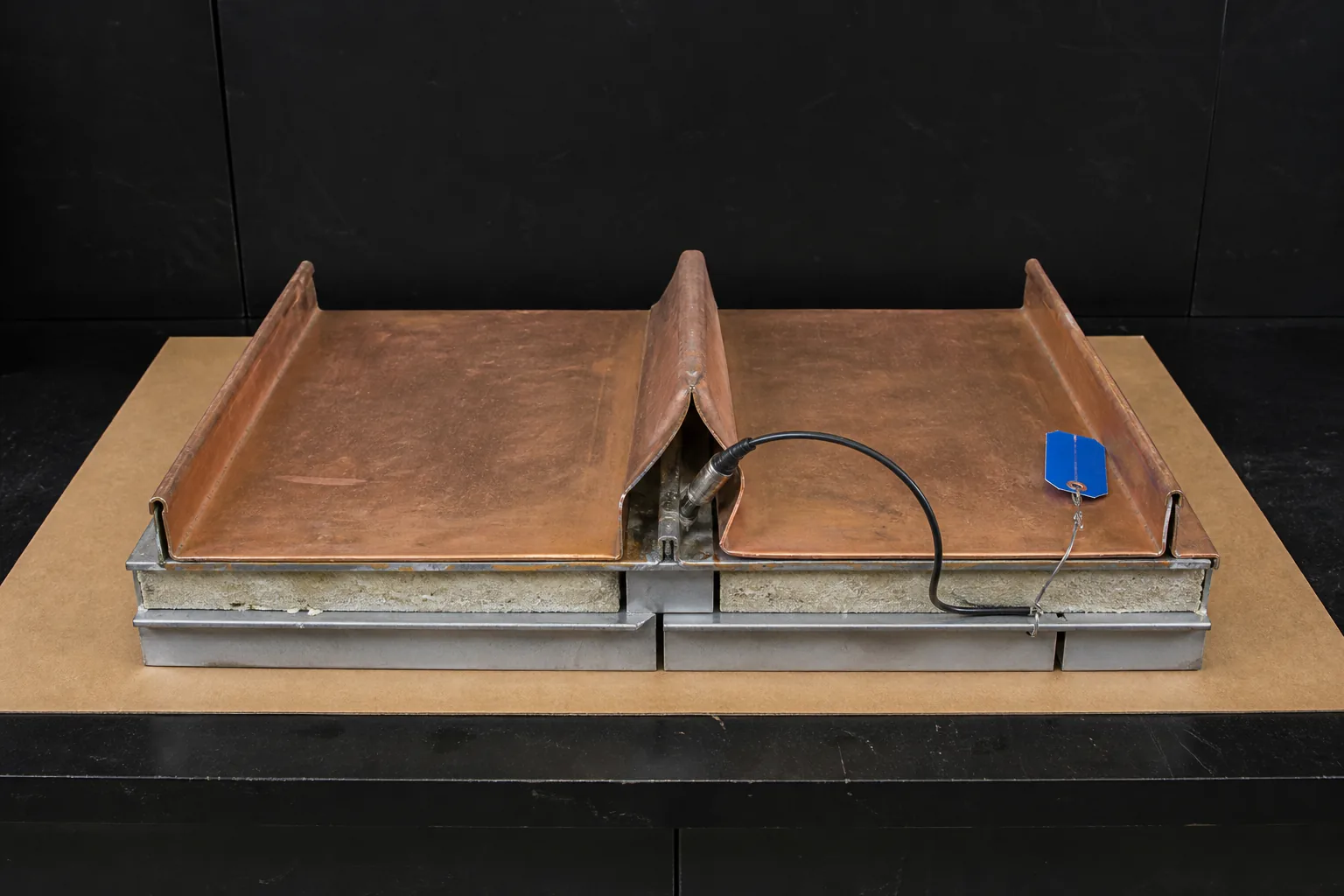
Above a respectable house there is a copper roof, of that agreeable colour which makes even bad weather appear to have been arranged by an architect.
It had seams. It had valleys. It had the calm, expensive expression of a material that expects to outlive a mortgage.
And because the roof needed holding down, somebody had given it ordinary steel screws: small, industrious, sincere, and apparently made of metal, which was thought sufficient.
Then it rained.
The roof did not spark. Nobody found a little lightning rod humming above the pantry.
The rain did not fill a jar with domestic electricity, nor did the downpipe acquire a charging socket.
A copper roof with steel screws is not a useful battery.
It is a battery in the way that a quarrel at a family dinner is a conference.
The necessary parties have arrived, the circuit has closed, and something small has begun paying for the arrangement.
What the Rain Completes
A galvanic couple asks for more than two unlike metals looking at one another across a building detail.
It needs dissimilar materials, an electronic connection between them, and an ionic path through a conducting electrolyte.
The screw touching the roofing supplies the electronic road.
A wet film or a little trapped rainwater supplies the ionic road.
The two routes together permit electrochemical work to happen.
In any galvanic cell, oxidation at one electrode releases electrons to the external circuit while reduction at the other consumes them, and ions move through the electrolyte so that charge does not accumulate and bring the affair to a stop.
That is the description of a battery.
It is equally the description of a roof, though the roof has shown the poor taste to spend its chemical potential on corrosion rather than on a torch.
The reaction names are less arbitrary than the terminal signs. Oxidation occurs at an anode and reduction at a cathode.
In a copper and steel couple, the more active steel fastener tends toward anodic oxidation while the copper supports a cathodic reaction.
Chemists are careful to distinguish reaction role from a terminal’s polarity, which is a useful precaution, because a roof does not come supplied with a positive sticker, a negative sticker, or a customer-service number.
Rain is therefore not merely water in a sentimental mood.
Its chemistry, its dissolved material, its time on the roof and its route through a joint all alter the ionic path.
A dry interface may have perfect electrical contact and no sustained galvanic current at all.
A wet crevice has the opposite manners: an inconveniently durable electrolyte, exactly where a fastening would prefer a little privacy.
The Roof Is Not the Battery; the Assembly Is
The roof is one electrode spread over a large area.
The screw is another, small enough to be overlooked by anyone selecting components under the pleasant doctrine that all metals are friends.
The battery is the whole thing while it is wet: copper, steel, metal-to-metal contact, and the conducting film of rain.
This is why the customary consolation, that copper is excellent outdoors, does not settle the case.
Corrosion resistance is not a hereditary title which one material can confer upon its neighbours.
Copper may weather in its own way while the coupled fastener system makes a quite different demand of steel.
The component that matters need not be the surface that catches the eye.
A galvanic series is an ordering of observed corrosion potentials, in a stated environment, against an appropriate reference electrode.
That small word, observed, has the wholesome effect of returning the rainwater to the story.
The series is not a universal aristocratic seating chart in which copper always holds the same rank and steel always knows its fate.
It belongs to an electrolyte and a set of conditions.
Greater separation in such a series usually means greater galvanic driving force.
Usually is not an appointment with the undertaker.
It is an early warning, and it asks the engineer to go and inspect the whole circuit.
But Is the Green Roof Not a Certificate of Good Behaviour?
No. This is the myth correction, and it is worth making before the roof becomes too handsome to question.
The popular story gives copper a green coat and calls the matter concluded.
The green is visible weathering. It is not a report on the concealed steel screw.
A copper surface can be telling one weathering story while a small electrically coupled fastener conducts quite another.
Colour is a poor inspector.
It cannot see contact continuity beneath a head, electrolyte in a lap, a crevice at a washer, or loss of section where the roof meets its fastening.
The inversion is almost comic in its unfairness.
The grand copper field, which receives all the admiration, serves as the cathodic member.
The obscure steel screw, which appears to have only a modest domestic duty, is the anodic member on which the whole electrochemical burden is concentrated.
A large roof and a small screw have not entered an equal partnership.
They have entered a constitutional monarchy.
Exposed area is among the controls that decide what current develops. So are polarization, solution resistance, and whichever cathodic reaction the environment can sustain.
The fashionable simplification is to find two entries on a galvanic chart and announce a destiny.
The standard declines to assist this drama. Separation indicates driving force; the effect remains conditional, and it need not be proportional to the severity of the corrosion.
A potential difference of two-tenths of a volt is a voltage.
It is not a material-loss rate in millimetres per year.
It has not measured the steel’s remaining thread, fixed an inspection date, or provided an alibi for a detail with trapped water.
A potential is a question asked by the chemistry.
Current is the costly answer supplied by the whole arrangement.
A Number on a Chart Cannot Condemn a Screw
A standard potential has a precise but narrow jurisdiction.
The classical relations describe how an electrode potential shifts with the concentrations in a correctly written reaction. They are admirable electrochemical consequences.
They do not say how long a roof joint stays wet, whether its rain film has low or high resistance, or whether oxygen and other reactants can keep the cathodic reaction supplied.
Nor does an open-circuit reading make a corrosion rate.
At open circuit the net external current is near zero.
Draw a current, and charge transfer, activation, concentration and ohmic effects all move the terminal voltage away from its equilibrium ideal.
Electrochemists keep applied potential, electrode potential and the ohmic drop distinct for exactly this reason.
A roof joint has no obligation to obey a clean classroom diagram merely because a voltmeter has been invited to tea.
The same discipline makes the battery arithmetic less mystical. Power is voltage multiplied by current, so a high voltage with essentially no current supplies essentially no power.
The copper roof is therefore not a modest household generator being wasted by bad installation.
It is an unwanted electrochemical circuit.
Its very uselessness is part of the nuisance.
Galvanic driving force is thermodynamic screening information. It is not a prediction of a damage rate.
The rate is tied to galvanic current, and galvanic current is constrained by polarization, solution resistance, reactant transport, exposed areas and circuit continuity.
The chart introduces the suspects.
It does not write the witness statements.
Then Somebody Must Say Which Copper
Here the word copper begins behaving like a family name at a country wedding: useful for the invitations, unreliable for the medical records.
The commercial coppers and brasses are a large and quarrelsome relation.
Their zinc, tin, lead, nickel and iron contents differ, and so do their strengths, their machinability, their conductivity and their behaviour in a wet joint.
Two alloys may share a nominal description and be listed at quite different compositions and conditions.
A property belongs to its named material, its form, its condition and its source.
It cannot be smuggled across a roof beneath the word copper.
None of this makes a roofing product unbuyable. It makes an unnamed one unassessable, which is a different and more embarrassing condition.
What the Fastener Must Know About the Roof
It must know rather more than that it is a screw.
The roofing product, the fastener alloy, the fastener coating, the electrical contact, the isolation detail, the exposed areas, the drainage, the crevices, the rain chemistry and the wet-and-dry history are parts of one system.
A coat of something, a washer of something else, or a convenient adjective such as stainless may alter that system.
None of them becomes an answer before its own continuity, defects, edges and environment have been specified.
This is not a demand that every gutter be promoted to a laboratory.
It is a refusal to let a catalogue adjective impersonate exposure evidence.
A corrosion note is worth keeping only with its medium, temperature, velocity or stagnation, oxygenation, stress, galvanic contact, time, geometry and failure mode attached.
A note about one water cannot be promoted to a verdict about all rain.
It is worth separating electrical conductivity from contact resistance as well. A published conductivity is a catalogue property of a clean alloy.
Contact resistance belongs to the interface, and the interface is where the trouble lives.
The galvanic path also needs ions in the moisture.
The roof is an assembly before it is an alloy lesson.
And So the Roof Dries
Not electric.
There would be no miniature turbines beneath the eaves, no useful reserve of charge for the lamps, no thunderous lesson delivered to whoever touched the downpipe.
The copper would look like copper in weather.
The screws would look like screws, until perhaps the detail had become rather less generous than their appearance.
The sensible roof would feel deliberate: a named roofing product rather than a general material family, a named fastener and coating rather than ordinary steel by habit, a considered joint rather than accidental electrical contact, drainage that declines to preserve an electrolyte for sentimental reasons, and inspection directed at the small member which cannot afford to be an afterthought.
This is the modest ending to an allegedly dramatic battery.
The rain need not be villainous. Copper need not be poor outdoors. Steel need not be weak.
The error is more domestic and more common.
Two competent materials are invited to share an electrolyte, and nobody asks which of them has been appointed to disappear.
AT THE BENCH
Questions, with the conditions attached.
Why do copper roofing and steel screws corrode differently when they touch?
Electrically joined dissimilar materials in a conducting electrolyte can form a galvanic couple. The more active member tends toward anodic oxidation, while the more noble member supports a cathodic reaction. In the stated copper-roof and steel-screw pair, the steel fastener is the member at risk. The result depends on the actual electrolyte, circuit continuity, exposed areas, and reactions available at the surfaces.
Does rain alone make a copper roof and steel screws into a battery?
Rain completes the ionic part of the circuit only when it provides a conducting electrolyte between electrically connected dissimilar materials. The metal contact supplies the electronic path, and the wet film supplies ion transport. Dry materials in contact do not sustain the same galvanic current. Rain chemistry, dissolved contaminants, crevices, drainage, and wetness time determine how conductive and persistent that electrolyte becomes.
Which part is the anode on a copper roof with steel screws?
Anode and cathode are defined by reaction: oxidation occurs at the anode and reduction occurs at the cathode. In the stated coupled roof detail, the more active steel fastener tends to act as the anode and copper supports the cathodic reaction. The labels describe the electrochemical roles in the particular wet environment, not permanent personality traits of two pieces of metal.
Does a larger voltage difference tell how fast the screw will disappear?
No. ASTM G82 says greater separation in an environment-specific galvanic series usually indicates greater galvanic driving force, but it does not make the effect proportional to corrosion severity. A difference of 0.20 V is a voltage difference, not a material-loss rate in mm per year. Polarization, solution resistance, exposed areas, circuit continuity, and cathodic reaction all affect the galvanic current.
Why can one small steel screw matter beside a large copper roof?
Galvanic current and damage are affected by exposed areas as well as by potential difference and electrolyte resistance. A small anodic steel fastener coupled to a much larger copper cathode can concentrate the anodic burden on a small component. The area ratio is therefore part of the connection design. A material-pair label alone cannot determine the severity or supply a corrosion rate.
Does green copper patina prove that the roof detail is fine?
No. Visible copper weathering and galvanic attack at a coupled steel fastener are different observations. Copper can weather while the steel member serves as the anodic part of an electrochemical circuit. A surface colour does not report circuit continuity, electrolyte conductivity, crevice condition, fastener section loss, or the available cathodic reaction. The hidden joint needs its own assessment.
Can a galvanic series replace a corrosion test for a roof detail?
No. A galvanic series orders observed corrosion potentials in a specified environment relative to a reference electrode. ASTM G82 treats it as an early-stage coupling assessment, not a universal rate chart. A credible roof decision also needs the actual materials and coatings, their electrical contact, local water chemistry, drainage, wet-dry history, exposed areas, crevices, and the required service evidence.
Is copper a complete material specification for a roof?
No. Copper-alloy data require a composition, product form, condition, test temperature, and value status. C26000, for example, contains 68.5 to 71.5% copper with 0.07% lead maximum, while C36000 contains 60.0 to 63.0% copper and 2.5 to 3.0% lead. Neither named alloy is automatically a roofing specification, and neither replaces a project product standard.
Why is a catalogue conductivity value not enough to judge a roof connection?
Electrical conductivity describes a material under stated conditions, while contact resistance is an interface result. At 68 °F, CDA lists C26000 at 28% IACS and C36000 at 26% IACS, but those catalogue values do not establish current through a wet roof joint. Contact condition, coatings, geometry, moisture, and the ionic path determine whether the connection carries galvanic current.
Does a stainless or coated screw automatically solve the copper-roof problem?
No automatic conclusion follows from a generic screw label. A coating, isolation washer, or different fastener alloy changes the system only when its chemistry, continuity, defects, edge exposure, electrical isolation, and service environment are defined. The corpus supplies no approved roofing-fastener combination or coating life. The selected detail needs product data, exposure evidence, and governing-code verification before release.
What has to be checked before a copper roof fastener detail is approved?
The check needs the roofing product, fastener alloy and coating, actual electrical contact, isolation detail, exposed cathode-to-anode area ratio, local water chemistry, drainage, crevices, wetness time, and the intended inspection basis. A galvanic series can screen the driving force in the relevant electrolyte, but project acceptance also needs primary product information, service evidence, and the applicable roofing requirements.
Why does the battery analogy not mean the roof can power anything useful?
A galvanic couple can have a potential difference without supplying useful terminal power. Electrical power requires both current and voltage: P = IE. At open circuit, net external current is close to 0 A, and a high voltage with essentially zero current supplies essentially zero power. The roof analogy describes an unwanted corrosion circuit, not a practical energy device or a battery rating.
Sources and further reading
- ASTM G82, Galvanic Series Guidestore.astm.org
- IUPAC, Terminology of Electrochemical Methods of Analysisiupac.org
- OpenStax, Electrode and Cell Potentialsopenstax.org
- Copper Development Association, C26000alloys.copper.org
- CDA, C46400alloys.copper.org