FIELD GUIDE / composites
The Diving Board Keeps Minutes
The board is wonderfully stiff in its intended direction and quietly vulnerable where impact, holes, and ply interfaces intrude. Its failure is an argument about damage accumulation rather than spectacular overload.
At a glance
- A carbon-fibre laminate must be identified by fibre, matrix, architecture, ply schedule, thickness, manufacture, and 0° datum rather than by the phrase carbon fibre.
- Impact, holes, edges, and poor support can create local interlaminar damage that governs residual fatigue life.
- Inspection records distinguish an ultrasonic indication from an accepted defect and state the method, calibration, location, size, and disposition.
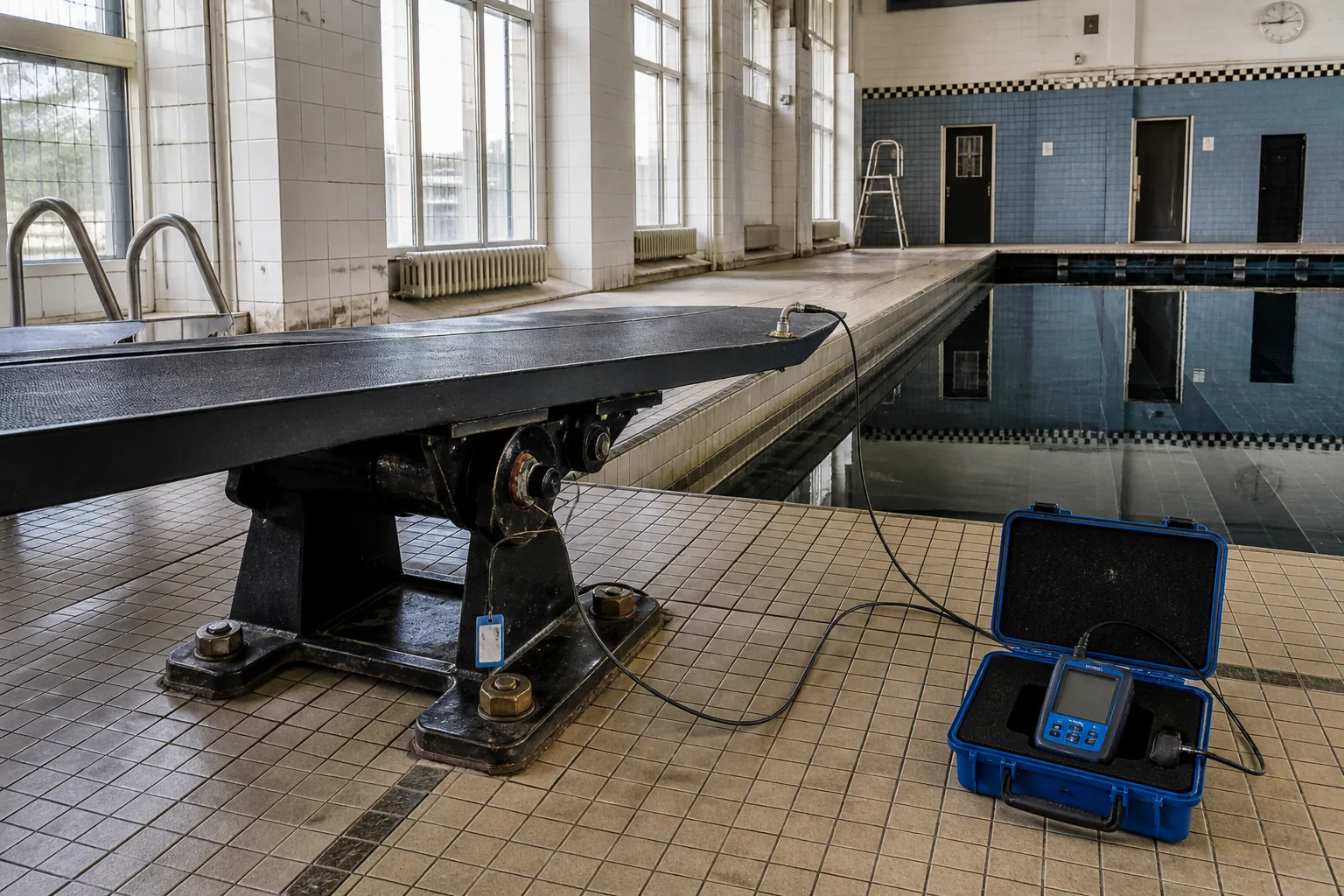
A municipal pool, weary of its old springboard and perhaps desirous of an object that looked as though it had arrived from a small private space programme, installs a board made from a handsome carbon-fibre laminate.
It would be black, naturally.
Carbon fibre has acquired the blackness of authority. It appears on racing bicycles, laboratory instruments, and the sort of wristwatch whose owner finds gravity insufficiently exclusive.
The board would be light enough to be admired, stiff enough to answer a diver’s step with a decisive little upward opinion, and expensive enough that somebody would call it an investment before anybody called it a laminate.
For some years it might behave impeccably.
It would bend. It would return.
It would take the neat departures of competent people and the less geometrical departures of their cousins.
It would meet wet feet, repeated flexure, a heel placed too near an edge, a dropped object, and occasionally a landing that turns a diving board briefly into a tribunal.
Then, quite possibly, it would begin remembering.
Not with a diary. Not in the plain steel manner of opening one honest crack for everybody to see.
A carbon-fibre board remembers in its layers.
It stores an argument at an interface, beside a drilled hole, under a struck edge, or in a region whose support has become less civil than the drawing intended.
The visible defect, if one ever arrives, is late to the conversation.
The Board Is Not One Material but a System
The first difficulty is that “carbon fibre” is not the name of a material, in the way that a loaf may be called bread without launching an inquiry into its internal diplomacy.
A structural carbon-fibre and epoxy laminate is a system: carbon reinforcement, epoxy matrix, a chosen fibre architecture, a ply order, a cure, a thickness, and a direction from which all other directions take their manners.
A compact example runs: carbon/epoxy, [45/−45/0/90]s, 2.4 mm.
That bracket is not decoration. The symmetric stack contains eight plies, and its 0° direction is tied to a drawing axis.
Without that datum, a claim about stiffness is a sentence looking for a subject.
The record needs more still: fibre product form, resin grade, cure condition, nominal and measured thickness, and manufacturing route.
Prepreg batch, fabric roll, vacuum integrity, cure recipe and post-cure are evidence rather than administrative wallpaper.
Aviation repair guidance treats roll identity, ply orientation, cure parameters, date and specimen-test results as manufacturing records, because a laminate is largely made at the moment it is cured.
The long fibres are splendidly willing in one direction.
In the local 0° direction, unidirectional reinforcement carries axial demand efficiently. The ±45° plies serve in-plane shear and torsion. The 90° plies stabilize transverse response and spread local load.
Woven carbon changes the architecture again. It eases drape and brings two directions into one ply, at the cost of interlacing and fibre undulation.
A tape laminate offers straighter fibres and more exact tailoring, then charges a higher rent for careless ply placement.
So a catalogue fibre tensile value is no more the board’s strength than the pedigree of a violin string is the strength of the violin.
The matrix has a vote.
The interfaces have votes.
The order in which the plies meet has, on bad days, a casting vote.
But Does Carbon Fibre Not Simply Beat Metal?
No. This is the popular myth, in its customary little cape.
Carbon fibre is not simply stronger than metal.
It is strong and stiff in designed fibre directions, and a finished board must also negotiate transverse response, shear, bearing at attachments, open-hole response, compression, flexure and interlaminar fracture.
ASTM D3039 is specifically an in-plane tensile method for polymer-matrix composites, and even it expects the reported material preparation, lay-up, stacking sequence, conditioning, alignment, rate, temperature, void content and reinforcement volume percentage.
A number from one coupon direction does not resign from its conditions merely because it has been printed in a handsome typeface.
The distinctions are not pedantic.
A 0° tensile result is fibre-dominated. A 90° result speaks much more of transverse fibre-and-matrix interaction. A ±45° coupon is commonly used to expose shear response.
Compression, flexure, in-plane shear, short-beam response, bearing, open-hole response and interlaminar fracture are separate result families. One does not calculate the last from the first by optimism.
Nor does a system become dependable by being called carbon/epoxy alone.
A cured thermoset epoxy cannot be reshaped by reheating, as a carbon and thermoplastic system can. It has its own moisture and temperature-conditioning requirements.
Fibre volume fraction, matrix fraction, void volume fraction and cured density must each be named by their actual basis.
Higher void volume commonly travels with poorer fatigue resistance, greater moisture susceptibility and more scatter in strength.
A calculated sixty percent fibre fraction is not an observation of sixty percent fibre and no voids.
The laminate has never agreed to this accounting trick.
The Bad Landing Goes Into a Very Small Place
The board flexes under a departure. A fair landing sends energy through a structure prepared to receive it.
An unfair landing brings a local blow: to an edge, to a region near an attachment, or to a poorly supported patch of the laminate.
A drilled hole offers the fibres an interruption.
An edge offers them an exit.
A hard local support offers the plies a disagreement about how bending ought to be shared.
These are the places where nominal stress begins saying respectable things while local stress has slipped away to make arrangements of its own.
But the composite’s characteristic answer to a blow is not the metal’s answer. Metal concentrates the insult and grows a crack from it, obligingly, in the open.
A laminate can take the same blow and disperse it sideways, between the plies, where nothing is watching.
The resin is locally disturbed. An interface separates. The upper surface may show a mark the size of a thumbprint, or a faint bloom, or nothing whatever.
What happens next depends on the fibre architecture, the resin, the cure quality, the ply stack, the hole and edge details, the impact history, moisture, temperature, and the method chosen to inspect the result.
There is no universal quantity of bad landing after which all boards agree to become unsafe.
Materials are less obliging than folklore.
A Delamination Is Worse Than It Looks
Because, at first, it may not look like anything at all.
This is the inversion, and it is the reverse of the intuition a springboard invites.
The clean board is easy to admire. The cracked board has at least had the decency to declare a problem.
The consequential state is a nearly invisible separation between plies: enough to change local stiffness, redistribute strain, and make the next several thousand flexures work on a different internal arrangement, but not enough to draw a theatrical line across the surface.
Composite fracture requires names for its manners.
Mode I interlaminar fracture is opening. Mode II is sliding. Mixed mode is their less tidy association.
The relevant toughness is an energy-release rate, reported as energy per unit area rather than as a stress.
A short-beam strength in megapascals is not a substitute for a critical strain-energy release rate, any more than a restaurant’s seating capacity is a substitute for its fire alarm.
The composite standards keep Mode I, Mode II and mixed-mode delamination methods separate for exactly that reason.
A delamination need not be large to alter what matters.
It changes the local load path. Under repeated bending it gives adjacent plies, resin-rich regions and the boundaries around a hole or an edge new work to do.
That does not license a prediction of remaining life without the particular laminate and its particular history. It does force the sober conclusion.
Impact and repeated loading do not live in separate houses.
An impact event can reduce whatever life remained before it.
And the board is not protected by static strength either.
A laminate can sit comfortably below any familiar monotonic strength and still accumulate damage at a local detail, quietly, on ordinary afternoons.
Somebody Must Try to See the Memory
Sometimes it can be seen. But inspection is not clairvoyance in a reflective vest.
An inspection record requires method, access side, scan area, calibration reference, instrument settings, operator qualification, indication location and size, depth estimate, acceptance criterion, and disposition.
Until those exist, a signal is an indication.
It is not an accepted defect, and it is not an acquittal either.
The board has not been pronounced innocent merely because somebody has used a machine near it.
Ultrasound offers three common displays, and the difference between them matters. A C-scan maps plan position across the surface. An A-scan gives amplitude against time at a single point.
A B-scan gives a cross-section.
Ultrasound can locate depth as well as outline, yet attenuation alone may not distinguish a void from a small delamination.
The instrument therefore locates a question before it identifies the answer.
That is not incompetence. It is the ordinary boundary between a signal and a disposition.
Aviation guidance cites nominal C-scan detection down to about 6.5 mm² of area, while noting that practical detectability is commonly nearer 13 mm by 13 mm.
The gap between those two figures is the whole problem in one line.
They are procedure- and structure-dependent illustrations, not a universal threshold for every diving board. Laminate construction, access, calibration, transducer frequency and acceptance criteria are all parties to the result.
A figure stripped of its companions becomes a false comfort with units.
Moisture adds another reason for records rather than romance.
Absorbed moisture in composites can affect repair performance and may produce delamination away from a repair during a later cure, and the necessary drying depends on plies and exposure.
“Wet,” at a swimming pool, is an observation of near-total uselessness.
An environmental condition needs a duration, a temperature, a relative humidity, a medium, a thermal-cycle range and a moisture uptake.
The pool has plenty of water. It does not thereby have a materials specification.
And So the Board Keeps Minutes
A sensible pool does not hold an annual ceremony in which the board is congratulated for being made of the future.
It keeps the particular board particular.
There are records for the fibre, the matrix, the architecture, the 0° datum, the thickness, the cure and the attachment details.
There are controls for holes, edges, supports and surface state.
There are rules for what happens after an impact event: which method inspects it, and what is done with an indication once one exists.
The board would not feel dangerous.
It would feel documented: identification, condition records, inspection, disposition, and a repair or replacement decided before a local separation becomes an eloquent public crack.
There would be no groan.
No smoke.
No black fibre leaping theatrically from the water.
There would be the plain fact that a laminate is not a miracle sheet.
It is a designed arrangement of directions and interfaces, very capable while its arrangement is respected and quietly exacting when it is not.
The old timber board creaked like a witness.
The carbon-fibre board keeps minutes.
AT THE BENCH
Questions, with the conditions attached.
Is carbon fibre simply stronger than metal?
Carbon fibre is not a single board-level strength value and is not simply stronger than metal in every direction or failure mode. In a carbon-fibre/epoxy tape laminate, 0° plies efficiently carry axial load, ±45° plies support in-plane shear and torsion, and 90° plies stabilize transverse response and distribute local load. Matrix, interfaces, ply sequence, holes, impacts, and support details can govern a finished board.
What information identifies a carbon-fibre diving board properly?
A traceable composite record identifies fibre type and product form, matrix type and grade, fibre architecture, cured condition, ply schedule, thickness, manufacturing route, and the drawing axis used as the 0° datum. A description such as carbon/epoxy, [45/−45/0/90]s, 2.4 mm identifies a particular laminate construction; the phrase carbon-fibre board does not establish material direction, quality, or design properties.
Why can a small bad landing matter after the board looks normal again?
A local impact can damage matrix and ply interfaces without making a visible through-thickness crack. That damage can reduce residual fatigue life because later bending cycles act on a changed local structure rather than an intact laminate. Whether damage is consequential depends on fibre architecture, resin, ply stack, support condition, impact history, environmental conditioning, and the inspection method used to find and characterize it.
What is a delamination in a carbon-fibre laminate?
A delamination is separation at an interface between laminate plies rather than a single visible crack through the whole board. Mode I delamination is opening, Mode II is sliding, and mixed mode combines them; interlaminar fracture toughness is reported as an energy-release rate, commonly in J m⁻² or kJ m⁻². A short-beam strength in MPa does not substitute for compatible delamination-fracture evidence.
Why do a laminate’s free edges and drilled holes behave differently from a metal’s?
A cut or drilled laminate exposes ply interfaces that were never intended to be a surface. Interlaminar stresses concentrate at a free edge, a ply drop, or a hole boundary, and machining can break fibres, smear resin, or start a separation that no surface inspection will show. A metal concentrates a blow and grows a crack in the open; a laminate can disperse the same blow sideways between plies.
What does a stated fibre volume fraction actually claim?
A fibre volume fraction is a calculated proportion, not an observation that the remainder is sound matrix. Fibre fraction, matrix fraction, void volume fraction, and cured density are separate fields, each reported on a named basis by a named method. A calculated sixty percent fibre fraction is not evidence of sixty percent fibre and no voids, and the difference matters most where the board is asked to survive repeated bending.
Why does a woven laminate behave differently from a tape laminate?
Woven reinforcement brings two fibre directions into a single ply and drapes more easily over curvature, at the cost of interlacing and fibre undulation. A unidirectional tape laminate offers straighter fibres and more exact tailoring, and charges a higher rent for careless ply placement. The architecture is part of the material identity, so a result from one construction is not a result for the other.
Can a cured laminate be reworked by reheating it?
A cured thermoset epoxy cannot be reshaped by reheating, as a carbon and thermoplastic system can. It carries its own moisture and temperature-conditioning requirements instead, and a repair is a new cure with its own schedule, pressure, and drying prerequisite. Calling both systems carbon fibre conceals the difference between a material that can be re-formed and one that can only be re-bonded.
Can an ultrasound scan prove that a board is undamaged?
An ultrasonic result is an indication until method, calibration, acceptance criterion, and disposition establish its meaning. A C-scan maps plan position, an A-scan gives amplitude versus time at one point, and a B-scan gives a cross-section. Ultrasound can locate depth and profile, but attenuation alone may not distinguish a void from a small delamination. Inspection records therefore state access, settings, location, size, and decision.
How small a delamination can an ultrasonic inspection find?
Detectability is procedure- and structure-dependent, not a universal material property. An FAA C-scan example cites nominal detection down to 0.01 in², about 6.5 mm², while practical detectability is commonly of the order of 0.5 by 0.5 in, about 13 by 13 mm. Transducer frequency, access, calibration, laminate construction, and acceptance criterion affect what a particular inspection can establish.
What should an inspection or replacement decision record?
An inspection or replacement decision records the impact history, the surface and edge state, the inspection method and its calibration, the location and estimated size of every indication, the acceptance criterion applied, the disposition, and the environmental conditioning the board has seen. Where a repair has been made, it records what was removed, the cure achieved, and the drying carried out beforehand. A board with no recorded impact history has not been shown to be undamaged; it has only been left unexamined.
Sources and further reading
- ASTM D3039/D3039M, Tensile Properties of Polymer Matrix Composite Materialsstore.astm.org
- ASTM D3171, Constituent Content of Composite Materialsstore.astm.org
- FAA, AC 43-214A: Repairs and Alterations to Composite and Bonded Aircraft Structurefaa.gov
- FAA, Technical Discipline: Advanced Composite Materialsfaa.gov
- NASA Contractor Report 165498ntrs.nasa.gov