FIELD GUIDE / foams
The Foam Chair Is Mostly Absence
The foam chair possesses admirable insulation and a scandalously small load path. It makes density, cell structure, and crushing behaviour do the explanatory work that a product photograph cannot.
At a glance
- Open-cell and closed-cell foams carry compression differently because connected voids, struts, cell faces, and enclosed gas create different load paths.
- A foam compression result needs strain, loading rate, temperature, direction, conditioning, cycle count, and recovery delay to be comparable.
- A skin, facer, thickness, and loading area can govern a foam chair result, so core density cannot by itself qualify the assembled object.
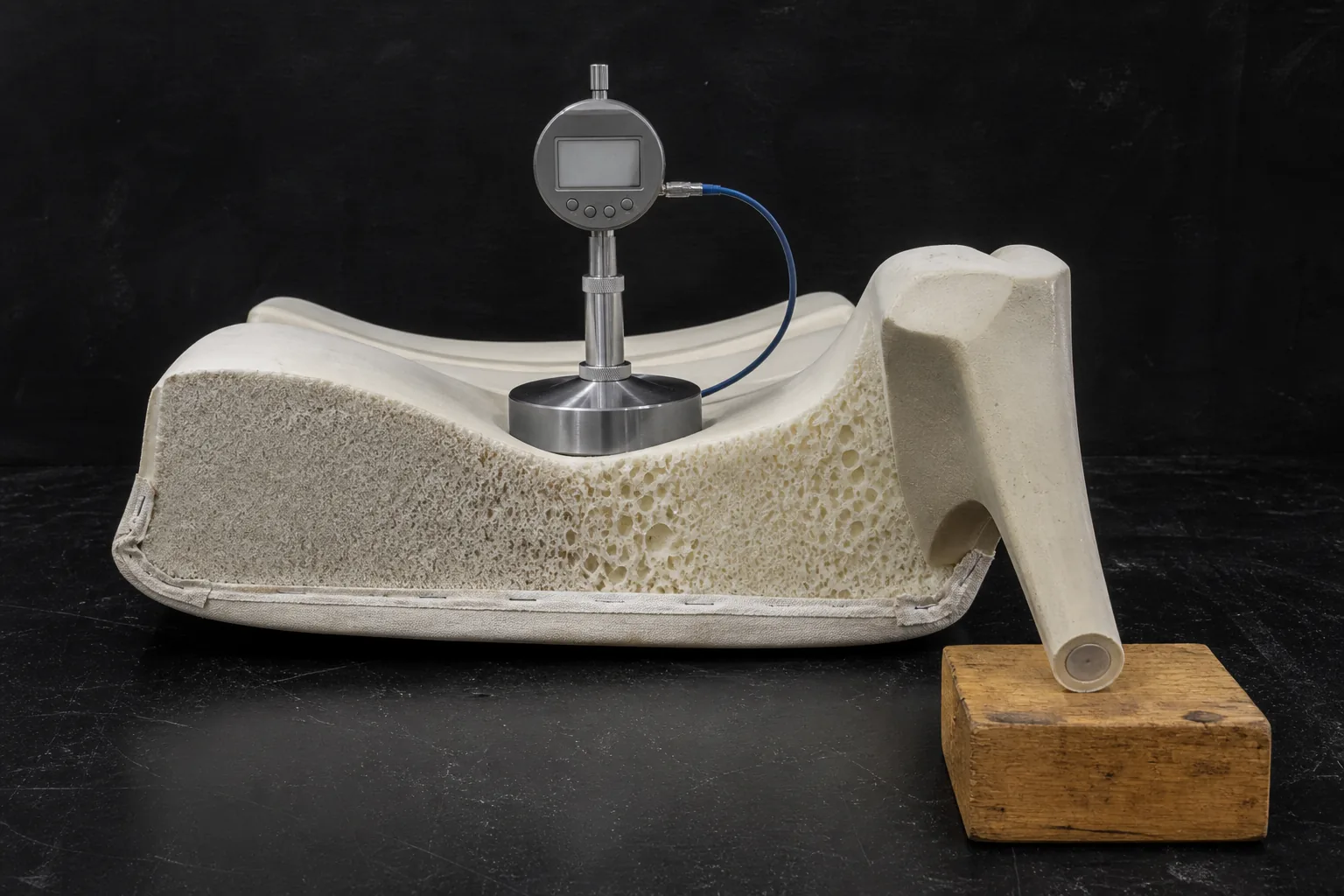
In the dining room there stands a chair made of the lightest serious foam available to a man who has confused lifting a thing with sitting upon it.
Not a cushion laid politely over a timber frame. Not an upholstered seat, which knows that softness may have a landlord.
The chair itself: legs, seat, back, and those little corners which furniture expects to survive a disagreement with the floor.
Foam.
It would be a remarkable domestic object. A child could move it with one hand. A draught might offer an opinion.
It would possess the silent, modern dignity of the very well insulated and the very nearly absent.
Then somebody would sit down.
And the chair would discover that its admirable lightness had been purchased by leaving most of itself out.
This is not a complaint against foam.
Foam is an ingenious arrangement of matter and vacancy, and vacancies are capable of useful work.
They can admit air, interrupt heat, absorb sound, float, filter, cushion, and sacrifice themselves with great professionalism.
But a formal dining chair asks an unromantic question.
It requires a load to travel from a small occupied region, through a seat and legs, to the floor, without changing the route while it goes.
That last condition is where the furniture catalogue becomes materials engineering.
The Chair Is Made of Cells
The first answer is not polyurethane, polystyrene, metal or ceramic. It is not even a trade name printed in very confident type.
It is cells.
Relative density is the foam’s density divided by the density of the dense parent solid.
It has no unit, which is entirely appropriate. It describes a proportion: the fraction of the old solid world still present after architecture has made a neighbourhood of voids.
Apparent density is the product field, and even it comes in two versions.
Apparent overall density and apparent core density are separate measurements, and the standards insist on the difference wherever a skin remains or has been removed.
This is not pedantry arriving in a white coat.
A face skin may be part of the material volume and mass. Removing it creates a different specimen.
A foam sheet and a foam-plus-facer laminate of the same thickness are not the same object under test.
Nor is a fifty-millimetre board interchangeable, in handling mass or in material use, with a hundred-millimetre board of the same density.
The number on the density label is not a tiny furniture engineer waiting to unfold.
The chair may be open-cell. In that republic the voids communicate, the skeleton is compliant, and under compression the struts bend while cells collapse.
Or it may be closed-cell, each little chamber keeping more of its gas to itself, its faces and enclosed gas lending resistance to local compression.
The difference is not decorative. A common open-cell spray foam is soft and easily compressed at an installed density around half a pound per cubic foot.
A typical closed-cell product is more than ninety percent closed and very much harder to compress.
Those are not two opinions about the same chair.
They are two architectures.
A polite polymer name cannot settle the disagreement.
But Is Insulation Foam Not a Light Structural Material?
No.
This is the myth correction, and it is necessary because a foam board looks so composed.
It is flat, pale, dry and lightweight. It leans in a builder’s merchant with the indifferent posture of something which has already mastered gravity.
Product photographs encourage the thought that it became a panel merely by being cut square.
Thermal resistance is not a disguised compressive strength.
Conductivity is a material measurement at a stated mean temperature. Resistance combines that conductivity with a thickness. Both are excellent facts, and both are answers to a question about heat.
Neither makes a seat, a leg, or a joint.
A conductivity measured on a named foam, at a named density, over a named temperature range, with a named method, has admirable provenance.
It still says nothing whatever about what happens when a concentrated furniture load arrives at the edge of a seat.
Insulation is not weak because it insulates.
A chair is not strong because it is rigid.
These are different products.
The Person Meets the Chair at a Small Place
Which is an impolite place for a low-relative-density structure to receive company.
The person does not arrive as a uniform atmospheric pressure, distributed with the fairness of a laboratory fixture.
Contact begins at a portion of the seat. Fewer cells are summoned. Their struts and faces carry the first argument.
The rest of the chair, however splendidly pale, may still be waiting for an invitation.
A proper record therefore begins with the specimen before it begins with the result: base-material family, topology, supplied form, grade, lot, skins, facers, coatings, adhesive, nominal thickness and tested dimensions.
Cell or pore size belongs in the record too, with its distribution and its window condition.
And a pore count per inch is a linear count, not a declaration of pore diameter.
Even a full building board is not a laboratory coupon merely because it happens to be made of foam.
The chair would also have direction. Cells may have a rise or a machine direction, and elongated cells do not promise equal manners when pressed from every side.
Temperature, humidity, and whether the foam is dry, wet, aged or conditioned all belong beside the identity.
The absent details are not graciously supplied by a stylish photograph.
At this point a buyer may ask for the compression strength.
The phrase is too vague to be allowed near a dining table.
Foam stress rises continuously through a compression test, and a flexible cushion may be specified at a deflection rather than at any grand terminal event.
The record needs the stress at a named strain, the apparent compressive modulus, the compressive set, the direction, the preload, the loading rate, the cycle count and the recovery delay.
A chair has no objection to standards.
It objects to being confused with the specimen.
Then the Cells Begin to Give
The comfort becomes geometry.
A cellular material’s compression curve has three acts. There is an early, near-linear region. There is a yield plateau, where cells progressively collapse at nearly constant stress.
And then there is densification, as the remaining solid gathers into an increasingly earnest crowd and the stress rises steeply.
At first this may feel delightful. A seat which yields around a body is performing one of foam’s oldest social functions.
But when local cells buckle or collapse irreversibly, the location of support changes.
The person has not merely depressed a cushion.
The person has revised the chair’s geometry while occupying it.
The inversion is exact.
Softness is pleasant right up until the load path needs it to stay in the same place.
After collapse begins, softness becomes a structural event.
This is why the whole stress-strain curve must be kept whenever energy absorption matters. The area beneath it is energy per unit volume.
Peak stress, plateau stress and densification strain are three separate gentlemen, and they should not be introduced as one.
A crushable absorber may properly consume energy by irreversible collapse. That is its profession.
A chair is expected to return from luncheon still recognizably chair-shaped.
Nor does one compression point reveal recovery. Unloading is not a ceremonial afterthought, which is why careful programmes measure it in small increments.
The base solid, the prior cycling, the load duration, the temperature and the accumulated damage together decide whether the skeleton recovers partly, substantially, or with the sad permanent courtesy of packaging.
Quiet, Dry and Hard to Burn Are Three Other Questions
Possibly the chair is all of them. None is the same question as any other.
Open-cell foam can be genuinely useful acoustically, because its porous network dissipates sound.
Absorption is reported as a fraction of incident sound power taken up by a configured surface, which means the specimen area and the mounting are part of the answer.
An absorption rating is not a transmission rating.
Neither of them is a leg capacity wearing a tie.
Moisture has its own vocabulary.
Permeance and water uptake are reported in their own units, each needing a duration and a condition, and each describing a route to a moisture decision.
None of them is a seat test.
Then fire arrives, as it does whenever people begin treating polymers as adjectives.
Foam plastics can be combustible even when a small specimen has a favourable index.
The relevant categories for foamed materials distinguish, among other things, whether burning drips ignite the cotton placed beneath the specimen.
That single distinction tells a reader exactly why the rating, the thickness, the colour or additive system, the conditioning and the test date must all travel together.
Both open- and closed-cell spray polyurethane foams are combustible, and in building use they are normally covered by a thermal barrier for that reason.
This does not make a dining chair a wall assembly.
It makes the distinction harder to avoid.
A Skin Can Disguise the Question
A skin can improve a local encounter.
It can also disguise what is being asked.
Foil, film, paper, a cementitious coating, or simply a denser skin can alter vapour behaviour, ignition, handling, apparent density and contact response, without changing the cells in the core at all.
That is precisely why the standards separate core density from overall density.
The chair with a hard shell and a light core is not simply “foam.”
It is an assembly, with a shell, a core, interfaces and edges, all of which have acquired jobs.
Likewise a layered foam is not one value repeated through a thickness. Layering may make a composite assembly; it does not abolish the distinct response of each layer.
If the chair were serious, its test would preserve the serious particulars: the actual topology, the base material, the density, the cell size, the skin, the thickness, the connections, the contact area, the rate, the temperature, the ageing, the cycling and the recovery.
A material result is evidence.
A shaped and assembled object needs evidence of its own.
And So the Chair Remains a Chair
Imagine it beside the table on an ordinary evening.
It would not announce its relative density. It would not display a plateau curve upon the backrest.
There would be no small bell to ring when the first cells lost their shape.
A visitor would simply sit.
And the chair would either pass the local load onward, recover afterwards, and keep its intended geometry, or discover that it had been designed chiefly to be easy to carry.
The sensible foam chair would feel less miraculous than the impossible one.
It would have a defined foam, a defined skin if any, a defined thickness, joints which share the burden, a stated compression test, a stated recovery rule, and a load case tested as furniture rather than admired as insulation.
Its useful properties would not have disappeared.
They would merely have been asked the questions they can answer.
That is the anticlimax.
The voids need not be banished.
They simply need a load path.
AT THE BENCH
Questions, with the conditions attached.
Why does a foam chair weigh so little?
A foam chair weighs little because much of its external volume is cellular void rather than dense solid. Relative density is the foam density divided by the density of the dense parent solid, so it describes how much material remains to carry load. Low density reduces mass, but it does not by itself establish compressive strength, bending stiffness, recovery, or furniture capacity.
Does low-density insulation foam make a good structural chair?
Low-density insulation foam does not become a structural chair material merely because it is light or has useful thermal resistance. The Department of Energy lists rigid insulation products from R-3.2 to R-6.5 per inch depending on type, while load support requires compression data at a stated strain and conditions. Insulation and furniture support are separate requirements with separate evidence.
What is the difference between open-cell and closed-cell foam under a chair seat?
Open-cell flexible foam has connected voids and a compliant skeleton; under compression its struts bend and cells collapse. Closed-cell foam retains isolated gas chambers and continuous cell faces, which can give greater resistance to local compression. Neither architecture is automatically suitable for a chair because base material, relative density, cell size, skin, thickness, and loading area still govern the result.
Why can a small contact area ruin a foam chair?
A small contact area concentrates a seated load into fewer cells, so local bending, buckling, and collapse can begin before the broader foam volume is engaged. A foam record therefore needs tested dimensions, load direction, thickness, skins or facers, and the stated strain. A core-density value alone cannot show how an assembled seat responds at a local contact point.
What does a foam compression-strength number need to say?
A usable foam compression result states stress in kPa or MPa at a named strain, together with loading direction, rate or crosshead speed, temperature, preload, cycle count, conditioning, and recovery delay. ISO 3386-1:2025 describes compression stress-strain characteristics for flexible cellular materials up to 250 kg/m³. ASTM D3574 also cautions that its results apply to the stated test conditions and may not equal in-use behaviour.
What happens after the cells in a foam chair start collapsing?
Cell collapse can produce a yield-plateau region in which deformation grows while stress changes comparatively little; later densification raises stress rapidly as the remaining solid is compacted. That sequence can be useful when a foam is intended to absorb energy, but it changes the geometry of a chair seat or leg. The full stress-strain curve, not one compression value, distinguishes plateau, peak stress, densification, and recovery.
Can a foam that absorbs sound also support furniture?
Sound absorption does not establish furniture capacity. NIOSH describes open-cell foam as a porous absorbing material and gives the sound-absorption coefficient alpha a range from 0.0 to 1.0; the value concerns incident sound power absorbed by a configured surface. Load support instead depends on the cellular load path, compression curve, thickness, contact area, and damage accumulated under use.
Does a face skin make a foam chair structurally reliable?
A face skin can change apparent overall density, surface handling, moisture behaviour, ignition response, and local contact response, but it does not automatically qualify the cellular core as a chair structure. ASTM D1622 distinguishes overall density from core density because skins can remain part of a specimen. A 25 mm foam sheet and a 25 mm foam-plus-facer laminate are different test objects.
Can a fire rating show that foam is safe for a chair?
A foam fire rating is a result from a defined test, not a general structural or fire-safety adjective. UL 94 includes HBF, HF-1, and HF-2 categories for foamed materials; its horizontal procedure uses a 38 mm flame for 60 s and considers calculated density. The rating must remain paired with thickness, colour or additive system, conditioning, and the installed assembly.
Why is the thermal rating of foam not a load rating?
Thermal resistance combines conductivity and thickness, whereas chair support depends on the material’s compression response and geometry. The Department of Energy gives typical closed-cell spray foam more than 90% closed-cell content and a nominal R-6 per inch, but those facts describe a particular insulation role. They do not state a concentrated furniture-load capacity or the recovery after repeated seating.
How should a foam chair be tested before it is treated as furniture?
A foam chair needs product-specific testing that preserves the actual foam topology, base material, density, cell size, skin or facer, thickness, joints, loading area, rate, temperature, ageing, cycling, and recovery period. The test result must be attached to a defined specimen and requirement. A material coupon can provide comparison data, but it does not by itself approve a shaped, assembled chair.
When is crushing useful instead of a failure?
Crushing is useful when a foam is deliberately selected to dissipate energy through controlled irreversible collapse, as in an energy absorber. The area under its stress-strain curve is energy per volume in J/m³, and plateau stress, peak stress, and densification strain are different quantities. A chair requires retention of shape and support, so the same collapse can be a functional failure rather than a benefit.
Sources and further reading
- ASTM D1622, apparent density of rigid cellular plasticsstore.astm.org
- ASTM D3574, flexible urethane foam testsstore.astm.org
- ISO 3386-1:2025, flexible-cellular compressioniso.org
- ISO 845:2006, apparent densityiso.org
- Frontiers, review of metal-foam mechanical propertiesfrontiersin.org