FIELD GUIDE / glass
The Glass Floor Dines Above the Roses
The glass floor is not defeated by a lack of compressive strength but by the defect it must tolerate. It distinguishes tempered, laminated, and merely thick glass before somebody tests the distinction with a heel.
At a glance
- Glass-floor assessment begins with the actual lite and interlayer construction, support, load geometry, edge condition, and a credible flaw rather than a bulk strength value.
- Laminated glass uses two or more plies and plastic interlayers to retain broken fragments, but its performance depends on ply split, interlayer, treatment, and support details.
- Inspection and failure analysis must preserve and map the origin region because a small surface feature can be lost during cutting or cleaning and a bright final region may not be the origin.
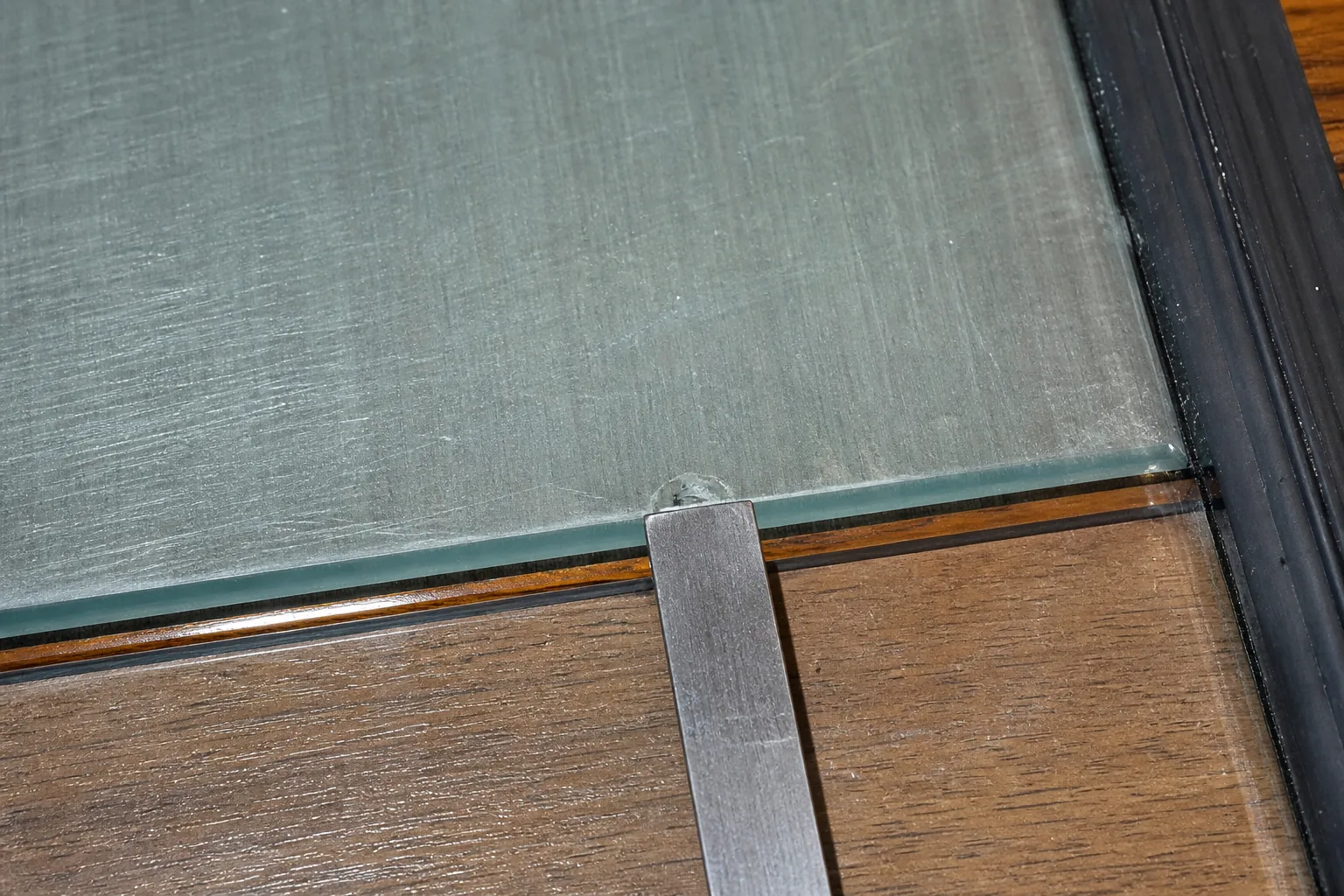
In a drawing room of a certain expensive and unteachable kind, the floor is transparent.
Not a window placed discreetly in the boards for the inspection of a wine cellar. Not a small panel above the coy machinery of a hotel lobby.
The entire room: dining table, chairs, sideboard, aunt, dog, and the man who always stands with his weight on one heel, all arranged above a garden visible through the floor.
The guests would dine above the roses.
The roses, one imagines, would acquire opinions about shoes.
At first this seems merely a question of thickness. Glass is hard, clean, impervious to moths, and magnificently indifferent to the tastes of the people who must look through it.
Make the pane thick enough, says the imagination, and the floor becomes a slab. A slab is strong. Dinner proceeds.
But glass has never agreed that thickness is an argument complete in itself.
It permits a floor only under a longer contract: composition, heat treatment, number of plies, interlayer, supports, holes, edgework, surface condition, load geometry, and the small defect somebody would prefer not to mention at the party.
The floor is not chiefly defeated by a shortage of strength.
It is defeated by the crack it must tolerate.
The Floor Is Not Made of One Material Called Glass
Before the guests are allowed their first olive, one must distinguish glass from glass.
The ordinary reference family is soda-lime-silica: silica with soda, potash, lime and magnesia in familiar proportions.
It is what windows are, and it is a named representative rather than the moral character of every sheet.
Float glass is not a secret third substance, nor is it a specification for a dinner party. Float describes how a sheet was formed.
Clear, low-iron, tinted, patterned and coated flat glasses may begin from closely related chemistry and still carry different impurity control, different surfaces, or different layers.
A floor may be perfectly transparent and almost entirely unspecified.
This is an achievement, but not a useful one.
Borosilicate arrives with a different sort of reputation.
The familiar trade names point at approximate thermal expansion coefficients rather than at purity grades, which surprises people who assume a larger number means a better glass.
Its published properties are useful facts about a stated product under stated conditions.
They are not a warrant to replace a designed floor construction with the phrase “heatproof glass,” which is what language says when it has left the building.
The floor may instead use an aluminosilicate, a family whose network and strengthening response are commonly designed together.
Its mobile alkali permits chemical strengthening. In a hot salt bath, smaller surface ions are exchanged for larger ones, and the cooled surface is left in compression.
It is a process, not an enchantment.
Depth of layer, achieved compression, thickness and damage resistance all remain matters for the particular composition and the particular schedule.
Even useful nouns must not impersonate one another. An alumino-borosilicate is not a general aluminosilicate value, and neither is a load rating for a floor.
Glass chemistry arrives with intervals and conditions attached, like a well-bred but rather demanding visitor.
A Thick Pane Is Not Yet a Strong Floor
Glass carries perfectly respectable bulk properties: a density, an elastic modulus, a hardness.
A person may admire each of these values in turn.
None of them says what a flawed, supported, edged, treated, assembled floor will do beneath a heel.
This is not pedantry in a waistcoat.
Glass flexural strength is governed by flaws and surface condition, which is why a proper record asks for specimen dimensions, loading geometry, edge finish, stress rate, humidity and preconditioning.
The number without the specimen is not a number that can be asked to support a chair.
Thickness changes more than the figure on the order. It changes bending stiffness, and it can change the constraint at a crack tip.
Near a free surface, the crack tip is free to deform. In a thicker constrained interior it is not, and the apparent critical toughness commonly falls toward its lower bound.
A six-millimetre sheet and a sixty-millimetre forging can therefore behave quite differently at a crack, with no alteration whatever to their chemistry.
Nor does a crack have a generic geometry.
A twelve-millimetre surface flaw in a thick wall is not described by the solution for a twelve-millimetre crack through the middle of a thin sheet.
A floor adds its own unhelpful particulars: the support line, the remaining ligament, the load’s position, the exposed edge, the hole or cut-out, and the restraint supplied by neighbouring panes.
The garden below is innocent in all this.
It is merely the incentive for the floor to be taken seriously.
What the Heel Asks of the Crack
It asks whether the crack-driving force has reached the applicable resistance.
That sentence is the whole social difficulty, and it is not improved by calling the glass “strong.”
Fracture occurs when the stress intensity at the crack tip reaches the critical toughness.
At fixed toughness and geometry, the critical nominal stress falls with the inverse square root of crack size.
This is the arithmetic that catches people.
Growing a crack from one millimetre to nine does not divide the tolerable stress by nine.
It divides it by three.
Which is worse than it sounds, because it means a flaw can become nine times larger while the floor gives only three times as much warning.
So the little scratch and the grand pane are not voting in the same election.
The same material under the same applied stress may be entirely acceptable with a half-millimetre flaw and entirely unacceptable with a five-millimetre one.
An abstract calculation of critical crack size exposes which variables govern. Finite width and crack shape can change the answer substantially.
It does not authorize a contractor to measure a nick with an expression of optimism.
The heel is not a distributed cloud of good intentions. Its contact location and the floor’s support arrangement together make a local load geometry.
A damage-tolerant assessment therefore begins with the component geometry, the load spectrum, the temperature envelope, the material condition, and a credible flaw that manufacture could leave behind or inspection could miss.
Its result is a residual strength, or a tolerable-flaw envelope.
Its result is never the immortal adjective safe.
Inspection belongs in the premise as well.
If examination reliably resolves a two-millimetre planar indication from one access direction but not beneath a complex attachment, those are two different assumed initial flaws.
The conclusion must name both the detectable size and the inspected volume.
Otherwise the floor is called damage tolerant in the manner that an umbrella is called weather tolerant: by leaving out the rain.
But Does Tempered Not Mean Unbreakable?
No.
This is where popular faith in safety glass puts on a hard hat and walks directly into the scenery.
Tempered glass is not invulnerable glass. It is glass in a specified residual-stress state, and it breaks differently.
Annealed glass is the baseline, cooled through a schedule that relieves manufacturing stress.
Heat-strengthened and fully tempered glass both receive deliberate surface compression through heating and differential cooling, and they are distinct product conditions with different fracture behaviour.
The standards name them separately for exactly that reason.
The distinction is not a minor bureaucratic flourish. It is the difference between having named a condition and having merely said something reassuring.
Thermally toughened glass is heated well above its softening region and then cooled differentially.
That leaves the surface in compression and causes a monolithic lite, when it does fracture, to break into many small blunt fragments.
Such fragment behaviour is a safety function.
It is not a promise that a damaged edge cannot begin a fracture.
It is certainly not a promise that a broken floor continues to do the work an intact one was doing.
Residual compression changes the terms of the brittle argument. A surface crack must first contend with compression before tensile opening can proceed.
But the surface compression and the edge condition must remain what the treatment assumed.
A small damaged edge changes the question from “how strong is the pane?” to “what flaw is present now, at what geometry, in what stress state?”
The first question decorates a brochure.
The second one keeps the guests out of the roses.
Laminated Is a Construction, Not a Grade
Laminated glass is an assembly: two or more plies bonded with one or more plastic interlayers. When a ply breaks, the fragments adhere to the interlayer.
The plies themselves may be annealed, heat-strengthened or tempered.
So laminated and tempered do not sit at opposite ends of a strength ladder. One describes a construction. The other describes the condition of a lite.
This is why a laminate is not automatically stronger in every loading mode than monolithic tempered glass.
Changing the number and thickness of plies, and the interlayer construction, changes the performance.
A usable record names the number of lites, each individual thickness, the heat-treatment condition, the interlayer chemistry and thickness, the coating surface number, curvature, edgework, holes and nominal dimensions.
Two assemblies of identical overall thickness can differ entirely in ply split and interlayer design.
They are twins only to somebody who has not met their parents.
Fragment retention is not a bulk property, and a substrate value is not an impact result for the finished laminate.
A chemically strengthened cover glass may possess a compressive surface layer without having any different elastic modulus from the untreated base composition.
Surface compression and compression depth are treatment fields. They are not substitutes for a floor calculation.
The floor is a family of materials and interfaces behaving together.
The page of numbers is only its calling card.
Then the Floor Becomes a Crack-Control Problem
At the edge, the support, the hole, the scratch, and the place where one construction meets another without admitting it.
A proper glass record describes a flattening defect, roll-wave distortion or edge damage separately from bulk chemistry, and keeps manufacture date, supplier, lot and drawing revision beside them.
These can seem fussy while the pane is sparkling above the peonies.
They become unusually dignified when a failure investigator must decide whether an origin began at a support, a damaged arris, a hole, a surface contact, or a defect present before the drawing room had curtains.
The investigator begins before cutting anything. The mating halves are matched and marked. The suspected origin is protected.
Deposits are recorded, and the first few millimetres around the origin are not casually ground away.
At the scale of millimetres, an overview can locate an origin candidate and distinguish a pre-existing crack region from a final overload zone.
At the scale of micrometres, microscopy reveals the local features.
The sequence matters.
Magnification without location is merely a small picture of a large mystery.
A surface feature two-tenths of a millimetre across can be lost in cutting or cleaning.
A bright final fracture region may be the last event rather than the place where the event began.
This is why one does not point at the dramatic half of a broken pane and announce a cause in a loud voice.
Fractography is corroborated against loading history, material records, chemistry and nondestructive examination.
Glass, in its broken state, is a witness.
It is not a magistrate.
And So the Guests May Dine
Imagine the room after the engineers have declined to be dazzled.
There is no pane advertised as simply strong.
There is a specified glass family and supplier designation; a stated construction of lites and interlayer; a stated heat-treatment condition; edgework and holes on the drawing; known supports; load cases; residual-compression fields where treatment is used; a credible flaw assumption; and an inspection premise that says what it can actually see.
Product data are kept with their test temperatures and methods. Nobody has attempted to turn a supplier’s reference value into a theorem.
The roses remain below. The heel remains a heel.
The crack, if it exists, remains a physical feature with a size and a place, rather than an atmospheric symbol of danger.
The dining room would not feel precarious.
It would feel accounted for.
And that is the quiet correction to the fantasy. Glass does not ask to be trusted because it is clear, thick, hard, tempered or expensive.
It asks to be understood in the condition in which it was actually made, and actually installed.
AT THE BENCH
Questions, with the conditions attached.
Can a glass floor be designed from the strength of the glass alone?
No. A glass-floor assessment needs the actual construction, support geometry, load case, temperature, material condition, edge condition, and a credible flaw that manufacture or inspection can leave behind. Glass flexural strength is specimen- and surface-dependent rather than a universal constant. The calculation compares crack-driving demand with applicable resistance and also checks other limit states, rather than treating an uncracked strength value as a complete safety decision.
Why can a small crack matter more than a thick pane looks as though it should allow?
At fixed toughness and geometry, the critical nominal stress for elastic fracture falls with the inverse square root of crack size. Increasing a crack from 1 mm to 9 mm cuts the idealized fracture-controlled stress to one-third, not one-ninth. Thickness can change constraint and support behaviour, but it does not make a surface or edge flaw disappear. The relevant crack shape and remaining ligament must be represented.
Is tempered glass unbreakable?
No. Fully tempered glass is a heat-treated product with deliberate surface compression, not an unbreakable material. ASTM C1048-25 identifies heat-strengthened and fully tempered flat glass as distinct product kinds. Thermal toughening heats glass above 640 °C and differentially cools it; the residual stress state makes a monolithic tempered lite break into many small, blunt fragments. Damage, edges, construction, and loading still govern whether fracture begins.
What is the difference between tempered glass and laminated glass?
Tempered glass is a monolithic lite whose heat treatment creates a residual surface-compression state and a characteristic fragment pattern. Laminated glass is an assembly of two or more glass plies bonded by one or more plastic interlayers, commonly PVB, so broken fragments adhere to the interlayer. A laminate may use annealed, heat-strengthened, or tempered plies; the two terms describe different safety functions and can apply together.
Does laminated glass automatically make a glass floor stronger?
No. Laminated glass provides fragment retention through its interlayer, but it is not automatically stronger in every loading mode than monolithic tempered glass. Its performance changes with the number of plies, individual ply thicknesses, heat-treatment condition, interlayer chemistry and thickness, support arrangement, edgework, holes, and load duration. Two nominally identical 6.4 mm laminated assemblies can differ in ply split and interlayer design.
Why are the edges of a glass floor so important?
Glass failure is commonly governed by flaws and surface condition, so edge finish is a required part of the mechanical record rather than a cosmetic detail. A damaged edge can supply the crack from which fracture starts when heel loading, bending, or support reaction drives it. Edgework, holes, nominal dimensions, residual-stress location, and edge damage must be recorded separately from the glass family or bulk chemistry.
What information has to be specified for a laminated glass floor?
A usable laminated-glass record states the number of lites, each individual thickness in mm, heat-treatment condition, interlayer chemistry and thickness in mm, coating surface number where present, curvature, edgework, holes, and nominal dimensions. It also identifies the supplier designation, generic family, and relevant lot or drawing revision. The construction record prevents a substrate property from being mistaken for a result for the complete laminate.
What does surface compression tell an engineer about strengthened glass?
Surface compression is a treatment field, not a bulk strength value. A record for chemically or thermally strengthened sheet states the compression in MPa, the depth of the compression layer in µm, the treatment route, measurement method, orientation, and location. Chemical strengthening can exchange surface sodium for larger potassium ions in a hot salt bath near 400 °C, leaving the cooled surface in compression; composition and schedule still control the result.
Can an inspector simply assume that no visible crack means the floor is safe?
No. Damage-tolerant assessment uses a flaw size that inspection could miss or manufacture could leave behind, and inspection capability is part of the assumption. An ultrasonic method that reliably resolves a 2 mm-deep planar indication in one access direction may not resolve an indication beneath a complex attachment. The assumed detectable size and the volume actually inspected must be identified before an inspection claim has a clear meaning.
Why is a fracture surface not enough to identify the cause of glass-floor failure?
A fracture surface records zones made under changing stress state, not necessarily one homogeneous event or one visible origin. Failure analysis preserves and maps the mating pieces before cutting, beginning with an overview near the 10 mm scale and then examining selected regions near the 10 µm scale. A 0.2 mm surface feature can be destroyed during cutting or cleaning, and a bright final overload region can be the last event rather than the origin.
What glass property values can be transferred directly from a supplier sheet to a floor design?
Supplier values require their stated conditions and cannot be transferred indiscriminately. A published density, elastic modulus, or thermal expansion coefficient belongs to a named product at a named temperature, and none of those fields establishes what a flawed, supported, edged, treated, assembled floor will do beneath a heel. A design record retains unit, temperature, method, sample condition, source version, and whether each value is typical, specified, calculated, or measured.
Sources and further reading
- ASTM C1048-25store.astm.org
- Pilkington Optilampilkington.com
- NIST, Fracture Toughness Data for Brittle Materialsnvlpubs.nist.gov
- SCHOTT, Main Properties of SCHOTT Glassmedia.schott.com
- Corning Gorilla Glass FAQcorning.com