FIELD GUIDE / carbon materials
The Graphite Kettle Grows Lighter
The graphite kettle survives temperatures that embarrass ordinary cookware and then discovers that a hot atmosphere is also a reagent. It corrects the habit of treating a high melting point as a complete thermal biography.
At a glance
- Graphite can be consumed by oxidation without first reaching a melting limit.
- Graphite grade, density, porosity, geometry, exposed area, impurities, flow, and thermal cycling belong in an oxidation-service assessment.
- A coating or protective atmosphere is a system that must remain effective at defects, edges, and during thermal cycling.
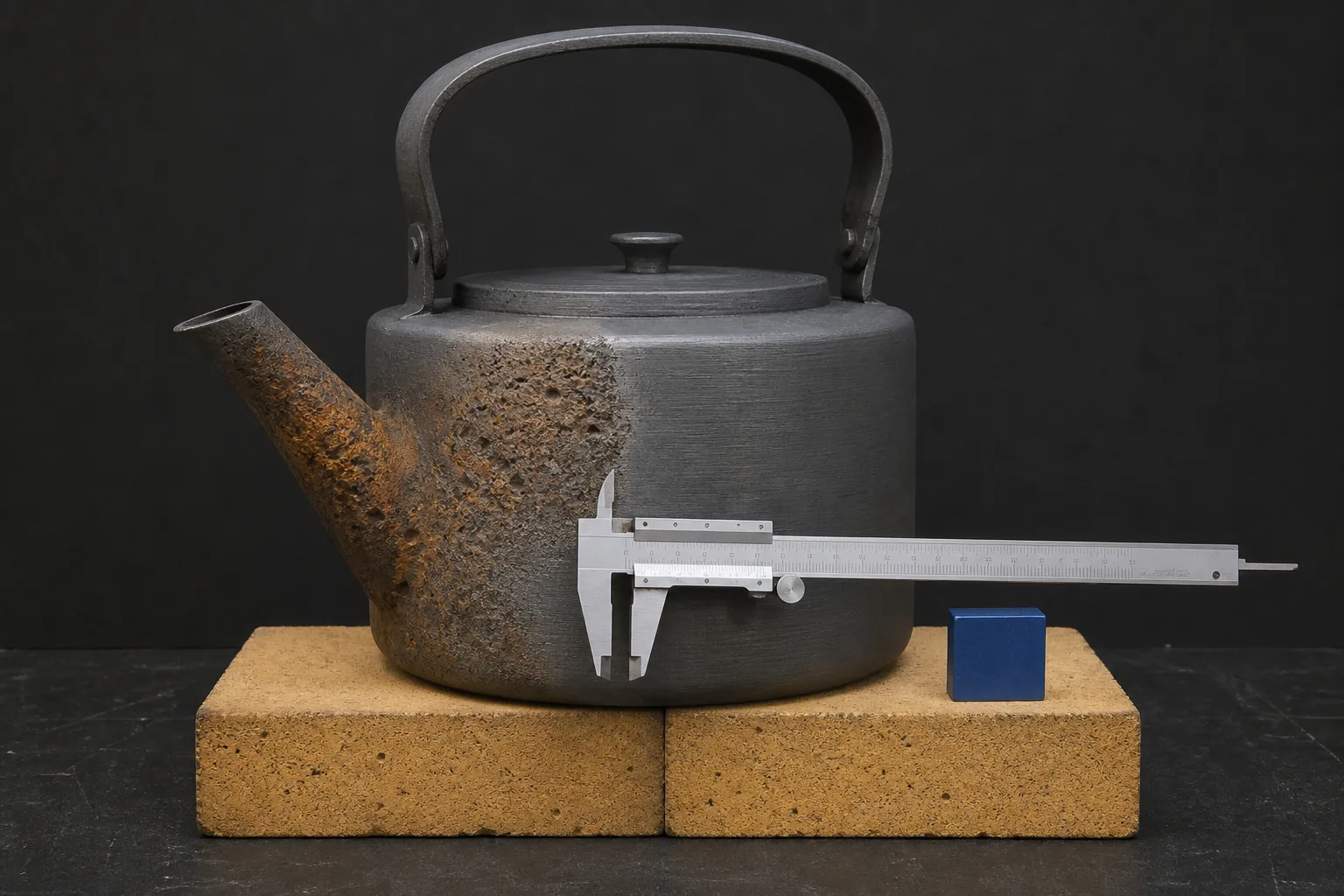
Upon the hob there stands a kettle made of graphite.
Not painted graphite. Not a steel kettle wearing a black coat and a slightly superior expression.
A kettle machined from the dark, sober carbon material itself: body, lid, spout, handle fittings, and all the small domestic arrangements by which water is persuaded to become tea.
At first it would seem an excellent appointment.
Graphite has known furnaces that would make an ordinary saucepan reconsider its career.
Synthetic graphite is graphitized above 2,100 °C, which is to say that it survived its own manufacture at a temperature no kitchen will ever approach.
A substance with that history may reasonably look across a gas flame with the composed disdain of a cathedral looking at a match.
But a kettle is not put in a furnace to enjoy the temperature.
It is put among air, water, steam, condensed droplets, cooking residues, and the daily small impatiences of a household.
The hot atmosphere is not empty space with a weather report.
It is a participant.
And graphite, for all its dignity, has a chemistry.
The Kettle Looks Very Certain of Itself
There is a real reason graphite inspires this confidence. It is not a fashionable black finish pretending to be a material.
But graphite is distinguished by structure, form, origin and processing, and those distinctions matter.
Natural flake, amorphous graphite, and vein or lump graphite are three separate commodity types. The word amorphous here means very small crystals, not an absence of graphite structure.
Synthetic graphite is made by high-temperature treatment, or by deposition from a hydrocarbon precursor. It inherits a manufactured particle morphology and an impurity history rather than a geological one.
That is already enough to spoil the sentence “it is graphite.”
The sentence is a coat hook.
It will not bear an engineering claim.
Synthetic products run from powders measured in micrometres to pieces measured in centimetres.
A powder, a flake, a dense machined block and a kettle wall share a broad material name as cousins share a surname.
They do not present the same exterior, the same edges, the same internal paths, or the same opportunity for a gas to arrive where it is not wanted.
The kettle is not a graphite crystal in a textbook.
It is an article with a wall thickness, a lip, a spout, a lid seat, machined surfaces, and whatever porosity, binder, ash, metal contamination, coating or post-treatment its particular grade brought to the domestic table.
A graphite property needs its specimen type, its test temperature, its measurement direction, and its density or porosity standing beside it.
A graphitic solid can behave very differently parallel and perpendicular to its layers.
There is no such thing as “carbon conductivity” to be poured over every black object like gravy.
The kettle proposes something even less forgiving: that one broad identity and one theatrical property should settle its whole biography.
It is a handsome proposal.
Materials decline it.
But Does a High Temperature Not Mean a Safe Kettle?
No. This is the popular myth, and it deserves a clean dismissal before it begins wearing an apron.
Graphite’s ability to live with high temperature is not a promise that it is fireproof, chemically indifferent, or indefinitely serviceable in every hot place.
A melting temperature answers one question: whether a solid loses its solid form by melting, under stated conditions.
Oxidation asks another: whether the surrounding environment can react with the material and change its composition.
A kettle may answer the first question magnificently and be consumed by the second.
The distinction is not verbal housekeeping.
It is the whole case.
Consider how the point is usually made with metals.
A protective film reduces the access of oxygen, water or ions to the metal beneath, which is why aluminium behaves as it does in air.
But aluminium’s corrosion resistance is not evidence that aluminium does not react with oxygen. Quite the reverse; it reacts eagerly, and the product stays put.
The useful mechanism is the film: its stability, its repairability, and the chemistry that may disturb it.
Bulk material and surface system are not the same citizen.
Graphite is not aluminium wearing black gloves. The comparison does not grant graphite an oxide-film biography.
It supplies the discipline. Do not mistake a material’s high-temperature reputation for a description of its actual surface reaction.
If the atmosphere has a route to the carbon, then the atmosphere belongs in the service claim. So do exposure duration, temperature history, flow, deposits and thermal cycling.
The kettle is not being heated in air, as though air were stage scenery.
It is being heated with it.
One might say that graphite is refractory and therefore safe.
One might also say that a ship is buoyant and therefore dry.
The sentence contains a property. The conclusion has wandered off with it.
The Air Does What the Heat Does Not
Heat is the condition that makes the encounter matter.
Air and steam are the partners that make it chemical.
There is a rule simple enough to be carved over the stove: oxidation never occurs alone. If one species loses electrons, another consumes exactly as many.
Heat does not supply an oxidizing partner merely by being hot.
The material, the gas, the surface and the transport path make the event between them.
So “the heat ate the kettle” is nonsense in a waistcoat.
Steam, oxygen-bearing gas, impurities and deposits are not decorative clauses appended after a service temperature. They change the thing being discussed.
Nor does a table of electrode potentials issue personality certificates. Solvent, acidity, complexation, passivating films, mass transport and competing couples all change what is actually accessible.
A graphite kettle cannot obtain a rate, a safe temperature, or an operating life by borrowing a number from a general table.
It needs the actual atmosphere and the actual grade.
This is less romantic than declaring graphite immortal.
It is much kinder to the person who owns the kettle.
The Oxidation Gets In Wherever There Is Room
The smooth black belly of the kettle is only part of the surface.
There is the machined rim and spout, the lid interface, any threaded fitting, any scratch from a sink, any edge where a coating ends, and the internal structure described by density and porosity.
A small vessel enjoys a vast proportion of edges compared with a large industrial block.
A porous vessel provides more than an exterior.
It provides a geography.
This is why surface area cannot be treated as a polite synonym for size.
Engineered carbons are specified with a measured surface area per gram, a pore volume, an aggregate morphology and a surface chemistry, because two carbons of the same family can differ in area by a factor of several.
A carbon kettle requires the same honesty at a larger scale.
What grade is it? Natural or synthetic? What lot? What binder or impregnation? What ash and metal contamination? What density or open porosity? What surface finish?
What area is actually exposed, and what gas reaches the interior?
The answers are not procurement clutter.
They decide whether the kettle is a dense object with a managed surface, a material with accessible internal paths, or an elegant black sponge placed over a flame.
Purity is a witness, not a verdict. A very high purity figure is a valuable material distinction, and it does not establish one oxidation history for all high-purity graphites.
Still less does it establish one for a kettle whose machining, geometry and atmosphere have never been named.
A purity figure cannot hold the handle for the rest of the specification.
It Would Be Safer in the Furnace Than at Home
That is the inversion, and it is worth pausing on, because it reverses the reason the kettle was bought.
The domestic imagination brings graphite home because it looks indifferent to heat.
Yet the industrial hot condition graphite is famous for surviving usually includes a specified atmosphere, controlled gas access, known geometry, process records, and a reason to inspect the material.
The home offers air, steam, spill residues, uncertain flow, repeated heating and cooling, and the settled conviction that a kettle should ask for no biography beyond “wipe clean.”
The extraordinary material is brought down not by a fiercer temperature.
It is brought down by a more ordinary atmosphere.
A decomposition temperature does not state a whole decomposition story either.
A mass loss at some stated temperature may be dehydration, ligand loss, oxidation or fragmentation, depending on the atmosphere and on what gas came off.
A number without its products and conditions is an invitation to error.
There is no responsible one-line service temperature for “graphite in air” without a stated grade, a density or porosity, an exposed geometry, a gas composition, the oxygen and steam partial pressures, the flow, the exposure time, the deposits, the coating condition and the thermal cycles.
A kettle does not care that those variables were omitted for the convenience of a sales brochure.
It continues to experience them.
A reference value is a pinned butterfly.
A working kettle is weather.
A Coating Is Another Object With an Atmosphere Problem
Perhaps a coating saves it. But coating is not a magic word.
A protective system is useful only insofar as it keeps reacting species away from the graphite in the places that actually matter.
Its centre may behave beautifully while an edge, a joint, a pore mouth, a fastener, a scratch or a thermal-cycle crack admits the gas.
The very conditions in which a graphite kettle becomes interesting are the conditions in which adhesion, compatibility, defects and differential movement cease to be minor aesthetic criticisms.
A protective film may be thickened deliberately, abraded away, dissolved by a particular chemistry, or undermined at a crevice or a galvanic contact.
Protective design therefore requires surface preparation, compatible cleaning chemistry, coating selection, storage atmosphere and test evidence.
The mechanism is not that the coating exists.
The mechanism is that access is reduced, under defined conditions.
For graphite, the record must distinguish bare material from coated assembly.
It should identify the coating, its preparation, its thickness and adhesion evidence, the edge treatment, the defect tolerance, the intended atmosphere and the thermal-cycle performance.
It should also name the test object.
A long fibre, a small coupon and a powder compact can each yield an honest strength number while answering entirely different questions.
So can a small coated coupon and a kettle with a spout.
A coupon is evidence.
It is not a spout.
And So the Kettle Grows Lighter
Chemistry will not tell the kettle when to retire.
Thermodynamics can state a direction under stated conditions. It cannot supply the clock.
Chemists are careful not to use stable as a synonym for unreactive.
Persistence may depend on bond rearrangement, on nucleation, on transport, or simply on the arrival of a triggering partner.
Time-to-change belongs to kinetic evidence, and to nothing else.
So the kettle receives no retirement date from its general name, from its colour, or from a grand fact about graphitization at two thousand degrees.
It receives an inspection basis only from relevant evidence: measured mass loss or dimensional change for the nominated grade, the relevant atmosphere and flow, a representative geometry and finish, the thermal-cycle history, and a stated criterion for what loss is unacceptable.
There is an administrative dignity in such a record.
It preserves the source, the method, the units, the conditions, the uncertainty, the lot and the date, and whether a property was measured, calculated or supplied as typical.
It does not average unlike reports into a new and convenient fiction.
If one laboratory reports fifteen square metres per gram and another reports thirty, under different preparation, the answer is to keep both conditions and investigate the discrepancy.
The answer is not to invent twenty-two and a half as a conciliatory fact.
So the graphite kettle would not fail with a cinematic slump into a shining puddle. That was never its style.
It would simply grow a little lighter each year, at a rate nobody had thought to measure, until its wall had become a question rather than a wall.
And the useful lesson would sit quietly on the hob.
A high melting point is not a complete thermal biography.
The atmosphere is part of the appliance.
AT THE BENCH
Questions, with the conditions attached.
Does graphite melt before it fails in a hot kettle?
A graphite kettle can lose mass by oxidation in an oxidizing atmosphere before a melting-temperature comparison becomes the governing service question. Hot air or steam can supply reacting species at the carbon surface, so the relevant limit includes atmosphere, temperature, gas access, exposure time, and graphite condition. A high-temperature capability stated without those conditions is not a complete service claim.
Is graphite fireproof because it has a very high temperature capability?
Graphite is not fireproof in the sense of being chemically immune to a hot oxidizing atmosphere. Its useful high-temperature behaviour depends on the material form and the surrounding gas. Oxidation changes the carbon material itself and can remove mass from an exposed surface. The absence of melting is therefore not evidence that a graphite article is unchanged or safe for continued service.
Why does the air around a graphite kettle matter so much?
Air matters because it is not merely a temperature carrier; it is a chemical environment that can reach and react at exposed carbon surfaces. Steam also belongs in the atmosphere definition rather than being treated as an incidental domestic detail. A valid graphite service assessment records the gas composition, temperature, flow, exposure time, and any deposits or contaminants that alter surface access or reaction pathways.
Does a purer graphite grade automatically last longer in hot air?
A purity label alone does not establish oxidation life in hot air. A usable graphite record also identifies natural or synthetic origin, grade, lot, post-treatment, ash or metallic contamination, binder, coating, density or porosity, and the specimen geometry. USGS describes high-temperature synthetic graphite as more than 99.9% graphite, while also noting that porosity and conductivity can differ from natural flake; neither fact supplies a universal lifetime.
Why do pores and surface area matter to a graphite kettle?
Pores and exposed surface determine how much reactive gas can reach carbon and how much material is available at the interface. A graphite service record therefore needs density or porosity, surface condition, dimensions, and the direction and rate of gas flow. Surface area is not a universal carbon number: NIST reference carbon blacks are listed at 10.5 m² g⁻¹ and 69 m² g⁻¹ by nitrogen adsorption under stated preparation conditions.
Is natural graphite the same as synthetic graphite for a hot vessel?
Natural and synthetic graphite are not substitutes merely because both are graphitic carbon. USGS identifies flake, amorphous, and vein or lump-and-chip as natural commodity types, while synthetic graphite is made by high-temperature treatment or deposition from hydrocarbon-derived precursor. The route affects particle morphology and impurity history. A kettle specification must identify the actual grade and processing history before applying any property or oxidation result.
What does graphite manufacturing temperature prove about kettle service?
USGS reports graphitization above 2,100 °C for synthetic graphite. That processing fact shows that graphite manufacture and high-temperature structure are not ordinary kitchen matters, but it does not certify a finished kettle for use in hot air or steam. Manufacturing temperature, service temperature, atmosphere, surface condition, and exposure duration answer different questions and must remain separate in a material claim.
Can a protective coating make graphite safe in a hot oxidizing atmosphere?
A protective coating can only support graphite service if it reduces access of reacting gas to the carbon and remains effective over the actual surface, edges, defects, joints, and thermal cycles. Protective films are not proof of bulk inertness. The coating material, preparation, thickness, adhesion, defect tolerance, exposure atmosphere, and cycling history require their own evidence before a service-life claim is made.
Does thermodynamics say how fast a graphite kettle oxidizes?
Thermodynamic direction does not state oxidation rate or service life. IUPAC distinguishes stability from a claim that a substance is unreactive, and the chemical-properties corpus treats time-to-change as kinetic evidence. A graphite kettle may be thermodynamically capable of chemical conversion under stated conditions while the observed rate still depends on temperature, gas transport, porosity, surface condition, impurities, and the detailed exposure history.
What information belongs on a real graphite kettle material record?
A real graphite kettle record identifies the structural family, form, origin, transformation route, supplier grade, lot, post-treatment, ash or metal contamination, sizing, binder, coating, and specimen geometry. It also records density or porosity, surface condition, test temperature, atmosphere, gas flow, measurement direction where relevant, method version, date, and whether each value is measured, calculated, or supplier-typical.
Why is a small graphite part not automatically like a large graphite part?
Size changes the surface-to-volume relationship, edge proportion, heating history, and the practical path by which gas reaches the material. USGS describes synthetic graphite products from 2 µm powders to 2 cm pieces, which are plainly not interchangeable test objects. A small coupon, a machined kettle wall, and a porous block require their own geometry, surface, and exposure records before an oxidation result can be transferred.
What should happen when graphite oxidation data are missing?
When graphite oxidation data are missing, the material should not receive an invented temperature limit or lifetime. The missing evidence should be named: grade, density, porosity, atmosphere, oxygen and steam content, flow, temperature history, surface finish, coating condition, and cycling. A measured programme using the intended article or representative specimens can then establish a conditional result rather than converting a generic graphite label into a guarantee.
Sources and further reading
- USGS, Graphite, Critical Mineral Resourcespubs.usgs.gov
- NIST, porosity and surface-area reference materialsnvlpubs.nist.gov
- IUPAC, stablegoldbook.iupac.org