FIELD GUIDE / elastomers
The Joint That Stopped Pushing Back
The rubber expansion joint appears elastic and indestructible until time, heat, and compression remove the force it was meant to keep. It is a failure of relaxation, not theatrical rupture.
At a glance
- Elastic deflection is recoverable movement, whereas creep and compression set are time-dependent losses of the installed condition.
- Compression stress relaxation is related to sealing-force loss but is not the same measurement as compression set.
- Compression set must be reported with method, temperature, duration, medium, deflection or force, and recovery condition.
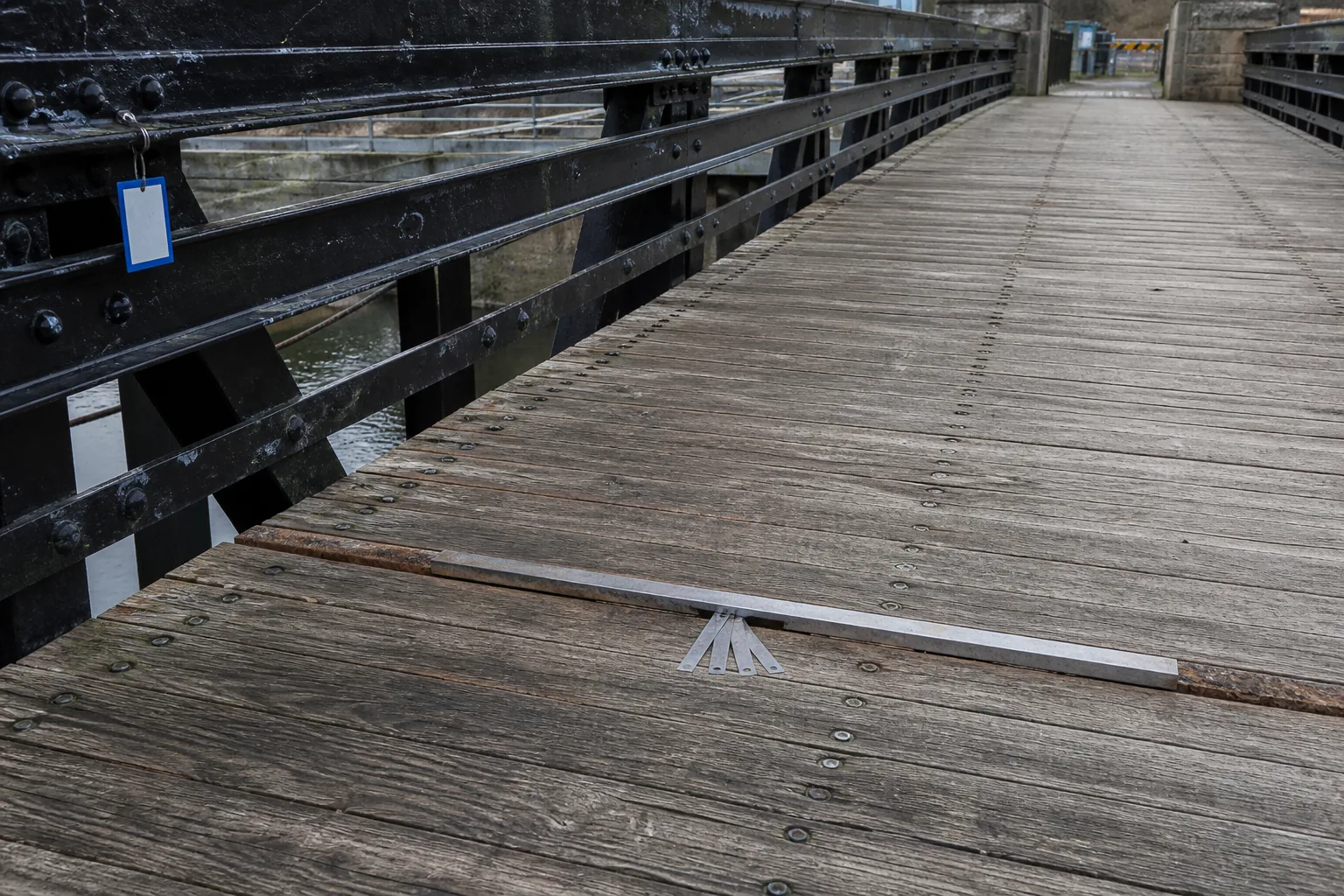
At the join between two sensible pieces of bridge there lies a great strip of rubber.
Not a bicycle tyre carelessly left beneath the parapet. Not the small black ring which vanishes beneath a plumber’s thumb.
A thick elastomer joint: pressed between its metal neighbours, expected to keep out water and whatever the water carries, expected to accommodate the bridge’s small daily changes of opinion, and expected to go on pressing for years after everyone has forgotten who first tightened the bolts.
At the opening ceremony it would look magnificent.
It would yield when pressed. It would recover when released.
It would possess that slightly miraculous quality by which rubber persuades the human mind that it has escaped the obligations of old age.
But the joint would not be immortal.
It would be asked to remain compressed while heat comes and goes, while the deck shifts, while air, water, ozone and perhaps some unsuitable fluid make their several introductions.
And one morning the danger would not be that it had snapped in a grand black ribbon across the roadway.
The danger would be that it had become quiet.
It would still look like a joint.
It would merely no longer press where the bridge had asked it to press.
The Bridge Is Asking for Force, Not Presence
The joint is installed compressed, so that its surfaces bear against their neighbours and exclude any path for water or debris.
It must also tolerate movement without converting every seasonal change or passing vibration into an argument between deck and abutment.
That is a more particular duty than “be flexible.”
Flexibility is a social accomplishment.
A seal needs retained contact.
The engineering temptation is to admire the first movement. A fresh elastomer is compressed, it deflects, and the observer sees it spring back.
The observer writes elastic in the margin and goes home pleased.
Yet an elastic shape change and a time-dependent loss of the installed condition are two different inhabitants of the same neighbourhood.
A member may become entirely unfit by accumulated deformation long before it has any intention of rupturing.
The bridge joint has that moral difficulty in its purest form.
It can retain its body and lose its office.
Rubber is not steel wearing softer trousers, of course. Its response is viscoelastic, its formulation matters fiercely, and any appropriate test must represent compression, recovery, temperature, medium and movement.
But the distinction survives the change of material.
Immediate deflection says what happens now.
Set and relaxation ask what is left after time has been allowed into the room.
But Does Rubber Not Spring Back Forever?
No.
This is the myth correction, because rubber has been handed a peculiar public reputation.
A steel spring, everyone agrees, may tire. A wooden board may sag. A gasket may be replaced without anyone calling it a betrayal of nature.
But rubber is imagined as a cheerful substance which can be squeezed until the end of history and will rise again each morning exactly as it was.
It will not.
Compression set measures the permanent loss of thickness, or the recovery, after a prescribed compressive exposure.
It is a recovery field. It is not a universal medal for rubberness.
A quarter of the original deflection lost after a day at one temperature in air cannot be made equivalent to the same figure after three days in fuel, merely by placing two percentages in adjacent columns.
Temperature, duration, medium, original thickness, imposed deflection or force, recovery time and specimen condition are each part of the sentence.
Remove them and the percentage becomes a small orphaned numeral, looking for a duty it can no longer identify.
ASTM D395 governs compression-set testing in air or in liquid media.
It contains a constant-force method and two constant-deflection methods, and where a detailed specification says nothing further, the constant-deflection route is the default.
Yet that default method is not suitable above a stated hardness.
So even before the joint is installed, the apparently simple question, what is its compression set, has already acquired a specimen, a method, a hardness boundary and an atmosphere.
This is not bureaucracy in a laboratory coat.
A thin moulded plaque, a thick compression button and a finished ring are three different evidence objects.
Finished components are often evaluated on one hardness scale while standard samples report another, and values taken on the finished part can differ from the comparable standard-sample values.
A joint called “seventy rubber” has therefore said almost nothing.
It has not named its scale, its compound, its cure, its shape, or the force which ought to remain after it has been made to wait.
Compression Set Is Not Loss of Sealing Force
They are cousins who should not be permitted to share a passport.
Compression set concerns the shape recovered after a prescribed compressive exposure.
Compression stress relaxation concerns the loss of force while an imposed strain remains.
Both matter to a sealed bridge joint. Both can make it less able to perform its domestic duty of keeping the weather outside.
But a set result does not become a relaxation result by optimism.
The distinction matters especially because this failure has none of the manners of a broken girder.
There may be no spectacular tear.
The elastomer may retain a respectable silhouette. Its hardness may sit within a familiar range. Its parent polymer may have an enviable reputation.
Meanwhile the force which once pushed it faithfully against the sealing faces has quietly diminished.
That is the inversion.
The joint is least dramatic at exactly the moment the failure becomes most consequential.
A torn strip invites a telephone call.
A relaxed strip merely makes room.
The compression-set standard is also mainly applicable to static compressive stress; repeated deformation is better represented by other tests altogether.
A low set number is valuable only at the installation squeeze, the temperature, the fluid, the ageing duration and the service duty which actually govern the joint.
The bridge does not accept a laboratory result as currency merely because it was printed in a good typeface.
It asks whether the result has ever met the real movement.
Somebody Must Say Which Rubber
Not “rubber.” That gentleman does not exist.
An elastomer family is the beginning of an identity, not its conclusion.
The international symbols for base polymers are an authority for the shorthand. They are not a prophecy of any compound’s properties.
A proper record adds the family name, the manufacturer grade or internal compound code, the cured state, the cure system where known, the filler or colour where these are material, the lot, the cure condition and the specimen geometry.
So a family name with a hardness after it is not a component specification.
It announces a base family and a nominal indentation measure.
It has not identified the exact compound, the fluid class, the cure, the ozone exposure, the test temperature, or the contact force remaining after ageing.
Hardness is resistance to indentation.
It is not strength, and it is certainly not a direct measure of sealing force.
A very hard rubber can be extremely definite about where it is, and quite unhelpful about staying there.
Family chemistry nevertheless changes the questions that must be asked.
The ethylene-propylene family has a largely saturated backbone, with just enough unsaturation reserved to make curing practical, and it is commonly chosen for water, glycol and outdoor duty.
The same family is placed squarely in the “not resistant” column for mineral oils.
That makes it a plausible citizen of one wet environment and a poor substitute in another.
A material name is not a diplomatic passport.
The nitriles offer practical oil and fuel resistance, and their hydrogenated relations preserve that behaviour with fewer vulnerable double bonds.
The famous high-temperature fluoroelastomers do not escape conditions either.
Their published service guidance arrives as a temperature with a duration attached: a long service life at one temperature, and a matter of hours at another some eighty degrees higher.
Those figures do not crown every such compound king of hot service.
They demonstrate the actual rule.
Temperature arrives with time, atmosphere, product and deformation already attached to it.
The Weather Tests the Compound, Not the Reputation
The bridge offers air and rain, but outdoor is not one liquid, one gas or one history.
Fluids must be named completely: the concentration, the temperature, the pressure, the duration, and whether the exposure is static or dynamic.
Those belong beside the volume change, the mass change, the hardness change, the tensile retention, the cracking, the blistering and the extraction.
Compatibility tables distinguish named materials against named media, and they retain different static and dynamic ratings for the same pair.
“Resistant to oil” is not an engineering sentence.
It is a family rumour.
Ozone is similarly particular. The ozone-cracking test exposes vulcanized rubber at a specified ozone level while a surface tensile strain is present.
Its record needs the ozone concentration, the strain, whether the exposure was static or dynamic, the temperature, the duration and the crack-rating method.
And the method expressly excludes natural and artificial sunlight.
An ozone result is therefore not an outdoor-weathering certificate, any more than an umbrella is a roof.
This is why a bridge joint must be specified with a kind of polite suspicion.
The compound may meet cyclic opening and compression, standing water, de-icing chemistry named in no generic chart, ultraviolet exposure unrepresented by any ozone test, or a local contamination supplied by adjacent work.
None of those values arrives with the material.
They have to be named before a result is allowed to mean anything at all.
A Percentage Becomes a Maintenance Problem
When it is connected to an installed geometry and a service limit.
Mechanical properties do not become design decisions while sitting alone on a certificate.
The record must say what motion, contact, force, leakage path, temperature history and inspection question the number is meant to govern.
A room-temperature result is a fine result in its own country.
It has no visa for the others.
The seal requires its own qualified evidence: the compound and cure, the finished geometry, the installation compression, the movement history, the temperature, the exposure medium, the ageing duration and the acceptance criterion.
If force retention is the governing requirement, it must be measured as force retention.
It cannot be inferred from an unrelated tensile coupon, and it certainly cannot be inferred from a bare hardness number.
If recovery after compression is the concern, then the method and its conditions must stay in the record.
If cycling governs, a static result must not be allowed to impersonate a dynamic one.
There is no insult to rubber in any of this.
Every material asks to be understood in the form in which it is actually used.
The rubber joint has a stubborn geometry, and it will not seal according to the moral character of its polymer alone.
And So the Joint Remains Under the Bridge
There will be no theatrical report from it.
The bridge will still move modestly in warmth and cold. Water will still look for a route.
The joint will still have its proper household work: contact, recovery, accommodation, exclusion.
Its condition will be decided by a compound identified beyond its family name; by test results that keep their method, temperature, time, medium and specimen; and by inspection or replacement tied to the service which actually arrives.
The essential enemy is not a single enormous compression.
It is the ordinary compression, held too long, warmed too often, and asked to return with the same force after the material has quietly made other plans.
Nobody need call the bridge haunted.
It has simply stopped pushing back.
AT THE BENCH
Questions, with the conditions attached.
What does compression set actually tell someone about a rubber seal?
Compression set measures the permanent loss of thickness or recovery after a prescribed compressive exposure. It is reported as a percentage, but the percentage has meaning only with the original thickness, deflection or force method, temperature, duration, medium, recovery time, and specimen condition. A seal with a high compression-set result may no longer recover enough shape to maintain the contact condition required for sealing.
Is compression set the same thing as loss of sealing force?
No. Compression set measures retained shape after a prescribed compression and recovery sequence. Compression stress relaxation measures loss of force while an imposed strain is maintained. Both concern long-term sealing, but they use different fixtures, imposed conditions, and temperature histories. A seal can look nearly intact yet lose enough contact force for leakage, so a compression-set result cannot be silently substituted for a relaxation result.
Why can a rubber bridge joint fail without a tear or a crack?
A rubber bridge joint can fail while its surface still appears continuous because sealing depends on retained contact force, not appearance alone. Sustained compression can produce time-dependent strain, compression set, or stress relaxation. Heat, ageing, fluids, ozone, joint geometry, cycling, and compound formulation can alter that retained force. The consequential state is often an intact joint that no longer presses where the design requires it.
What has to be written beside a compression-set percentage?
A compression-set record needs the percentage, original thickness, deflection or force method, temperature in degrees Celsius, duration in hours, medium, recovery time, and specimen condition. A result of 25% after 22 h at 100 °C in air does not mean the same thing as 25% after 70 h in fuel. The identical percentage can represent different exposures and therefore different service implications.
Which ASTM method applies to compression set in rubber?
ASTM D395 covers compression-set testing in air or liquid media. It includes constant-force Method A and constant-deflection Methods B and C, and it uses Method B when a specification does not state a detailed method. ASTM D395 also says Method B is not suitable above 90 IRHD. The selected method changes what the reported percentage represents.
Does a good static compression-set result qualify a joint that moves every day?
No. ASTM D395 is mainly applicable to static compressive stresses, while repeated deformation is more closely simulated by other tests. A low compression-set value is useful only at the installation squeeze, temperature, fluid, ageing duration, and duty that govern the joint. A moving bridge joint needs evidence that represents its repeated movement as well as its sustained compression.
Why is EPDM not simply a weatherproof rubber for every bridge joint?
EPDM has a mostly saturated backbone and is commonly used for water, glycol, and outdoor duties, but it is not a universal service answer. Parker lists particular EPDM coolant compounds from −50 °C to +150 °C and lists mineral-oil products as a not-resistant category. Compound, fluid, temperature, pressure, duration, and static or dynamic service determine whether an EPDM joint is suitable.
What does a label such as EPDM 70 IRHD leave out?
A label such as EPDM 70 IRHD identifies neither a complete compound nor a qualified service condition. An elastomer record needs the ISO 1629 base-polymer symbol, family name, manufacturer grade or internal compound code, cure system where known, state, specimen geometry, lot, and cure condition. Hardness is an indentation response, not a direct measure of strength or sealing force.
How should ozone resistance be tested for a stretched rubber part?
ASTM D1149 tests vulcanized rubber and related soft materials at specified ozone levels while surface tensile strain is present. A useful result records ozone concentration or partial pressure, strain percentage, static or dynamic exposure, temperature, duration, and crack-rating method. ASTM D1149 excludes natural and artificial sunlight, so an ozone result is not by itself an outdoor-weathering certificate.
Why does heat make a rubber seal a time problem instead of only a temperature problem?
Heat ageing changes are meaningful only when temperature and duration are kept together with atmosphere and the measured changes in tensile behaviour, elongation, hardness, and compression set. Chemours, for example, reports FKM guidance ranging from 3,000 h at 232 °C to 48 h at 316 °C for stated products and air exposure. A single temperature number cannot represent all service lives.
What is the difference between compression set and stress relaxation?
Compression set measures the permanent loss of thickness, or the recovery, after a prescribed compressive exposure. Compression stress relaxation measures the loss of force while an imposed strain is held. Both can make a joint less able to keep weather out, and a set result does not become a relaxation result by optimism. Where retained sealing force is the governing requirement, it has to be measured as force, not inferred from a recovered dimension.
Can a material certificate prove that a finished elastomer joint will seal for its whole life?
No. A certificate or data sheet is an input, not a complete component qualification. The finished joint needs evidence matched to its compound, cure, geometry, installation compression, movement, temperature, fluid or water exposure, ozone conditions, and ageing duration. Standard samples and finished components can also use different hardness measures, such as Shore scales and IRHD, so their values are not automatically interchangeable.
Sources and further reading
- ASTM D395, Rubber Property—Compression Setstore.astm.org
- Parker O-Ring Handbookparker.com
- Chemours, Viton selection guidechemours.com
- ASTM D1149, cracking in an ozone controlled environmentstore.astm.org
- ISO 1629:2025, Rubber and latices — Nomenclatureiso.org