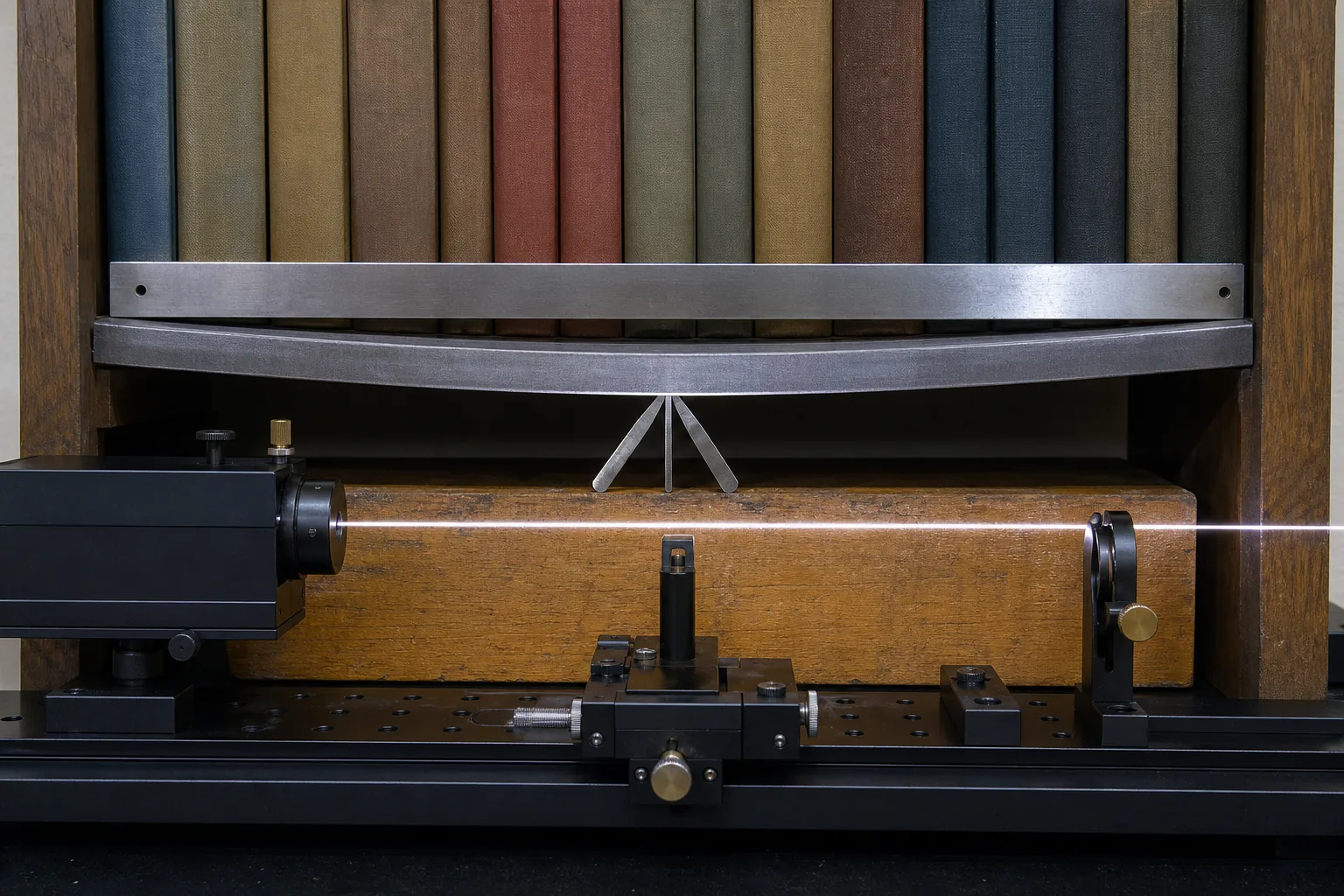
First, the Bookcase Would Look Like a Monument
Suppose that a person of unusually literal tastes resolved to make a bookcase of lead.
Not a bookshelf with a thin lead lining, which would merely be an awkward domestic object. Not lead type in a drawer, which has already made its peace with smallness.
The uprights, the brackets, the shelves themselves: lead plate, folded and joined into a respectable wall of literature.
Lead is the dense, soft member among the service metals.
It appears in batteries, in radiation shielding, and in some chemical-service equipment, and it has never been asked to hold up a wall of books.
Density has a peculiar way of flattering the eye.
It makes a thing look settled.
A lead bookcase would have the grave composure of a minor monument, and its owner might mistake composure for strength.
Then the books would arrive.
Not all at once; a library has better manners. A history on Monday, a dictionary in autumn, the accumulated vanity of hard covers over several years.
The shelf would not protest at placement.
It would begin the long, unobtrusive business of changing its mind.
That is where the furniture stops being a joke and becomes a lesson. A short-term strength figure answers a chosen stress event.
A shelf is asked a different question entirely: can it keep its intended shape while the same load remains for a long time?
That second question is creep.
It can ruin a library without an overload.
But Would Its Weight Not Make It Strong?
Here lies the first popular error. Lead is imagined as permanent because it is heavy and solid: the metal of shields, seals and weights.
Solid it is.
Permanence is another department.
Lead is dense and soft, and its low melting temperature is the awkward part.
What matters to deformation is not the thermometer reading but the service temperature measured against the melting temperature on an absolute scale, and by that measure an ordinary sitting room is a warm place for lead.
This is not an accusation that the shelf has secretly become liquid.
It is an accusation more subtle and more irritating.
Under sustained stress, a solid can continue to strain.
Popular imagination therefore expects the wrong catastrophe. It waits for a single baroque collapse, perhaps with the collected works of somebody severe arriving upon the carpet.
No. A bookcase need not snap to fail.
A permanent bow loses level and clearance, and invites every book to form a little municipal district at the centre.
That is the distinction the handsome density conceals. Yield strength concerns the stress at a chosen event. Creep resistance concerns what happens while the event refuses to end.
A turbine clearance or a bolted joint can be unfit after half a percent of accumulated strain while still carrying its load quite happily.
The moral transfers to furniture with embarrassing ease.
Retained load is not retained usefulness.
The Argument Begins in the Geometry
A shelf is a beam with cultural ambitions, and beam bending has no respect for the grandeur of the books it carries.
For a simply supported beam with a central load, the small-deflection result is δ = PL³/(48EI).
There are two quiet tyrants in that expression: the span, L, and the second moment of area, I.
The span enters cubed. Double it, holding load and section constant, and the idealized elastic deflection becomes eightfold.
The shelf does not need an exotic load to discover this.
It needs distance between supports, which is readily available in a bookcase and entirely indifferent to the owner’s confidence.
Then there is the section. A broad, deep member gives bending more geometry to work with; a thin plate laid flatwise offers less. Note what the formula does not contain.
It contains load, span, modulus and second moment of area. There is no tensile-strength figure anywhere in it.
Strength-to-weight and stiffness-to-weight are not the same selection metric, and a shelf is asking about the second.
This is why thickening the shelf is not a ceremonial gesture.
A greater section reduces immediate bending; shorter spans and intermediate supports reduce it further; a hollow section can place material where bending actually uses it.
None of these moves puts time back in the cupboard.
They change the sustained stress, and the shape from which creep sets out.
Yield Strength Is Not the Same as Staying Put
ASTM E8/E8M covers tensile methods used for comparison, alloy development, quality control and design under particular circumstances. Even its room-temperature scope runs from 10 to 38 °C unless otherwise specified.
Its caution is as useful as its test. Standardized coupons may not fully represent the end product or its in-service environment.
A tensile test is a result from a specified specimen.
It is not an oracle for a fabricated bookcase.
The record must therefore say more than “lead.” It must give product form; alloy or purity basis; temper, heat-treatment or cold-work condition; direction; surface condition; temperature; strain rate; and test method.
Product form determines tolerances, texture and property direction.
A hardness quoted as a bare number, with no scale attached to it, is not a usable datum.
A bare strength value is scarcely better mannered.
The physical bookcase supplies its own additional particulars: span, thickness, depth, support contact, holes, folded edges and bracket stress concentrations.
An acceptance plan might require no more than 0.20 mm of permanent sag at a stated load.
It would then have to say whether that load is centred, evenly distributed, or applied in stages, because each arrangement moves the bending somewhere else.
The books may be evenly distributed. They may also gather in dense little cliques.
The room may remain placid, or visit the shelf with temperature excursions.
Lead is not sentimental. It is merely responsive.
Then Time Joins the Load
At elevated temperature a stress well below any short-term tensile limit can still accumulate unacceptable strain.
A steady creep rate of two parts per million per hour sounds like nothing at all, and produces about 1.75 percent strain in a year if it holds.
The word doing the work in that sentence is if.
Real creep rates generally do not remain constant through an entire service history. The arithmetic is an order-of-magnitude screen, not a prophecy.
That warning is particularly congenial to our lead shelf.
A proper creep record names a rate at a stated stress and a stated temperature, rather than announcing “good creep resistance” and hoping to be believed.
No such record exists for this lead plate, this load and this room.
Alloy or purity, temperature, span, thickness, support details, stress concentration and duration all alter the rate and the extent.
The books cannot be sentenced by a number that has never met them.
Yet the mechanism remains perfectly legible.
The library supplies sustained bending stress.
The shelf supplies a low-melting, soft metal for which room temperature is already a warm room.
Time supplies the accumulation.
No single book need be the villain. Indeed, the last book may be an innocent volume on gardening, placed upon a shelf whose decision was taken years earlier.
The Myth Deserves a Second Correction
The first myth was that lead is permanent because it is dense. The second is subtler, and it hides inside the word flow.
Flow encourages the kitchen-table imagination to look for drips, for puddles, for a dramatic loss of dignity beneath the skirting board.
Nothing of the kind occurs.
The troublesome version is slowly accumulating strain under sustained load: sag, changing alignment, a support quietly carrying a different share than the drawing intended.
It is a time-dependent solid bookshelf.
It is not a liquid one.
Lead remains genuinely useful in batteries, in shielding and in chemical service, where its form and its service conditions have been thought about.
A radiation shield is not a lightly supported domestic beam merely because both happen to be lead.
An Honest Requirement Would Be Duller
It would begin with function. The shelf’s job is not merely to avoid fracture. It must remain level enough to store books.
So the requirement should state allowable deflection or accumulated strain, library load and distribution, span, section geometry, supports, operating temperature, environment and required time at load.
It should identify the actual lead material and condition, rather than congratulating the base metal for existing.
ASTM E139 makes the necessary division. It distinguishes creep deformation from time to rupture, under constant tensile force and temperature.
This is a useful division of the domestic problem.
A shelf that must remain level needs a deformation criterion.
A component whose principal concern is eventual separation needs a rupture criterion.
They are adjacent questions, not interchangeable answers.
One might write a requirement capping accumulated strain at one percent after 100,000 hours at a stated metal temperature and stress.
But such a line is a form, not a substitute for lead data.
It becomes a real requirement only when the temperature, the stress, the specified condition and the allowable deformation have been joined to evidence.
A room-temperature tensile result alone cannot fill those cells.
The final arrangement would be less romantic than the original scheme: shorter spans, deeper sections, more supports, a documented material condition, a stated time at load, and inspection for growing sag.
At which point an engineer might quietly select another material for the members whose job is to stay aligned.
Somebody Must Keep Account of a Slow Defeat
The first inspection need not be theatrical.
A straightedge, a fixed reference and a dated record are more useful than admiration for the metal.
The conditions belong with the measurement: library load, span, support arrangement, room temperature, and the actual lead plate or sheet.
A 0.20 mm requirement cannot be meaningfully policed with an instrument of 0.10 mm resolution unless somebody has done the uncertainty analysis to show that it can.
This is ordinary engineering discipline, not a specifically leaden superstition. Density is reported with its temperature and condition.
Mechanical data is reported with the test standard, specimen orientation, strain rate and temperature.
When a laboratory re-tests a retained sample, the earlier value, its date and the reason are kept beside the new one.
The shelf does not require a laboratory archive.
It does require someone able to distinguish a measurement from a memory.
There is a temptation to take one reading and announce a verdict. Temperature excursions, thermal gradients, oxidation and the history of the load are all still in the room.
Lead answers the conditions that exist, not the ones that would make a tidier story.
The sensible response is procedural. Set an allowable sag. Check it at stated intervals. Keep the library within the stated arrangement. Review the supports before deflection becomes a new geometry.
If the member no longer holds alignment, alter the section or the span, redistribute the books, or replace it.
The failure mode is slow.
That is no excuse for making the response slow as well.
And So the Bookshelf Stands
There would be no crash at noon.
No villainous novel singled out by destiny.
No liquid metal beneath the skirting board.
There would be a straightedge, a measurement, a record of the shelf’s level, a review of span and support contact, and perhaps a decision to move the heavy volumes down a tier, where their learned authority is less structurally demanding.
The bookcase would not feel dangerous.
It would feel supervised.
For timber may creak, and iron may rust,
while shelves make promises they cannot trust;
but lead, beneath a patient load,
keeps walking down its measured road.
And there it would stand, in the regulated calm of an ordinary room, its failure having none of the drama of a broken beam.
A matter of supports, dimensions, specified condition and time.
A static load waiting to become a history.