FIELD GUIDE / nickel alloys
The Magnificent Wall and the Small Crevice
A fountain made to circulate acid lets an expensive alloy meet its less expensive enemy: the narrow stagnant gap. The article is about compatibility charts arriving at the point where conditions stop being chart-like.
At a glance
- A chemical-compatibility chart is a conditional screening result rather than a lifetime promise.
- Crevice geometry, aeration, weld condition, and small wetted components can govern a system even when the vessel wall has a favourable result.
- An acid duty must name formulation, concentration basis, temperature, pressure, flow, duration, cleaning exposure, and upset condition.
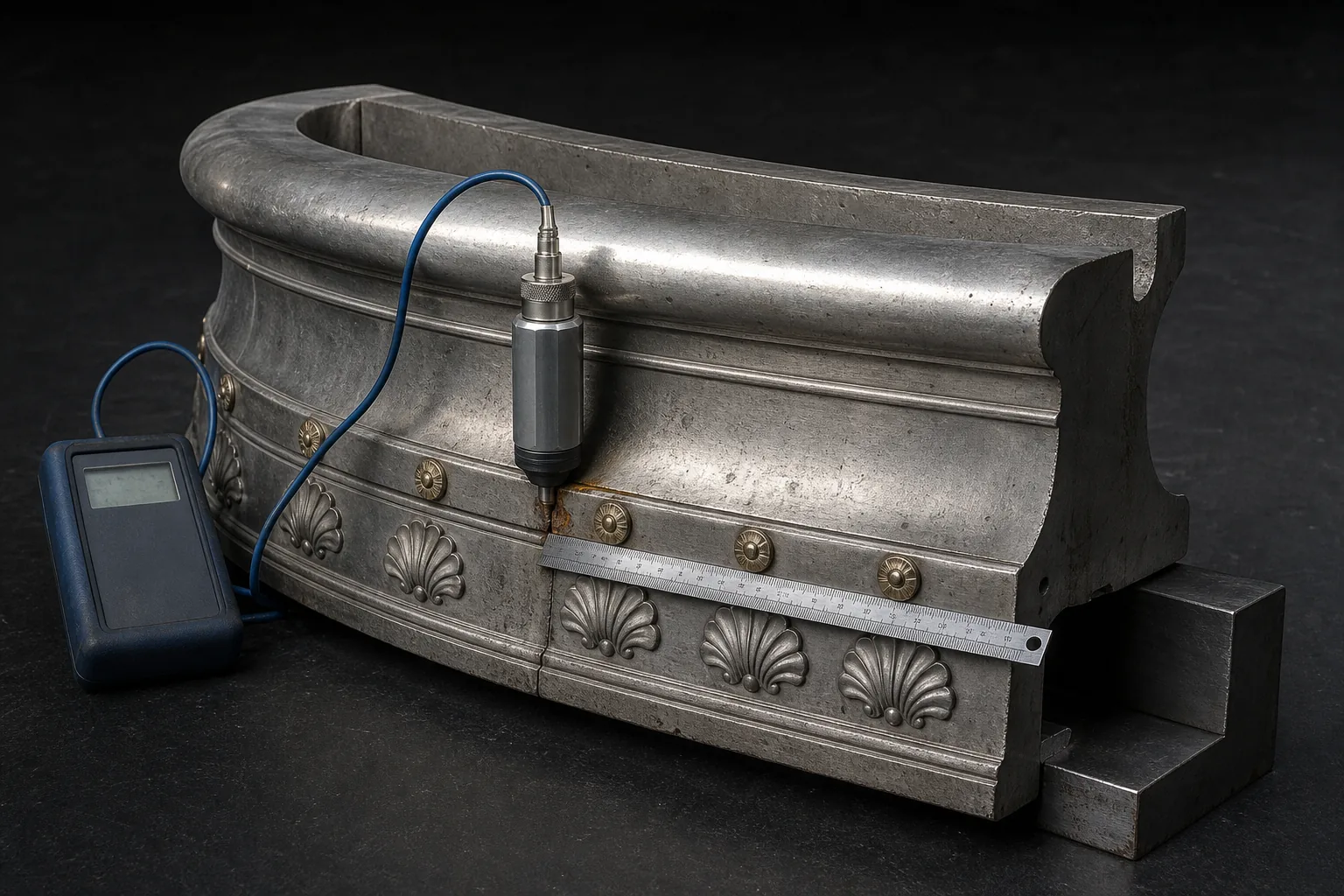
Somewhere beyond the last reasonable garden wall there is a fountain, made to circulate acid.
Not a laboratory pump hiding behind a screen. Not a pipe rack with the manners to call itself process equipment.
This is a fountain: a basin, a rising column, a lip over which the liquid returns with ornamental conviction, and a row of decorative bolted seams intended to look expensive in the afternoon.
Its maker had chosen a corrosion-resistant nickel alloy.
The brochure was handsomely printed.
The metal had one of those reassuring names in which nickel is accompanied by chromium, molybdenum and perhaps tungsten, as though a committee of stern uncles had been appointed to keep chemistry out of the garden.
It would be a splendid object, until the acid reached the bolts.
For a nickel-alloy acid fountain does not fail because nickel is a fraud.
It fails because a favourable general description has been asked to govern a particular liquid, at a particular concentration and temperature, circulating for a particular time, through particular welds and joints, until it arrives in a gap too narrow for the brochure to enter.
The wall may be magnificent.
The crevice will be very small.
Engineering is full of such reversals.
The Fountain Is Not Made of “Nickel Alloy”
The first temptation is to answer the question with that phrase. It is rather like answering a question about a family dog with the word mammal.
Correct, dignified, and not yet useful.
Commercially pure nickel is one material. The old nickel-copper alloys are another, at home in alkaline solutions and seawater.
The high-molybdenum, low-chromium grades are specialists in reducing acids, and can be undone by oxidizing contamination arriving from upstream.
The higher-chromium grades trade some of that for resistance to oxidizing media and chloride pitting.
The broadest of the nickel-chromium-molybdenum family are valued for mixed acids, chloride pitting, crevice attack and stress-corrosion cracking at once.
These are different bargains with different environments.
A fountain may be made of an alloy family.
A procurement record must identify the grade, the designation, the product form, the condition, the specification, the dimensions and the heat traceability.
A producer’s catalogue of available tube sizes is a supply range.
It is not the circumference of permission.
Nor does a rod-and-bar specification certify a pipe merely because the pipe recognizes the alloy number.
The fountain’s first act of corrosion resistance, therefore, is clerical.
Metal, like a duchess, prefers to be introduced correctly.
But Is Nickel Alloy Not Universal Acid-Proof Metal?
No.
This is the myth correction, and it should be made before the fountain acquires a mythology of its own.
Nickel alloy is not one substance. Nor is acid one exposure.
A compatibility chart which says an alloy is suitable for acid, without chemical identity, concentration, temperature, oxidizing condition, duration, product condition and endpoint, is not a design instruction.
It is a sentence stopped in the middle.
There is a superb example in the comparative chloride data.
In one test of salt solution with ferric sulfate and hydrochloric acid, a widely specified alloy pitted at 90 °C while its higher-chromium neighbour remained unpitted above 150 °C.
That comparison belongs to a stated 24-hour test.
It does not make the second alloy a creature of permanent immunity, nor the first unfit for every chloride-bearing service.
It makes a narrow, valuable statement about named alloys in one specified test.
Likewise a published rate of 0.20 mm a year, in reagent-grade 20 percent hydrochloric acid at 38 °C, is a proper corrosion rate under named conditions.
It is not an oracle for a fountain whose acid may be warmer, diluted, evaporated, aerated, contaminated, stagnant beside a bolt, or refreshed every minute by circulation.
The popular story imagines that more nickel is always the cure, as though acid saw the periodic table and became embarrassed.
Chemistry is less susceptible to prestige.
An alloy has not failed its reputation when a different condition defeats it.
The reputation failed when somebody treated it as a condition.
The Acid Declines the Description
The fountain designer may say, with that alarming calm often found at the beginning of a disaster, that it is simply acid.
The acid declines the description.
A usable duty statement names the chemical identity and formulation, the concentration basis, the physical state, the normal and maximum material temperature, the pressure, the contact mode, the total duration, the cleaning chemical and the upset condition.
A workable example runs: 55 percent acid solution at 65 °C, flowing liquid, 6 bar, continuous contact, with a daily hot clean-in-place at 80 °C.
That does not select a metal by itself.
It merely tells the chart which question it has been asked.
The proper lookup is chemical plus concentration plus temperature plus material. Chemical name alone will not do.
A result for five percent acetic acid does not establish one for eighty-five percent, which is why the published guides keep dilute, intermediate, concentrated and glacial as separate rows.
Concentration changes the relative water, the dissolved species and the chemical activity arriving at the surface.
It is not a decimal ornament placed after the real chemical name.
Nor does a lower concentration become kinder by moral law. The controlling exposure may simply change.
Separate rows are a reminder that make-up water, evaporation, dilution, contamination and cleaning all alter what actually occupies the basin.
The conclusion is not that one direction along the concentration scale is always worse.
It is that interpolating between friendly-looking rows is poor engineering when the fountain contains a mixture rather than a textbook label.
Temperature conducts the same small rebellion. A result at one temperature does not receive a passport to another.
The cleaning cycle belongs in the duty statement quite as much as the handsome normal operation does.
A screening chart quoted at room temperature is a screening observation at room temperature.
It cannot be promoted, by confidence alone, into evidence for a hot fountain.
Nor can a static soak be confused with a pressurized, circulating path.
The liquid is entitled to its full biography.
The Brochure Stops at the Test Boundary
Compatibility ratings are commonly limited to 48 hours, with the publisher stating outright that it knows nothing of effects beyond that period.
ASTM D543 makes the same sober point about short continuous-immersion work. Such tests are principally useful for eliminating the least suitable materials, or for indicating a probable relative order.
They do not promise a life in ornamental circulation, still less a calendar date at which a fountain will politely begin to leak.
This is not a defect in the chart.
It is a definition of what the chart has earned the right to say.
An iso-corrosion diagram is admirably explicit about the same thing. One line marks the concentration and temperature combinations expected to give a tenth of a millimetre a year.
Another marks half a millimetre.
The lines do not claim that every item of that alloy erodes at those rates in every acid service.
They say that a stated material, a laboratory basis, a concentration, a temperature and a rate threshold have been joined together in a plot.
The useful engineering question then becomes whether the fountain has that chemistry, that temperature, that surface, that duration, and an allowable rate consistent with its wall.
Uniform corrosion is not the only court in the garden.
For localized corrosion the record needs solution chemistry and concentration, temperature, applied potential where relevant, exposure time, specimen surface, crevice assembly and a definition of the result.
The rate and the test condition travel together.
Separate them, and the number becomes a counterfeit coin.
The Fountain Fails Beside a Bolt
Because the bolt has made a room of its own.
The broad, swept wall is exposed to the circulating fountain.
The narrow region at a decorative lap, a gasket, a thread, an attachment or an imperfectly closed seam is a different location, with different exchange with the bulk liquid.
It can have its own concentration, its own temperature, its own aeration, its own chemistry.
The expensive vessel wall is therefore the easy part.
The decisive environment is the cheap little crevice, where flow has become reluctant and the broad compatibility statement has quietly become conditional again.
The data say so plainly, for anyone who reads the second column.
One well-regarded alloy is reported with a critical pitting temperature above 150 °C in acidified ferric chloride, and a critical crevice temperature of 55 °C in the same solution.
The same metal. The same liquid. Nearly a hundred degrees of difference.
The gap between those two numbers is the fountain’s whole problem.
This is why localized-corrosion evidence asks for a crevice assembly rather than an alloy name.
An unremoved crevice remains a fabrication defect even when the plate is made from a formidable alloy.
The fountain does not care that the sales literature called the metal high performance.
It has found a smaller jurisdiction.
The weld joins this minor parliament.
A corrosion-resistant grade can still be compromised by an oxidized root, embedded iron, a bad filler choice, lack of fusion, or a crevice nobody removed.
Supplier guidance for such alloys is correspondingly fussy: gas-tungsten welding as first choice, a capped heat input, a limited interpass temperature, stringer beads rather than weaving.
Those are instructions for a named product, not a universal procedure. But they reveal the sort of detail a decorative seam has concealed from a casual observer.
Where pipe must be welded from one side, the root is protected by an inert back purge.
The record then needs the purge method, the gas quality and flow, the oxygen criterion if one is specified, and the result of the root examination.
A line reading “nickel alloy, welded” is as descriptive as a dinner invitation reading “food.”
The fountain’s other small aristocrats must also be named.
Its wetted path may include a housing, a liner, an impeller, seats, seals, tubing, adhesive, a sight glass, closures and cleaning-contact parts.
A wall result cannot be conferred upon an elastomeric seal merely because both happen to be damp and expensive.
Nor does a test coupon establish a finished moulded, welded or assembled article without an argument.
Evidence attaches to its specimen and its endpoint.
The assembled fountain is not flattered into becoming that specimen.
A Strong Record Contains Enough to Argue With
For identity, it holds the producer or generic grade, the designation, any alternate designation, the product form, the specification, the condition, the dimensions and the heat traceability.
For chemistry, it distinguishes a certified heat analysis from a brochure’s nominal composition.
A pitting-resistance equivalent may be calculated, provided the equation travels with it. The result has no unit at all. It is a comparative index, not a measured corrosion rate.
It does not replace the acid duty, despite having the sort of number that tempts a meeting to end early.
Mechanical properties retain their condition and their temperature, and they may matter greatly to a structure or a thermal calculation.
They do not announce a pressure-design allowable, a corrosion allowance or a crevice rating.
Different evidence, different work.
Stress-corrosion evidence likewise refuses to be adopted by reputation.
A stressed chloride test that runs a thousand hours without cracking is a useful contrast against a lesser material that cracks in two.
It is not a warrant to omit residual stress, welds, chlorides and temperature from the review of an actual assembly.
So the acceptance record for the fountain must contain the acid formulation and concentration, the contaminants and redox condition, the temperature range, flow and aeration, pressure, duration, cleaning and upset exposure, every wetted component, the weld and crevice details, the relevant test method, the endpoint, the allowable corrosion rate where one is used, and the unresolved question standing beside each claim.
A result can then say what it actually means: screening candidate, supplier confirmation, immersion trial, assembly trial, or rejection.
And So the Fountain Runs
Imagine it in the quiet hour, when nobody is admiring it.
The acid rises. It falls.
It runs briskly across the principal wall, then pauses in its ornamental little hiding places.
There will be no dramatic hiss from the basin, and no moral lesson engraved in the spray.
There will be inspection of seams, records of the exact alloy and its product condition, control of the actual acid, review of the cleaning cycle, and attention to gaskets, roots, bolted laps, and every place where fluid stops behaving like the fluid on the chart.
The fountain would not feel cursed.
It would feel bounded.
And that is the unromantic correction to the universal acid-proof metal.
Nickel alloys are not magic. They are materials with particular service windows.
Their great achievement is not that they make chemistry disappear.
It is that, when named and conditioned properly, they give chemistry a boundary it must respect.
AT THE BENCH
Questions, with the conditions attached.
Does a nickel-alloy rating mean a fountain can circulate any acid?
No. A chemical-resistance rating establishes bounded performance for a named material under a stated exposure and criterion. It does not establish service in every acid or every assembly. Acid identity, concentration basis, temperature, oxidizing contaminants, pressure, flow, exposure duration, and the allowable endpoint determine whether a published result transfers to a circulation fountain.
What information belongs in an acid-service duty statement?
An acid-service duty statement records chemical identity and formulation, concentration basis, liquid, gas, or vapour state, normal and maximum material temperature, pressure, contact mode, total duration, cleaning chemical, and upset condition. A statement such as 55 mass% acid solution at 65 °C, 6 bar, flowing liquid, continuous contact, and daily 80 °C cleaning provides a usable starting condition; acid service does not.
Why is an acid concentration on a chart not just a minor detail?
Concentration changes the solvent, dissolved species, water content, and chemical activity at a material surface. A result for 5% acetic acid does not establish a result for 85% acetic acid, and a proprietary mixture may introduce a different controlling constituent. The defensible comparison uses the tested composition or a test of the composition that actually occurs after dilution, evaporation, contamination, or cleaning.
Can a room-temperature compatibility result be used for a hot fountain?
No automatic transfer exists from a room-temperature result to a hotter duty. Temperature commonly accelerates chemical interaction and transport, while duration and applied stress can also affect damage. A result reported at 20 °C establishes performance at that stated condition, not at a higher operating, cleaning, or upset temperature. A hotter exposure needs a matching source or a confirmation test.
Is C-276 simply a universal acid-proof nickel alloy?
No. HASTELLOY C-276, UNS N10276, is a broad Ni-Cr-Mo-W alloy, but its corrosion data still require environment details. A producer’s 0.1 mm/y iso-corrosion line concerns reagent-grade acid concentration and temperature combinations, not contaminated plant acid or an unspecified crevice. The exact grade, product condition, oxidizing contaminants, temperature, flow, duration, and endpoint remain part of the claim.
Why can a small bolted seam matter more than the fountain wall?
A narrow seam creates a distinct local exposure from the well-mixed flowing liquid. Localized-corrosion evidence must record crevice assembly, specimen surface, solution, temperature, exposure time, and result definition because the small geometry can govern attack. An unremoved crevice, oxidized weld root, embedded iron, unsuitable filler, or small wetted seal can therefore defeat an otherwise favourable wall-material result.
What does a corrosion rate say that a word like resistant does not?
A corrosion rate states a measured or predicted material loss under defined conditions, while a word such as resistant often omits the test boundary. Haynes defines C-276 iso-corrosion lines at 0.1 mm/y and 0.5 mm/y for stated reagent-grade acid concentration and temperature combinations. Those values are useful acceptance thresholds only with their solution, temperature, duration, specimen condition, and corrosion mechanism attached.
Are C-276 and C-22 interchangeable because both are nickel alloys?
No. C-276 and C-22 are neighbouring Ni-Cr-Mo alloys with different nominal balances and different intended margins. C-276 is listed with 16 wt% chromium and 16 wt% molybdenum, while C-22 is listed with 22 wt% chromium and 13 wt% molybdenum. The higher chromium content is associated with oxidizing-media and chloride-pitting resistance, but neither composition substitutes for a duty-specific result.
Can a chart result for the metal body be carried over to the seals and fittings?
No. Chemical evidence attaches to the tested material, article, and endpoint. A fountain fluid path can include a housing, liner, impeller, seats, seals, tubing, adhesive, sight glass, weld consumables, and cleaning-contact parts. A favourable result for a nickel-alloy wall does not establish the performance of an elastomeric seal, bonded joint, threaded closure, or assembled crevice beside it.
How long does a short compatibility test prove that a fountain will last?
A short compatibility test supports screening, not a service-life forecast. Cole-Parmer limits its chart ratings to 48 h and states no knowledge of effects beyond that period. ASTM D543 likewise treats short continuous-immersion tests mainly as tools to eliminate unsuitable materials or establish a probable relative order. Continuous fountain service requires a duty-specific acceptance criterion and further evidence.
What needs to be recorded before a nickel-alloy fountain is accepted?
An acceptance record identifies the producer grade or generic grade, UNS designation, product form, condition, dimensions, specification, heat or lot traceability, and corrosion evidence. The corrosion record adds acid formulation, concentration, contaminants, temperature, aeration, velocity, pressure, duration, specimen condition, crevice assembly, test method, endpoint, and rate where applicable. A bare trade name or chart letter cannot make the record auditable.
Sources and further reading
- Cole-Parmer, Chemical Compatibility Databasecoleparmer.com
- Haynes, HASTELLOY C-276 alloyhaynesintl.com
- Haynes, HASTELLOY C-22 alloyhaynesintl.com
- Haynes, HASTELLOY B-3 alloyhaynesintl.com
- Haynes, Back-purging and Welding Requirementshaynesintl.com
- Alleima, Sanicro 276 data sheetalleima.com