FIELD GUIDE / uranium
The Plate That Demanded Denominators
The uranium table service has less to do with a green glow than with routes of exposure, chemical form, and damaged surfaces. The broken plate is the real change of state.
At a glance
- Uranium identity requires both an isotopic vector and a chemical form, because neither uranium mass nor a colour identifies the hazard.
- External exposure and material that can enter the body are different exposure routes, so dust generation changes the hazard-management problem.
- A damaged uranium-bearing object needs its chemical form, particle characteristics, surface condition, quantity, and provenance recorded before a control decision can be justified.
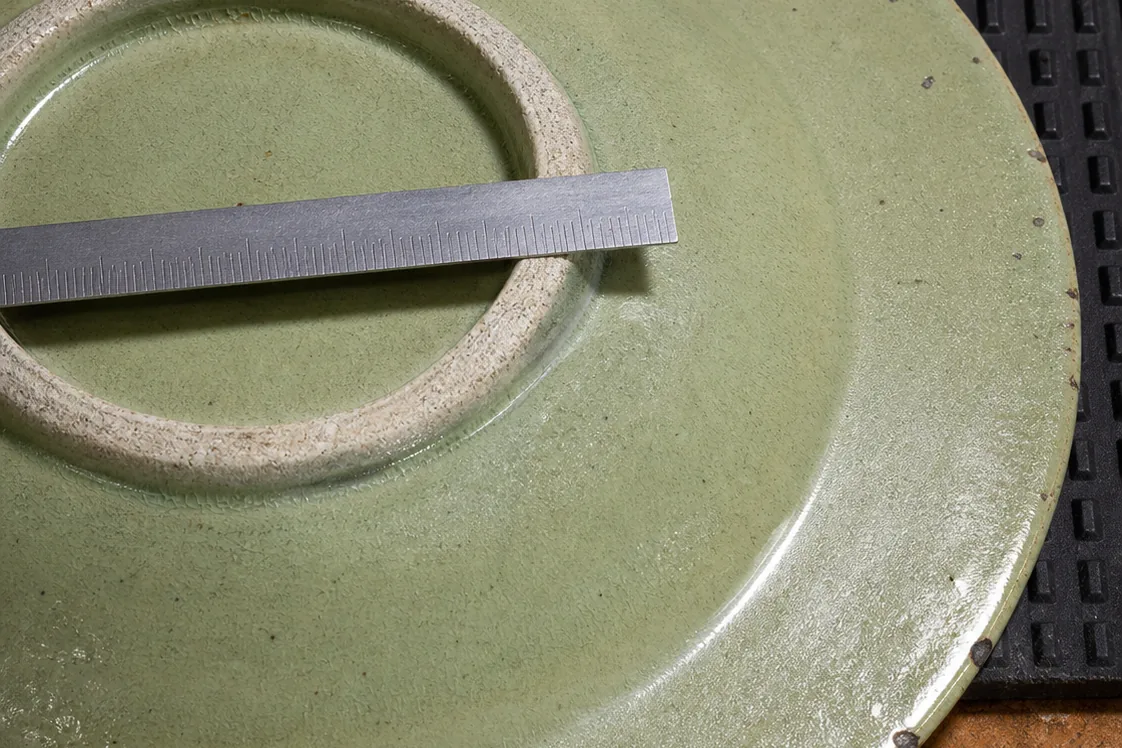
There is a dinner service made of uranium-bearing material.
Not a small specimen in a cabinet, attended by labels and silence.
A service: plates, cups, saucers, the rather over-confident bowl intended for trifle.
It is brought out at holidays, washed after supper, stacked carelessly, and at some point receives the ordinary domestic insult of a tile floor.
It might possess an agreeable green.
This is unfortunate, because green has made a great many things seem friendlier than they are: pond scum, absinthe, certain municipal carpets.
But colour is not a nuclear record.
It cannot tell whether the material is uranium-238, uranium-235 or uranium-234; whether the uranium sits as an oxide, a soluble compound, a metal, or something else; or whether the surface is a coherent thing or a quiet supplier of particles.
The dinnerware would not be an atomic bomb in a dining room.
It would be a materials-identification problem in a dining room, which is a less cinematic sentence and a far more useful one.
But Would the Dinner Set Become a Nuclear Bomb?
No.
This is the moment at which popular culture tends to burst through the sideboard with a warning siren in each hand.
Uranium is not a weapon merely because somebody has shaped it into an object.
Uranium-235 is the neighbour capable of sustaining a fission chain reaction in appropriate configurations, and that sentence already contains all the words that matter: isotope, quantity, geometry, configuration.
A plate has none of them in any interesting arrangement.
Natural uranium is a little over ninety-nine percent uranium-238, with about seven parts in a thousand of uranium-235 and a trace of uranium-234.
The uranium-235 figure is not a decorative speck to be waved away.
Neither does it permit natural uranium to be called uranium-235.
So the bomb is not the question, and it never was.
The question is what the plate is made of, and what happens when it stops being a plate.
What Is Actually on the Plate
That has a far more important answer than “uranium.”
Uranium dioxide is not triuranium octoxide.
One is a named powder precursor in a conventional fabrication route. The other is associated both with the usual mining concentrate and with a stable deconversion option.
They share uranium and oxygen as a family shares a surname, which is to say not nearly enough for one to borrow the other’s passport.
Nor is chemical purity isotopic purity.
A conversion process may produce uranyl nitrate above 99.95 percent pure, and that figure is about the stated chemical material.
It is not a uranium-235 assay, and it is certainly not a dinnerware certificate.
A sentence saying “nearly pure uranium” without giving its denominator has simply set a trap and invited the reader to stand in it.
The proper first record for the hypothetical plate would name its chemical form, its uranium oxidation state where relevant, its moisture and impurity condition, its isotope vector, its total uranium mass, and the uncertainty and basis of the assay.
An assay quoted as a percentage of uranium-235 means weight percent of the uranium.
It does not mean that percentage of the total mass of the container, because the other elements in the compound have also arrived for dinner.
Formula, element mass and object mass must each keep their own chair.
The isotopes also refuse to be one voice.
Their half-lives differ by four orders of magnitude, and so their specific activities differ enormously: uranium-234 is thousands of times more active, per unit mass, than either of its abundant relatives.
The smallest mass fraction in the natural trio is therefore not the smallest voice in an activity calculation.
A table service should not be assessed as though its atoms had elected a spokesperson.
The Glow Is Not the Danger
It is only the easiest thing for a nervous imagination to see.
Radiation terms are not a single property poured into a single bottle.
Alpha, beta, gamma and neutron descriptions belong to an identified nuclide or mixture.
A survey reading in microsieverts per hour is a different sort of fact altogether. It is conditioned by geometry, shielding, detector response, distance and background.
It cannot be treated like a density, a half-life, or a colour chart.
The distinction may sound bureaucratic until the object has to be evaluated.
An intact plate on a shelf, and a fragment held against an instrument, do not arrange the same geometry.
A measured reading, a declared assay and a calculated activity are three different claims.
A useful record keeps seven fields apart: the result, the unit, the basis, the uncertainty, the method, the sample date and the source document.
That small bureaucracy is precisely what keeps a dinner plate from acquiring a fictional personality.
Nor do published activity figures transfer between forms.
Natural uranium metal and freshly produced depleted uranium have quite different specific activities, and neither is a label for an arbitrary uranium-bearing ceramic or glaze.
The isotope vector differs. Refining can remove decay daughters which then grow back over years.
An old plate, an oxide powder, a recovered lot and a metal reference all decline to be one another, merely because a cupboard has called them vintage.
Then the Plate Stops Being a Plate
At the crack, the matter changes its manners entirely.
An intact uranium-bearing object is still an object.
Its condition can be observed, its location recorded, its surface assessed, and its radiation field measured with the geometry stated.
Its hazard question is principally one of identity, containment, and the particular external field produced by the particular material.
A chipped, ground, abraded or powdered object is no longer only an object.
It has become a possible source of transferable material.
The description a powder needs is quite different from the description a plate needs: particle-size distribution, bulk density, tap density, surface area, moisture and flowability, each measured against a named procedure.
The quantity of uranium is not enough, because the route has changed.
Form is not a clerical nicety. A twenty-five-millimetre plate and a twenty-five-centimetre wall both possess length units while doing entirely different transport and structural work.
The fracture of a plate creates the same kind of missing geometry: where the material now is, how it is distributed, whether it is loose or adherent, and which surface has become available for transfer.
This is the central inversion, and it is the whole article in two lines.
The solid at a distance and the material that can enter the body are not the same exposure problem.
Internal exposure brings chemical form and uptake route into the account.
External assessment brings geometry, shielding, detector response, distance and background into it.
A break therefore creates rather more than a sharp edge.
It creates a question about contamination, about airborne material, and about the difference between having a thing nearby and having part of it somewhere no dinnerware ought to be.
Chemical form governs what a release actually is.
Where a uranium compound meets moisture and produces a soluble product and an acid gas, the principal hazards named are inhalation and chemical toxicity, not the dramatic ones.
That is not a claim about what any particular damaged plate contains.
It is a reminder that a report needs the compound, the phase, the moisture contact and the airborne concentration.
It does not need a noble-sounding number of kilogrammes.
Ordinary Housekeeping Will Not Settle It
Only if ordinary means something rather more formal than it usually does.
The first domestic instinct is to sweep, wipe, wash, and return the good plates to the cupboard before the pudding notices.
The material record refuses this shortcut.
A damaged unknown needs its physical form, chemical form, source history, isotope data, total mass, surface condition, particle characteristics, sampling point, laboratory method, calibration material, units and uncertainty all kept distinct.
Measured, calculated, declared and limit values must not change hats halfway through the sentence.
For material with a non-natural history, the discipline is to account for the full range of uranium isotopes where relevant, and to support that with laboratory analysis or a process specification.
That is not a prediction that every old saucer contains all of them.
It is a warning against the lazy ritual of treating enriched, depleted, natural and uranium as though any of them were a complete passport.
The person with the broken saucer needs fewer myths and better records.
The sensible language is not safe or deadly as a household adjective.
It is: what compound, what isotopes, what quantity, what condition, what route, what measured field, and what governing control?
Materials enjoy broad nouns.
Safety does not.
And So Dinner Is Served
Probably not haunted.
There would be no reason for spoons to levitate, and no universal green light to illuminate the roast.
There would be documentation. The object would be characterized rather than guessed at.
A damaged surface would be treated as a change in material condition, rather than as a minor failure of crockery etiquette.
Measurements would retain their geometry. Isotope figures would retain their denominator.
There might be a laboratory report, a chain of custody, a controlled inspection, and a decision based on the actual object rather than on a story told about it.
The relevant questions are gloriously unromantic.
Was a result measured, calculated, declared, or merely a limit?
Was the sample taken before the damage, or after it?
Does a claimed uranium-235 fraction refer to uranium mass or to compound mass?
The answer to any one of them may rearrange the meaning of all the others.
A table service made of dangerous material does not demand mysticism.
It demands denominators.
And the quiet conclusion is this. The dramatic object is not dangerous because it glows in a story, or because it has borrowed the name of a bomb.
It becomes serious when a material identity is replaced by a guess, when a surface becomes particles, or when a field measurement is asked to answer a question it was never designed to hear.
AT THE BENCH
Questions, with the conditions attached.
Does uranium dinnerware automatically work like a nuclear weapon?
No. Uranium is not a nuclear weapon merely because it is present in an object. Nuclear behaviour depends on isotope composition, quantity, geometry, and surrounding materials. U-235 is the uranium nuclide that can sustain a fission chain reaction in appropriate reactor configurations, while natural uranium is principally U-238 at 99.28% by mass. A household object must still be identified and controlled according to its actual material record.
Why is it not enough to call a plate uranium-bearing?
A uranium-bearing plate needs both chemical and isotopic identification. Uranium dioxide, triuranium octoxide, uranyl nitrate, uranium metal, and uranium hexafluoride are different forms, and isotopic proportions determine nuclear attributes. Natural uranium is listed by the IAEA as 99.28% U-238, 0.72% U-235, and 0.0055% U-234 by mass. Colour, object type, and the word uranium do not replace an assay and chemical analysis.
Is the green glow the important danger signal?
No. A visible appearance does not identify isotope composition, chemical form, surface condition, or exposure route. A defensible record states the uranium form, isotope vector, total uranium mass, physical form, and surface condition. Half-life and specific activity attach to named nuclides or defined mixtures, while a survey result in µSv/h depends on geometry, shielding, detector response, distance, and background.
Why does a broken uranium-bearing plate need different handling from an intact one?
Breakage can change a solid object into loose fragments, abraded material, or particles. Powder records need particle-size distribution, bulk density, tap density, surface area, moisture, and flowability under named procedures. This changes the issue from an intact object at a location to potential contamination and an internal-exposure route. The chemical form and airborne concentration matter; uranium mass alone does not describe the release.
Is a radiation-meter reading a property of the plate?
No. A reading in µSv/h is a field measurement, not an intrinsic property such as a nuclide half-life or density. It depends on detector response, geometry, shielding, distance, background, and the identified nuclide or mixture. A usable record keeps the instrument result separate from assay data and reports the measurement basis, method, sample or location, date, and uncertainty.
Does depleted uranium have the same activity as natural uranium?
No. The IAEA example gives natural uranium metal a total specific activity of 25.4 Bq/mg and freshly produced depleted uranium 14.2 Bq/mg. The difference is not explained by U-235 alone: enrichment also changes U-234 content, and refining can remove decay daughters that later grow back. An activity value therefore requires the isotope vector, material form, and daughter-product condition.
Can a lead lining solve every radiation problem from uranium?
No. Shielding depends on radiation type, energy, geometry, composition, and layer order. In an IAEA comparison, lead has a density of 11.35 g/cm³ and polyethylene 0.96 g/cm³, yet hydrogen-rich polyethylene performs the neutron-slowing task that lead does not. A photon attenuation coefficient also requires a stated beam and geometry; it is not an occupied-room dose prediction.
What information matters after an unknown uranium-bearing object is damaged?
The control record needs chemical form, isotope vector, total uranium mass, physical form, particle characteristics, surface condition, source history, sampling date, analytical method, laboratory, calibration material, reporting units, and uncertainty. For non-natural material, U-232 through U-238 may be relevant. These fields distinguish a measured result from a declared value or a specification limit and prevent a generic uranium label from becoming a handling decision.
Does a percentage of U-235 describe the whole weight of a uranium compound?
No. Commercial enrichment normally means the U-235 weight fraction in total uranium, not in the total mass of a compound. A 4.95% U-235 result does not mean that 4.95% of a uranium hexafluoride cylinder’s total mass is U-235, because fluorine contributes mass. Any percentage must name its denominator, its analytical or declared status, and the material form.
Why does the chemical form matter as much as the radiation label?
Chemical form determines what material is present and how a release must be described. Uranium hexafluoride contacting moisture forms uranyl fluoride and hydrogen fluoride, and the NRC identifies soluble uranium compounds and hydrogen-fluoride inhalation as principal chemical hazards at an enrichment plant. A release record therefore needs compound, phase, moisture contact, and airborne concentration rather than kilograms of uranium alone.
Can a historic uranium-bearing plate be assigned a standard hazard value from a reference table?
No. Reference values describe specified isotopes or defined material conditions, not every object containing uranium. U-238, U-235, and U-234 have IAEA-listed specific activities of 12.44, 80, and 230,700 Bq/mg respectively, with different half-lives. An object requires its own assay, chemical form, quantity, geometry, surface condition, and measurement record before a value can be used for a decision.
Sources and further reading
- IAEA, Depleted Uraniumwww-pub.iaea.org
- NRC, Deconversion of Depleted Uraniumnrc.gov
- IAEA, Neutron monitoring for radiation protectionwww-pub.iaea.org
- NRC, Uranium Conversionnrc.gov