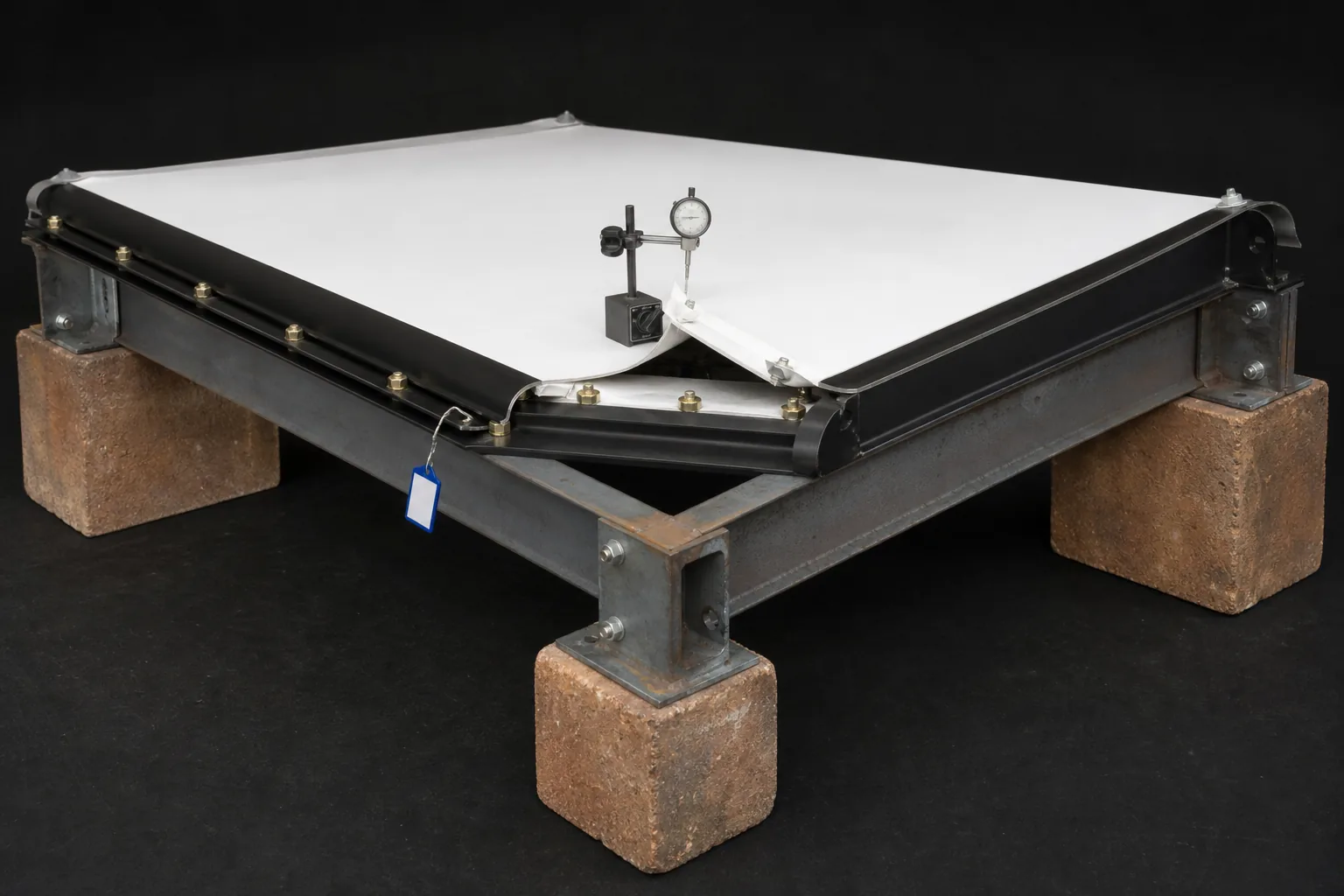
Above a modest public hall there is a roof of PTFE: white, serene, chemically unruffled, and stretched across its supports with the placid authority of a tablecloth which has read a great deal of philosophy.
Rain would meet it. Dust would meet it. A bird with imperfect aim would meet it.
The roof would receive these visitors with the composure for which PTFE is famous.
It is a fluoropolymer, and its fully fluorinated backbone gives it that distinctive combination of chemical resistance and very low surface energy.
This is an impressive disposition in a sheet exposed to weather.
It is also, when the sheet must become a roof, a slightly antisocial one.
For a roof is not a surface.
It is a conspiracy of surfaces: seams, laps, edges, penetrations, clamps, supports, drains, and the tiny territories where one material has persuaded another to stay put.
The sheet is the ambassador.
The joints run the government.
The Roof Is Not Made of PTFE Alone
Certainly not in any useful sense.
A polymer record describes a population of molecules and a material history. It does not describe a single immaculate molecule held up to the rain.
It needs the base-chain identity, the formulation, the molecular-size distribution, the morphology, the processing state, and the article actually tested.
A plastic routinely includes materials beyond the polymer itself, to improve performance or to reduce cost.
A polymer name is an introduction.
It is not a roof specification.
The distinction becomes especially sober once fillers, reinforcement, pigments, membrane thickness and surface treatment enter the room.
A compound filled to twenty percent by mass and one filled to twenty percent by volume do not have the same density.
A multilayer sheet with a nominal overall thickness does not prove that any individual layer has that thickness.
Neither observation is a PTFE roof prescription.
Each is a reminder that a familiar family name can conceal the article which actually carries the weather.
PTFE’s chemical resistance remains genuinely useful.
It may be exactly why the architect, holding a rendering in one hand and a cup of coffee in the other, chose it for a hostile roof environment.
But resistance to reagents says that the sheet is reluctant to react.
It does not say that the sheet will transfer load through a seam, receive a fastener without changing its local pressure over time, or agree with a support that bends in a different rhythm.
Chemical resistance is an excellent character reference.
It is not a fastening schedule.
But If Nothing Sticks to It, Can Anything Harm It?
Here is the myth which always gathers around a remarkable property.
Nothing sticks to it, therefore nothing can harm it.
The first clause names a practical difficulty.
The second is a small engineering coup d’état.
What the property actually describes is a surface which is reluctant to form strong associations with other materials.
That reluctance is entirely impartial.
It applies to the bird, to the grime, to the rainwater, and equally to every adhesive, coating, primer, sealant and tape which the roof will need in order to exist as a roof.
The membrane has not been given immunity.
It has been given a preference, and the preference is against company.
Nor does chemical inertness protect a material from mechanical events.
Load, temperature, sustained deformation, ultraviolet exposure, abrasion at a clamp, and the slow rearrangement of a polymer under stress are not reagents.
They do not care in the slightest that the backbone is fully fluorinated.
The roof will not be dissolved.
It may still be deformed, unseated, opened at an edge, and eventually asked to explain where the water came from.
Nothing Sticking Becomes a Structural Problem
Because an adhesive begins not with strength but with contact.
Before it can cure, a liquid, a softened film or a pressure-sensitive mass must displace air and conform to microscopic contours.
Wetting is what lowers the interfacial free-energy penalty and makes that possible.
Surface energy, viscosity, application pressure, cleanliness, and the time before the material thickens all determine whether this first domestic introduction ever takes place at all.
Low surface energy makes the occasion considerably more difficult.
It is not a supernatural force field. The roof does not fling adhesive from its back in disgust.
But the same low-energy surface which helps PTFE resist unwanted attachment also demands a demonstrated means of obtaining the wanted attachment.
The formulation must wet the prepared substrate, under the allowed process conditions.
That word prepared is doing rather more work than it appears to be doing.
The Sheet Must Be Persuaded, Not Merely Cleaned
Preparation can provide topography by abrasion. A primer can offer a particular coupling chemistry. A compliant adhesive can reach over a rough coating and hold on mechanically.
These are mechanisms. They are not charms.
No single explanation, whether intermolecular attraction, polar interaction, covalent coupling or mechanical interlocking, accounts for every successful bond.
And a glossy surface can carry an oil film a few nanometres thick while looking innocent enough to be invited indoors.
So the proposed roof must name its surface treatment, the interval permitted between treatment and bonding, the cleanliness condition, the seam or adhesive product, and the process by which wetting is actually demonstrated.
A polymer family name does not establish a treatment for a particular roofing membrane.
Treatment must be qualified before the roof is allowed to call itself joined.
There is a second consequence, less obvious and more expensive.
A treated surface is a temporary condition.
Abrasion roughness fills. Chemically activated surfaces recover. A membrane treated on Tuesday and bonded on Friday has not been bonded in the state that the treatment produced.
The interval belongs on the drawing, alongside everything else that has a clock attached to it.
A Tensioned Roof Must Keep Its Shape to Keep Its Strength
There is a further complication, and it belongs to the roof rather than to the polymer.
A stretched membrane does not carry load the way a beam carries load.
It has almost no bending stiffness worth discussing. What it has is tension, and a curvature which turns that tension into a resistance to whatever is pushing on it.
Take away the curvature and the tension has nowhere to act.
So the geometry is not decoration draped over a structure. The geometry is the structure, and it exists only while the membrane is held taut against its supports.
This is why a slack panel is not simply a less handsome panel.
A membrane which has lost tension deepens under load, flutters in wind, ponds in rain, and pushes far larger forces into the very clamps which were already relaxing.
Ponding deserves its own moment of respect. Water collected in a shallow depression makes the depression deeper, which collects more water, which deepens it further.
Very few structural problems are so obliging about accelerating themselves.
And here the low surface energy performs one last unhelpful favour.
A surface which sheds water beautifully across a well-tensioned curve sheds it no better at all once the curve has become a basin. The property that sold the roof does nothing whatever about the failure the roof actually has.
Abrasion joins the argument at the clamp line, where a membrane that has begun to move against its hardware will keep doing so, in small increments, for as long as the wind is interested.
None of this is a reason to refuse a tensioned membrane.
It is a reason to design the tension, and the means of restoring it, with the same seriousness as the sheet.
The Fastener Is a Continuing Conversation
Here the matter changes character entirely.
A fastener can give a new roof the satisfying appearance of certainty. The clamp is down, the washer is seated, the sheet lies where the drawing said it should.
But polymers under sustained stress do not stay still.
Strain accumulates at essentially constant load, and in a clamped joint it relaxes the preload which was holding everything together.
This is creep, and it is the second half of the PTFE problem. The first half was that the sheet resists attachment.
The second half is that, having been attached by pressure instead, it slowly reduces the pressure.
That is not an accusation that every PTFE roof creeps at a known rate.
Any rate would depend on the PTFE form and its fillers, the thickness, the fastening pressure, the sustained stress, the temperature, the weather and the support geometry.
It is the reason all of those variables belong in a qualification plan.
The fastener is not merely a point in space.
It is a continuing conversation between a polymer article and its load, and only one party to that conversation is capable of changing its mind.
The owner may be forgiven for imagining that a fastened roof fails when a fastener snaps.
A more ordinary sequence is available.
Sustained deformation changes the local pressure. Changed pressure changes the local load path. An edge begins to see peel rather than shear. A seal opens by a small amount.
And water, which has never needed much of an invitation, finds its professional calling.
That is the inversion, and it is a neat one.
The material’s celebrated refusal to take hold does not stop at the rain.
It enters the designed attachment as well, and time takes notes.
And So the Roof Remains a Roof
Imagine it after a season of ordinary weather.
No dramatic solvent attacks it. No reagent delivers a villainous monologue. The white sheet is exactly as unbothered as the brochure promised.
There are simply seams, fasteners, edge details, supports, drainage paths, records of treatment and cure, defined acceptance tests, and inspections proportionate to a joint whose weak regions may never announce themselves.
There would be a re-tensioning arrangement, because a membrane which relaxes has to be given somewhere to relax to.
There would be an inspection interval aimed at the clamps rather than at the admired expanse between them.
PTFE can resist a great deal of what a roof must endure.
But a building does not ask its materials merely to endure.
It asks them to meet, to transfer force, to remain aligned, to exclude water, and to go on doing so after time has had its say.
The rain is the visible visitor.
The joint is the resident.
AT THE BENCH
Questions, with the conditions attached.
Why does a PTFE roof need special joint design if PTFE resists chemicals?
PTFE has a fully fluorinated backbone associated with chemical resistance and low surface energy. Chemical resistance describes reluctance to react with an exposure; it does not establish that an adhesive wets the surface or that a seam transfers roof loads. A roof therefore requires a defined joint system, including prepared surfaces, bond geometry, cure, support, and environmental qualification, rather than a sheet selected by polymer name alone.
What does low surface energy change at a roof seam?
Low surface energy raises the difficulty of obtaining intimate adhesive contact on PTFE. Before cure, an adhesive must displace air and conform to the microscopic surface contours; wetting depends on surface energy, viscosity, application pressure, cleanliness, and the allowed process. If the chosen treatment and formulation do not wet the prepared PTFE, chemical resistance elsewhere in the sheet does not create an interface capable of transferring load.
Why is PTFE difficult to join in the first place?
PTFE has a very low surface energy, which is the same property that makes it resist unwanted attachment. That reluctance is impartial: it applies to grime and rainwater, and equally to every adhesive, primer, sealant, and tape the roof needs in order to exist as a roof. An adhesive begins with contact rather than with strength, and a formulation must be shown to wet the prepared surface under the process conditions actually allowed.
Why can a roof seam fail even though the adhesive did not tear?
A joint can fail at the adhesive-to-adherend interface while the adhesive bulk remains intact. Adhesion is resistance to separation at that boundary, whereas cohesion is resistance to tearing or cracking within the adhesive. A clean mating surface after a test indicates interfacial adhesive failure; residue on both adherends indicates cohesive failure. Either result still needs its load, geometry, and acceptance criterion to establish adequacy.
What does creep do to a mechanically fastened PTFE roof?
Creep is strain that accumulates under essentially constant stress. In a roof joint it can relax clamped preload, alter contact pressure, increase peel at a flexible edge, or eventually rupture a load path after a short test has passed. The relevant behaviour depends on PTFE form, fillers, thickness, fastening pressure, temperature, sustained stress, support geometry, and exposure, so it requires a defined test rather than an assumption from chemical resistance.
Does a treated PTFE surface stay treated?
No. Abrasion roughness fills, and a chemically activated surface recovers. A membrane treated on one day and joined several days later has not been joined in the condition the treatment produced. The specification therefore needs the treatment method, the cleanliness condition, the maximum interval before joining, and a means of verifying that the interval was kept.
Why does a fastened PTFE roof loosen without anything breaking?
Polymers accumulate strain under sustained load, and in a clamped joint that strain relaxes the preload holding the assembly together. Nothing snaps. The local pressure falls, the load path shifts, an edge begins to see peel rather than shear, and a seal opens by a small amount. The rate depends on the PTFE form and fillers, thickness, fastening pressure, sustained stress, temperature, weather, and support geometry, which is why those variables belong in a qualification plan.
What does a tensioned PTFE roof need besides a sound seam?
A stretched membrane has almost no bending stiffness; it carries load through tension and curvature, so the geometry is the structure. A panel that has lost tension deepens under load, flutters in wind, and can pond, with collected water deepening the depression that collects it. The specification therefore needs the intended tension, the means of restoring it, the clamp-line inspection interval, and a drainage arrangement that does not rely on the material shedding water it is no longer shaped to shed.
Why does the support under a PTFE roof matter to the seam?
Joint shape converts an external roof load into local stress. A seam that sees mostly in-plane shear can behave differently when a flexible membrane edge or stiff support levers it into peel or cleavage. Bonded area alone does not settle the result because support stiffness, lap offset, thickness changes, edge radius, and load introduction concentrate stress near the joint ends. Representative subcomponents expose those effects before installation.
What kind of creep test can show whether a roof joint is durable?
A useful creep requirement states stress, temperature, duration, permitted strain or displacement, and the condition counted as failure. One adhesive-film data set uses 5.5 MPa at 85 °C for 192 h as a creep-rupture condition, while another limit is 192 h at 11.0 MPa and 24 °C. Neither is a PTFE roof lifetime model; each illustrates that a valid test fixes all of those variables.
Does surface preparation merely help the adhesive stick better?
Surface preparation determines whether an adhesive can become a continuous load path at all. Abrasion can supply mechanical topography, a primer can provide particular chemical coupling, and a compliant adhesive can contact a rough coating, but no mechanism is universal. The selected formulation must wet the prepared substrate under the actual process conditions. For PTFE, the treatment method and its durability require direct qualification rather than a generic claim of adhesion.
Can a roof seam be approved by looking at it after installation?
Visual inspection can identify some workmanship problems, but it does not prove every weak bond region. NASA notes that weak bonded regions can be difficult to detect nondestructively even when an air-gap defect is detectable. A reliable programme therefore combines controlled preparation and cure with process coupons, representative subcomponents, and prototype testing under service-relevant conditioning. Inspection is part of qualification, not a substitute for it.