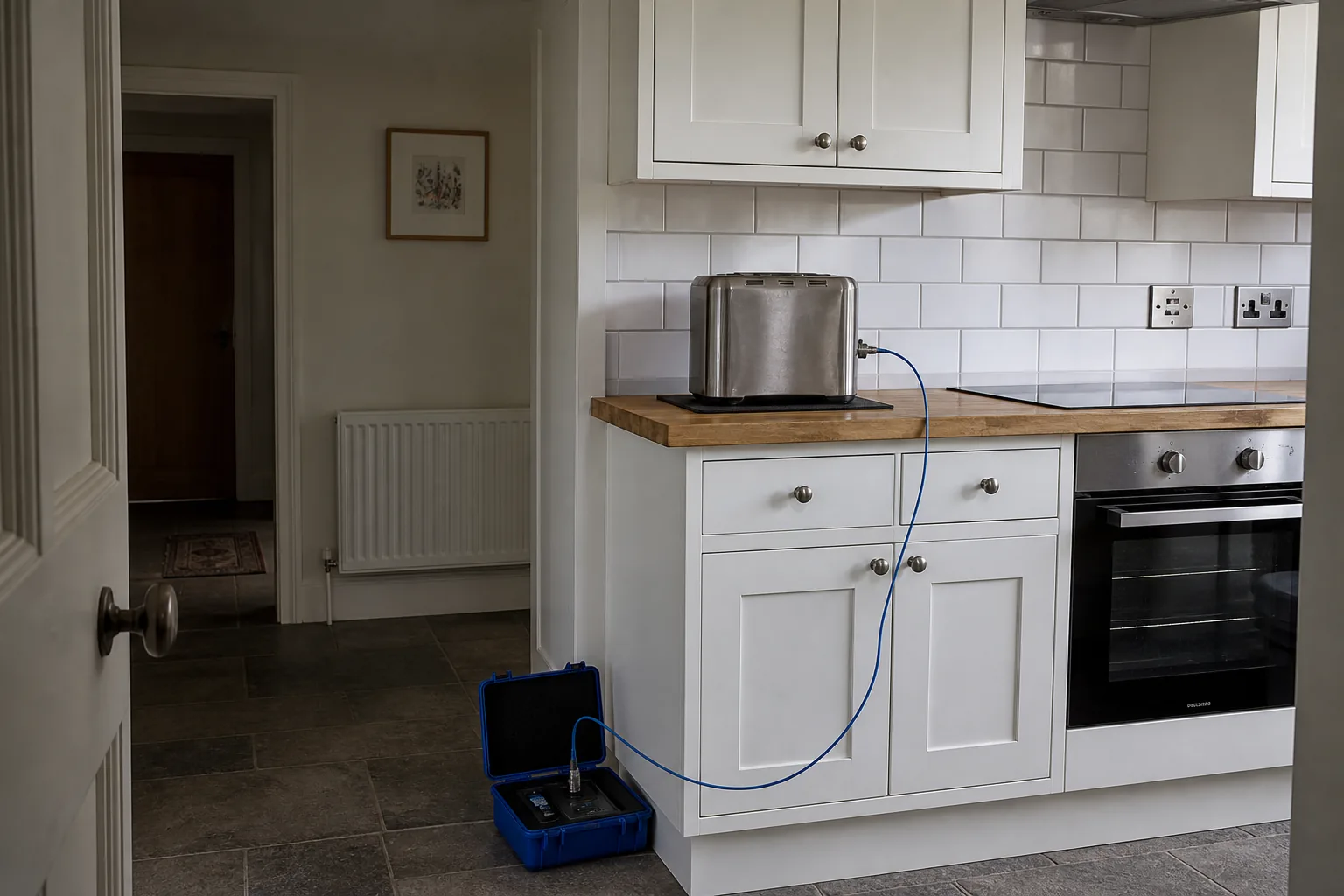
On a kitchen counter of otherwise decent moral character there stands a toaster made from a turbine superalloy.
Not a toaster with a handsome nickel-plated lever. Not an ordinary pressed shell given a marketing name involving aerospace.
The case, the bread carriage, the heat shields, the brackets, the little patient springs and the regions in which they fasten: superalloy.
A superalloy toaster.
It would have the grave, expensive appearance of a machine misplaced somewhere between a breakfast tray and a gas turbine.
Its owner would explain that nothing could be too resistant to heat for a domestic appliance.
This is a proposition with the persuasive force of common sense and the practical duration of a slice of toast.
For a superalloy is not an invulnerable metal in a cape.
It is a family of deliberate bargains: chemistry, microstructure, product form, processing, environment, load, time and temperature, all agreeing for a while to behave.
Remove them from their proper assembly, place them beside the marmalade, and they begin to ask questions.
The toaster would survive its first breakfast magnificently.
The second breakfast would begin the inquiry.
But Is It Not Safe Because It Cannot Melt?
No. This is the first popular myth, and the most inconvenient to correct, because it sounds so satisfyingly metallic.
A wrought nickel superalloy does not have a melting point.
It has a melting range, commonly tens of degrees wide, and the two ends of it mean different things.
First liquid and fully liquid do not arrive as the same event.
Neither of them tells a reader when a joined shell distorts, when a surface oxidizes, when an insulating part tires of its employment, when a spring changes its disposition, or when a coating begins an argument with its substrate.
Melting is the last gate.
Service usually loses its composure at an earlier and far more particular one: creep under sustained stress, oxidation at a protective surface, fatigue at an interface, loss of dimensional fit, local overheating, or a phase response which has decided the original heat treatment was only a suggestion.
A material that melts at fifteen hundred degrees does not thereby acquire a fourteen-hundred-degree application.
Peak, duration, rate, cycle count, environment, load and the property that must survive all have votes.
The celebrated name does not rescue the shorthand either.
A famous turbine alloy is published with a service range attached to it, and that range is a statement about named product forms in named uses.
It is not an instruction to make the crumb tray from it.
The toaster would not fail because the alloy had forgotten how to be hot.
It would fail, if it did, because “hot” had never been a complete job description.
The Famous Strength Belongs to a Condition
The distinction is less glamorous than invincibility. It has the advantage of being true.
These alloys are strengthened by fine coherent precipitates, gamma prime and gamma double prime, which impede the movement of dislocations through the matrix.
Their distribution matters as much as their existence.
Coarsening, rafting under load, loss of coherency, and the arrival of unwanted topologically close-packed phases all alter the response.
So the toaster’s proud alloy could be excellent precisely because it had been solution-treated and aged in one particular way, and considerably less excellent after a fabrication route or a long exposure had made that microstructure somebody else’s problem.
A creep figure is a good illustration of how much company a number keeps.
A published value carries a strain criterion, a temperature and a duration: so many megapascals for one percent creep at a stated temperature over a thousand hours.
Strip those companions away and the number becomes a decorative numeral.
Nor can a trade name be allowed to wander the house unidentified.
The same alloy is supplied as sheet, plate, bar, billet, pipe, tube, casting and powder, from foil up to sections of considerable thickness.
A sheet datum has no automatic authority over a heavy casting.
The metal is the same only in the loose social sense in which cousins are the same person.
The turbine has room for this seriousness.
A domestic toaster has a price label.
Both, unfortunately for the salesman, must obey metallurgy.
The Shell Would Not Expand Politely
Only a free body expands politely, and freedom is not how appliances achieve their familiar talent for remaining assembled.
Take half a metre of structure, a coefficient of twenty micrometres per metre per kelvin, and an excursion of forty degrees.
It wants four-tenths of a millimetre of movement.
That is often larger than a machining tolerance counted in tens of micrometres.
In other words, the respectable cold fit can be a warm disagreement.
The toaster shell, element supports, reflectors, fasteners, insulation, coatings and control mounting have no obligation to desire the same change in length.
And the governing question is not which coefficient wins a gentleman’s ranking contest.
It is the change in length of the joined things.
Two materials with different coefficients, taken through the same excursion, will each arrive somewhere the other did not intend.
Constraint then decides whether that becomes harmless sliding, curvature, elastic stress, cracking, interface damage, or an unusually expensive clicking noise.
This is why a thin compliant layer can be wiser than a noble alloy, and why a rigid ceramic and metal pair may need a closer expansion match than either would need alone.
A superalloy case could be splendid in isolation and troublesome at exactly the points where it has been told to cooperate with less aristocratic materials.
The screw, the braze, the weld, the insulating board and the electrical feedthrough would become a parliament of very small tyrants.
Nor is a room-temperature coefficient a passport through all climates. An expansion curve has a history, including any phase change along the way.
A single borrowed number is a poor chaperone through it.
A Mild Breakfast Cycle Counts as Repetition
The usual fantasy pictures the turbine alloy growing bored, because a toaster never reaches turbine temperature.
But a low peak is not necessarily a kind duty when it is passed back and forth through a constrained assembly.
Consider the contrast. A cycle from twenty-five to a hundred and twenty-five degrees makes a hundred degrees of expansion excursion on every single pass.
A steady hold at the same upper temperature makes none at all, after the initial warm-up.
One is motion, repeated.
The other is an event that settles down and then stops arguing.
Only the first of them is a fatigue problem.
The domestic cycle has its own complications. Heat appears locally, enters thin sections first, and crosses contacts which are not merely geometry but resistance.
Diffusion time scales with the square of the distance. At one millimetre the characteristic time is on the order of a second; at ten millimetres it is nearer a hundred.
So the surface and the interior can be conducting entirely separate thermal conversations while the lever is still down.
A thermocouple two millimetres below a surface does not automatically report that surface’s fastest excursion.
A high-conductivity fixture may also draw heat from a small coupon faster than service ever would.
There is nothing mystical in this.
It means only that a test needs the actual mass, heat path, interfaces and timescale before its average temperature may call itself the material temperature.
Repeated thermal life is therefore not measured by asking how close the case comes to melting.
It is measured by keeping the temperature-and-time profile, and then looking at the fit, the oxide, the coating, the grain structure, and every attachment that lived through the excursion alongside them.
An Oxide Skin Must Be Introduced Properly
Oxidation, hot corrosion, sulfidation, carburization, nitridation, molten-salt attack and aqueous corrosion are separate entries in the superalloy record.
A stated capability in air does not establish resistance to a sulfate deposit.
The atmosphere, the deposit, the temperature, the cycle, the velocity and the measured mass change all belong to the question.
The toaster has generally escaped sulfate-deposit hot corrosion, which is one of the few mercies breakfast grants it.
It has not escaped environment.
Real hot-section protection makes the point more sharply. A bond coat of nickel, cobalt, chromium, aluminium and yttrium sits beneath a ceramic top coat of stabilized zirconia.
The bond coat supplies adhesion and environmental protection, and its record needs the expansion of both substrate and coating, the elastic modulus, the thickness, the deposition method, the cooling arrangement and a thermal-cycle test.
Coating failure is commonly an interface and mismatch problem.
It is not a league table in which the substrate simply holds a higher oxidation score.
So the superalloy toaster would acquire not one protective skin but a multilayer domestic constitution.
Each layer would expand, oxidize, conduct and retain adhesion according to terms that had to be written down.
The crumbs would remain unconsulted.
It Cannot Borrow a Turbine Blade’s Authority
Not without borrowing the blade’s entire identity, and the blade is unlikely to lend it.
A single-crystal superalloy has no transverse grain boundaries, which is a large part of why its creep resistance at temperature is so good.
Its crystal orientation is part of what it is.
The additions that raise that capability also complicate phase stability, density, cost and processing.
A single crystal is not merely a bar with better manners.
It would be extraordinary to make the carriage of a toaster from a controlled crystal and then attach it to ordinary hardware with no account of orientation, defect inspection, repair status or local stress.
Yet that is the silent trick inside the phrase turbine alloy toaster.
It takes a qualified component system, removes its grain architecture and its process record, and expects the prestige to remain behind like a scent.
The family names refuse the same trick. Adjacent single-crystal grades are not one interchangeable aristocracy; they pursue different balances of creep, oxidation, density and approved process window.
The appropriate substitute for a drawing callout is not “some sort of turbine thing.”
Even plain density remembers its condition. The same alloy annealed and the same alloy annealed and aged are published at slightly different densities.
A very small numerical difference makes a very large editorial point.
The condition sits beside the property.
In a toaster, as in a turbine, it has not gone out for tea.
Then the Sensible Toaster Tests Its System
Not its courage. Its system.
A useful thermal qualification states the named alloy, the heat treatment, the form, the thickness, the grain condition, the attached materials, the joints, the atmosphere, the coating condition, the temperature profile, the dwell, the ramp, the number of cycles, and the functional result that will be accepted.
It retains dimensions before and after cycling.
It examines the locations where expansion has no easy escape.
It does not report a single impressive maximum temperature and then declare the matter toasted.
Where a transition or a melting event matters, the test language needs its own discipline.
A thermal-analysis report must say the sample mass, the heating and cooling rates, the atmosphere, and whether it is naming the onset, the peak or the end of an event.
Two analysts disagreeing by a few degrees may not be disagreeing at all.
They may simply be naming different points on the same event.
Likewise a property set must occupy a common state.
A conductivity at one temperature, a specific heat at another, an ambient density, and a diffusivity measured after porosity had changed do not constitute one physical audit.
The relations between those properties will catch the impostor, if anyone bothers to apply them.
This is not bureaucratic embroidery.
It is what prevents a toaster from being designed by a brochure.
And So the Toast Is Made
Probably no better than before, in any way its purchaser could honourably taste.
The alloy might endure an impressive temperature regime, in the precise condition for which it was selected.
It might also arrive with a production route, a joining problem, an inspection burden and a price that make a domestic shell look less like an appliance and more like a small procurement scandal.
A toaster is not a furnace merely because it has developed ambitions.
The point is not that ordinary materials are secretly superior. It is that superiority is an unhelpfully lonely word.
The useful question is whether the material, the form, the processing, the thermal cycle, the joints, the environment and the required life make a system that can survive together.
The finished superalloy toaster would not glow with heroic permanence.
It would sit on the counter, attached to its less exalted companions, accumulating cycles, growing oxide at a rate peculiar to its atmosphere, and awaiting an inspection nobody wished to pay for.
And the toast would be exactly as good as before.