FIELD GUIDE / nuclear fuels
The Water Has No Professional Ethics
A fountain made from reactor fuel fails before the first pleasant splash, because water is not merely water in a fuel problem. Geometry, moderation, cladding, heat removal, and criticality turn landscaping into nuclear engineering.
At a glance
- Reactor fuel is a manufactured fuel-gap-cladding-assembly system rather than a bare uranium substance.
- Zirconium-alloy cladding separates UO₂ fuel from coolant during normal operation, so exposing pellets changes the system boundary.
- Fuel identity and post-use claims require design records and irradiation history, including coolant conditions, power history, burnup, and cooling time.
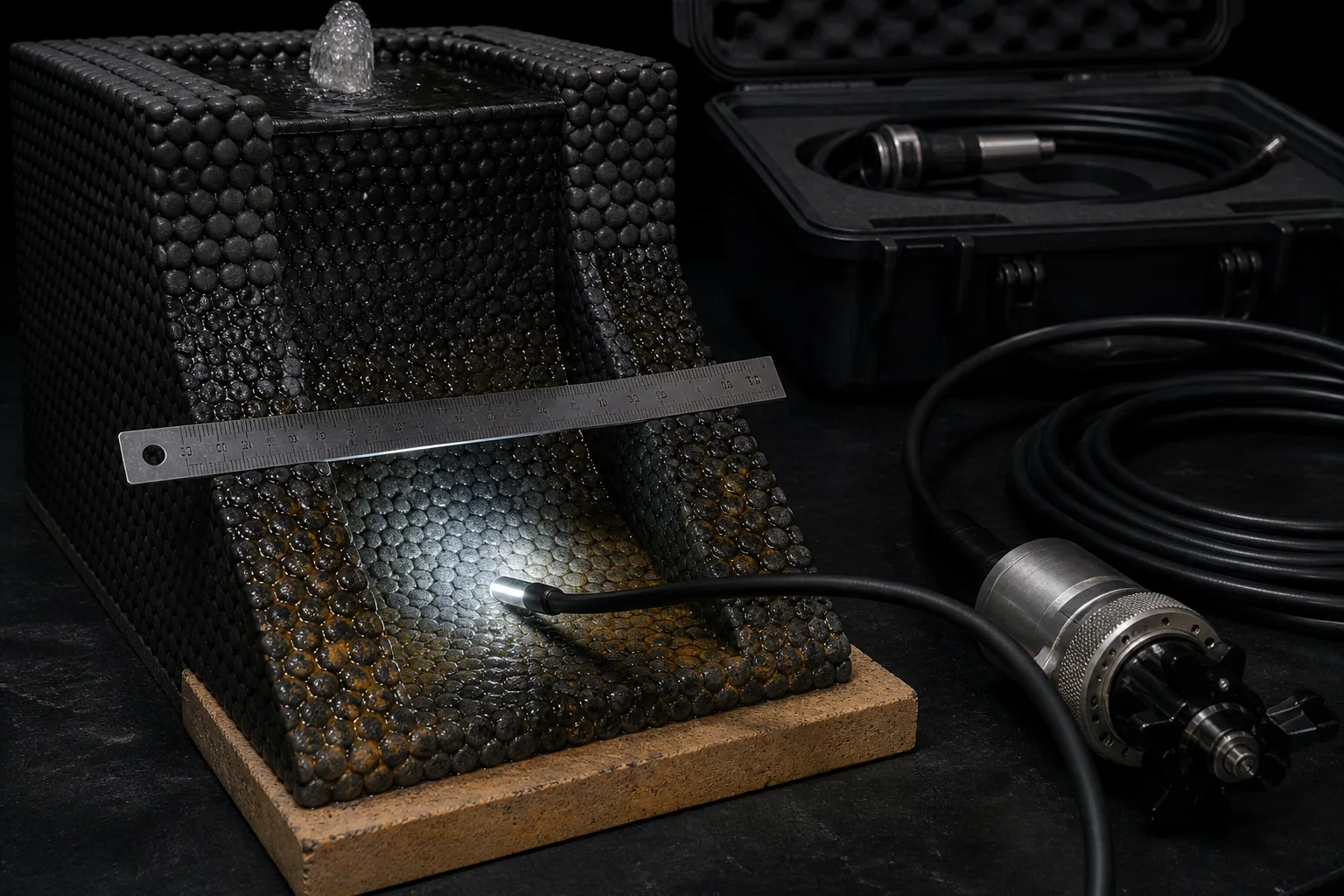
In the courtyard of some institution too prosperous to be sensible, there is a fountain made from nuclear fuel.
Not a discreet specimen behind glass. Not a pellet in a teaching case.
The basin itself, its little dark islands, its obliging rings and terraces: sintered fuel pellets, arranged so that water rises, arches, falls, and runs among them with the cheerful insistence of municipal landscaping.
At first sight the thing might be admired as modern sculpture.
Ceramic is a sober substance. It does not glitter like a vice. It does not droop like wax.
It sits where it is put and looks as though it has no opinions about weather.
But nuclear fuel is not a pebble which has acquired an unfortunate pedigree.
The reference light-water fuel is a system: sintered uranium-dioxide pellets, a zirconium-alloy tube, a gas-filled gap, a rod some four metres long, and an assembly holding a few hundred of them.
A fountain begins by taking that careful sentence apart, and then asks the water to finish the work.
The plumber would ask where the return line goes.
The fuel engineer would ask which fuel, which water, which geometry, which cladding, which power history, and which regulator had lost custody of the project.
The water would go on being picturesque.
It has no professional ethics.
A Fuel Pellet Is Not a Very Serious Stone
This is the first domestic misunderstanding, and it contains several lesser ones wearing the same overcoat.
A uranium-dioxide pellet is ceramic, certainly. Its thermal conductivity is low compared with a metal’s, which is one reason temperature, densification, cracking and fission-gas behaviour all matter under irradiation.
But the pellet is the fuel meat.
It is not the fuel system.
In ordinary construction, pellets are stacked in a sealed zirconium-alloy tube with a gas-filled gap, and the rods are held as an assembly.
The cladding separates fuel from coolant in normal operation. The ceramic retains many of the fission products.
A fountain retains only its water feature.
This is why uranium rod is a phrase best left to cartoons and hurried conversations.
The manufacturing sequence runs powder to pellet, pellet to rod, rod to assembly, and every stage has tolerances: pellet diameter and height, cladding outside diameter and wall thickness, active length, rod pitch, and fuel mass in heavy-metal terms.
The attractive little black cylinder in the basin has lost not merely a tube.
It has lost its measurement language.
Nor does a familiar outline settle its identity.
A mixed-oxide ceramic contains plutonium as well as uranium, and under stated conditions it can be broadly reactivity-equivalent to a low-enriched uranium oxide.
That equivalence is not a conversion coupon for garden designers.
It announces that the plutonium vector changes reactivity, spectrum, decay heat and fabrication safeguards, even where the pellet and rod geometry look reassuringly familiar.
One must therefore name the complete creature: formula and phase, heavy-metal vector, fissile-isotope vector, pellet architecture, cladding, rod design, assembly design and intended reactor.
A ceramic has never objected to a casual name.
A reactor analysis does.
The Cladding Has Been Omitted
It has gone precisely where all good containment arrangements go, when somebody mistakes a component for a decorative finish.
The zirconium-alloy tube is not an apron tied around the pellet for modesty.
It is the stated separation between fuel and coolant during normal operation.
Between fuel and cladding lies the gas-filled gap, and the thermal record needs its own conditions: a conductivity with its temperature, density, burnup and basis; a centreline temperature with its linear heat rate, coolant condition and gap conductance.
An axial length gives a scale.
It does not substitute for a power profile.
A fresh, dense conductivity value is not the conductivity of cracked, porous, irradiated fuel.
Nor is a smooth pellet’s apparent solidity a heat-removal plan.
The water in our basin may be cool to a fingertip.
It has not thereby become the qualified coolant condition of a rod with a specified cladding, gap, flow geometry and heat source.
This is important, because for a moment it sounds like free cooling.
It is not free cooling.
It is mandatory heat removal, under a documented system condition.
Those are different amenities.
The same stern bookkeeping applies to the cladding itself. Strength requires a specimen condition. Creep requires stress, temperature and time.
Corrosion needs an oxide thickness or mass gain, a water chemistry, a temperature and an exposure.
Hydrogen pickup is reported in parts per million by mass, and without the alloy, the oxide condition and the sampling location it is weak evidence.
The fountain keeper, whose usual domain is algae and clogged nozzles, has acquired an entire materials record.
Water Is Not Only Water
Here the fountain performs its one useful trick. It makes an error visible by making it ridiculous.
In a domestic basin, water is scenery with a pump.
In a fuel problem, water may be a chemical environment, a heat-transfer medium, a moderator, a reflector, a transport path, or part of the geometry which must be analysed.
Which role applies depends on the fuel system, and that conditionality is not a lawyer’s hedge.
It is the subject itself.
Consider the contrast offered by heavy-water reactors. They commonly use short natural-uranium bundles in pressure tubes, rather than the long enriched assembly of a light-water plant.
Natural uranium contains under one percent of the fissile isotope, and it is the neutron economy of heavy water which permits that inventory choice at all.
Change the water and you have changed what counts as fuel.
Natural uranium is a composition statement. A fuel bundle is an engineered package.
Move either statement into an arbitrary light-water fountain and it stops saying what it said before.
The interface schedule grows quickly: fuel, cladding, any coating, seals, structural supports, basin lining, water chemistry, temperature, flow, contact duration, deposits, and every place where water bridges two materials.
A compatibility record is a matrix, not a list.
Its columns are contacts and barrier paths. Its rows are environment, time, load and acceptance quantities.
A fountain has a basin.
A fuel system has limiting interfaces.
It is unwise to confuse the two merely because both contain water.
But Would the Fountain Not Explode Like a Nuclear Bomb?
No.
This is the point at which popular culture removes its safety goggles, mounts a dolphin, and rides directly into the shallow end.
Reactor fuel does not become a nuclear weapon because water touches it.
A detonation is not a property automatically emitted by the words uranium and wet.
Material form, isotopic characteristics, enrichment, mass, geometry, surrounding materials and an extraordinarily particular engineered arrangement govern what sort of nuclear behaviour is possible at all.
But the correction does not turn the fountain into an afternoon project.
Criticality control is real precisely because geometry, concentration, surrounding materials and fuel condition alter the question.
And water is on that list.
The record must carry the heavy-metal and isotope vectors, the enrichment, the fuel mass, the rod pitch and the assembly design.
Used-fuel records add burnup and the enrichment-credit assumptions that go with it.
Pool and cask analyses manage heat, confinement, shielding and criticality together, because those four problems are not separable by wishing.
None of these inquiries admits a decorative exception.
Even the figures which look comfortingly concrete refuse to travel alone.
A rod-average burnup limit is a real regulatory number, and it is meaningless without its denominator, its average basis, its cycle dates, its power history and its cooldown time.
Burnup is energy extracted per initial heavy-metal mass.
Strip the denominator away and it is not a smaller fact. It is not a fact at all.
The system has no patience for a number that has wandered off from its conditions.
Which may be why it makes such poor garden art.
The Water Becomes Part of the Core
Not at a single cinematic instant.
It becomes part of the problem the moment its role is no longer merely scenic.
For one fuel architecture, water is considered in a qualified coolant and moderator arrangement.
For another, graphite supplies the moderator while containment is provided at the scale of the individual particle, by concentric carbon and silicon-carbide layers grown around a kernel less than a millimetre across.
For yet another, a metallic fuel gains heavy-metal density and thermal conductivity, and pays for them in swelling and in chemical interaction with its cladding.
Fuel material is never a noun on its own for very long.
It immediately begins demanding its neighbours.
The water’s most inconvenient talent is that it changes several conversations at once.
It can carry heat while imposing chemistry.
It can surround a geometry while participating in the neutron behaviour.
It can wash a surface while turning every breached barrier into a containment question.
The fountain’s innocent circulation has converted an external liquid into part of the coupled system.
This is the inversion.
Water is not merely the thing splashing over the fuel.
Under the right nuclear conditions, it helps define what the fuel arrangement is.
And So the Fountain Would Have to Stop Being One
That is what it would need, to become respectable.
It would need a certified fabrication record, or a regulator-reviewed design document, rather than the visual assurance that the pellets all look alike.
It would need nominal dimensions and tolerances, inspection acceptance criteria, the licensed analysis method, and the identity of every material that touches the water.
A supplier brochure can name an alloy while omitting precisely those things.
Omission is not an invitation to fill the blanks with confidence.
It would need an irradiation history where irradiation has occurred: burnup, linear heat rate, fast-neutron fluence above a defined energy threshold, time at temperature, cycle dates, power histories and cooling time.
It would need post-irradiation claims to distinguish a calibrated instrument, a calculated prediction and an actual examination.
A result without its specimen, its method and its location is a rumour in a lab coat.
For used fuel it would need decay heat at a stated cooling time, an inventory, and a dose rate at a stated distance and shielding condition.
Spent fuel is stored under at least twenty feet of water, and that depth is a facility safety margin arrived at by analysis.
It is not a universal figure for adventurous horticulture.
Water has a number here.
But it has brought a building, a safety case and a stated purpose along with it.
At which point there would be no marble nymph, no pleasant splash, no coin at the bottom hoping to be wished upon.
There would be containment, water chemistry control, sampling, instruments, records, procedures, inspection, and a fresh analysis whenever a condition changed.
And that is the quieter lesson.
A fuel pellet may look like a small black stone, just as a sealed rod may look like a tube, and water may look like water.
Material engineering begins where these ordinary-looking things meet.
The water does not become interesting because it is dramatic.
It becomes interesting because the system cannot proceed without saying exactly what it is doing there.
AT THE BENCH
Questions, with the conditions attached.
Could reactor-fuel pellets be used as stones in a fountain?
No ordinary fountain configuration is a fuel system. Commercial light-water-reactor fuel uses sintered uranium-dioxide pellets stacked inside sealed zirconium-alloy tubes, with a gas-filled gap between pellet and cladding; the rods are then held in a reactor-specific assembly. Exposing pellets to circulating water removes the normal fuel-cladding-coolant boundary and creates a configuration requiring nuclear, chemical, thermal, and radiological analysis.
Why is cladding needed if uranium dioxide is a ceramic?
Uranium dioxide being ceramic does not make a fuel pellet a complete reactor component. In the reference light-water-reactor system, zirconium-alloy cladding separates the fuel from coolant during normal operation, while the pellet, gas-filled gap, tube, and assembly establish the heat-transfer and containment arrangement. Ceramic solidity does not supply the specified barrier, geometry, inspection basis, or coolant interface.
Would water make nuclear fuel explode like a bomb?
Water contact does not by itself make reactor fuel explode like a nuclear weapon. Criticality and nuclear safety depend on the fuel composition and isotope vector, enrichment, mass, geometry, surrounding materials, neutron absorbers, and engineered controls. A reactor-fuel configuration can still require rigorous criticality evaluation, but a wet pellet is not a weapon merely because it is wet.
Why does the shape of wet fuel matter so much?
Fuel geometry determines more than its appearance. A typical explanatory light-water-reactor illustration has tubes about 3.7 m long and 100 to 300 rods per assembly, but those values do not define a vendor lattice. Dimensions, rod pitch, fuel mass, cladding thickness, enrichment, surrounding materials, and water arrangement all belong to the system description because geometry enters heat transfer, neutron behaviour, and criticality control.
Is all nuclear fuel just uranium metal in rods?
No. The usual light-water-reactor reference system is sintered UO₂ ceramic pellets in zirconium-alloy tubes, not uranium metal rods. Other members include natural-uranium-dioxide bundles for pressurized heavy-water reactors, mixed-oxide fuel containing uranium and plutonium oxides, coated TRISO particles in graphite, plate fuel, and fuel salts. Formula, fuel form, cladding or coating, and reactor environment must remain together.
What does water have to do with heat removal from fuel?
The thermal path is a system property. Fuel thermal conductivity must be stated with temperature, density, burnup, and measurement or model basis, while centreline temperature also needs a stated linear heat generation rate, coolant condition, and gap conductance. A fresh dense UO₂ value cannot represent cracked, porous, irradiated fuel. Removing the intended cladding and coolant arrangement removes the basis for that thermal description.
What roles can water play in a fuel system at once?
Water can be a chemical environment, a heat-transfer medium, a moderator, a reflector, a transport path, and part of the geometry that must be analysed, and it can be several of these simultaneously. Which roles apply depends on the fuel architecture rather than on the water, which is why a heavy-water system and a light-water system make different inventory choices from the same element. Circulating water past bare pellets converts an external liquid into part of the coupled system.
Does the same water behave the same way in every reactor fuel system?
No. Water changes meaning with the reactor-fuel package. Pressurized heavy-water reactors commonly use short natural-uranium-dioxide bundles in pressure tubes, while the long enriched-UO₂ light-water-reactor rod is a different system. Natural uranium contains about 0.7% U-235 by mass, and heavy water’s neutron economy permits that inventory choice. The same composition does not transfer unchanged into a different lattice and moderator arrangement.
What records would be needed before anyone could assess wet nuclear fuel?
A usable assessment needs the fuel-meat formula and phase, heavy-metal and isotope vector, enrichment, pellet or particle architecture, cladding or coating, rod and assembly design, intended reactor, and nominal dimensions with tolerances. It also needs water chemistry, temperature, duration, flow arrangement, power history, burnup, cooling time, and the controlling design or regulatory record. A visually similar fuel rod does not supply missing tolerances or licensed analysis.
Why can used fuel not be treated as a generic hot or radioactive object?
Used-fuel heat, radionuclide inventory, dose rate, and criticality-relevant assumptions depend on irradiation and storage conditions. A record must state cooling time, package geometry, shielding condition, burnup basis, power history, and whether a result is measured, calculated, or obtained by post-irradiation examination. Pool and cask analyses manage heat, confinement, shielding, and criticality together; none is a universal property of the formula UO₂.
What is the surprising problem with a fuel fountain?
The surprising problem is not that the water simply attacks a hard ceramic. In a nuclear arrangement, water can be coolant, chemical environment, moderator, reflector or geometry variable, depending on the system. The pellet therefore cannot be assessed as an ornamental stone. The relevant object is the coupled fuel, cladding, water, containment, and reactor configuration, with the most limiting interface governing the stated operating window.
Sources and further reading
- NRC, What is Nuclear Fuel?nrc.gov
- World Nuclear Association, Nuclear Fuel and its Fabricationworld-nuclear.org
- NRC, Higher Burnupnrc.gov
- World Nuclear Association, Mixed Oxide (MOX) Fuelworld-nuclear.org